Canadian Macedonian Heritage Society Canadian Macedonian Heritage Society Become a member!

Tagged “Macedonian Language”

Browse Tagged “Macedonian Language” from the Canadian Macedonian Heritage Society archive, library and community collections.

Patsy Sider - MY NAME IS MACEDONIA

My birthplace is the village of Nevoliani, Aegean Macedonia My name is Macedonian and in our home, we speak the Macedonian language. My first day in school I will remember it as long as I live. At recess, I speak to my friend the Macedonian language. The teacher hears me that I do not speak the Greek language. The time when I enter the classroom I suffer the Jesus Christ sufferings. He says to me. "You an ...

Patsy Sider - MY BELOVED FATHER, AVRAAM BOSSOTAS (1908-1987)

It was painted on my father's face, the joy and the fear The times when he held the radio close to his ear. He was hearing Macedonian songs Prohibited by the Greeks, the Macedonian songs. The volume of the radio was too low Any lower could not go. He wondered, if the Greek policeman was outside of his home Hidden under the window, or the porch, for eavesdropping. Mother was shaking as a leaf. She was whispering to ...

Patsy Sider - THE CANADIAN CITIZENS, FROM FLORINA

The Canadian citizens, from Florina, who live in the free world of Canada The times when they visit my birthplace, the city of Florina-Lerin To my relatives and my acquaintances, for me personally, they say the following. "Shame on her, she hates the Greeks, she speaks the Macedonian language And she goes to Macedonian Church..." My heritage is Macedonian I do not see any shame to that The Macedonian language is one ...

Patsy Sider - MACEDONIAN HERITAGE

We were not familiar with the Macedonian Heritage The reason was, the Greeks Authorities hid it from us. In the Greek schools, we were taught the Greek language And they were accusing our language, the Macedonian language. They were insulting and physically abusing us, the Macedonians And they flooded our Macedonian land with the Greek refugees. They tore down the Macedonian churches And the Macedonians were sent to ...

Patsy Sider - THE MACEDONIAN PRAYER

My memory goes back To those years that I had no speech. I loved the Macedonian songs. The unmerciful Greeks forbade our culture. Why, why, they took away The customs which belonged to us? Why, why, they took away The language and the scripts which belonged to us? Discrimination is a mortal disease. It poison's the mind and the soul. We search for human rights We obey the Holy Word. Rise, O, Macedonian children To ...

Patsy Sider - THE GLORIOUS MACEDONIA

The Glorious Macedonia Was divided in 1913 to four pieces. The Great powers were given one piece to Serbia, Bulgaria, and Albania And the biggest piece from all, were given to Greece. In Macedonia where we were born We were not familiar with Vergina. Now where apart of Macedonia is a free and a peaceful Nation The Greeks stir up to confuse the world That Vergina is a Greek Symbol. Alexander the Great was a ...

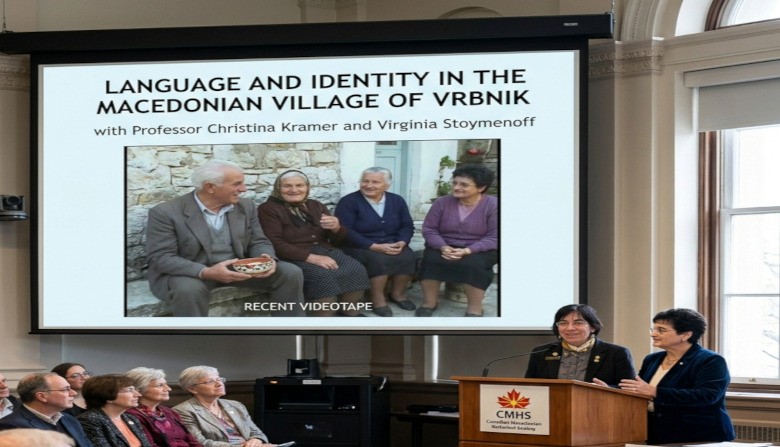
Language and Identity in the Macedonian Village of Vrbnik with Christina Kramer and Virginia Stoymenoff

On April 13, 2003, Christina Kramer, professor of Slavic Languages & Literatures at the University of Toronto, and Virginia Stoymenoff, gave a brilliant presentation on their visit to the village of Vrbnik, in Southern Albania. The presentation took place in the committee chamber at North York City Hall. This extremely valuable lecture enthralled the audience and was highlighted by a recent videotape from the village. Both professor Kramer and Virginia Stoymenoff went to great lengths to visit Vrbnik, in Albania, and meet with its isolated Macedonian residents. The CMHS appreciates their efforts and congratulates them on a superb presentation.

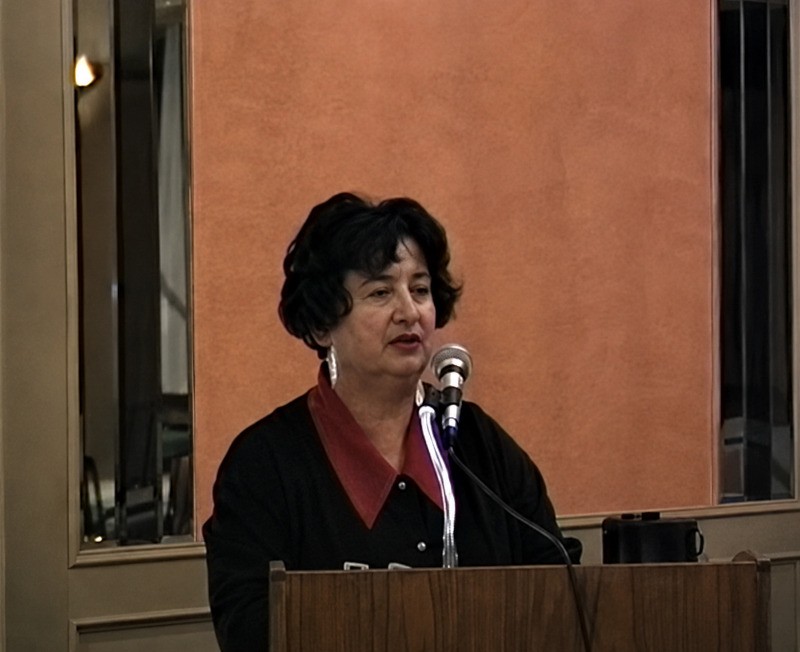
Macedonian language by Vera Antic

Organized by the Canadian Macedonian Historical Society (CMHS), the lecture on the Macedonian language by Vera Antić-Stojčevska stands as an important scholarly contribution to the understanding of one of the Balkans’ most historically layered and culturally significant languages. Preserved within the CMHS archival lecture series, this presentation examines the historical development, literary codification, linguistic uniqueness, and cultural significance of the Macedonian language, situating it within both the Slavic linguistic family and the broader historical experience of Macedonia. As a distinguished scholar of Macedonian literature and medieval texts, Antić-Stojčevska approaches the language not merely as a system of grammar and vocabulary, but as a living historical organism shaped by migration, empire, religion, and national identity. Her lecture reveals how language functions as one of the strongest pillars of cultural continuity and historical survival for the Macedonian people.

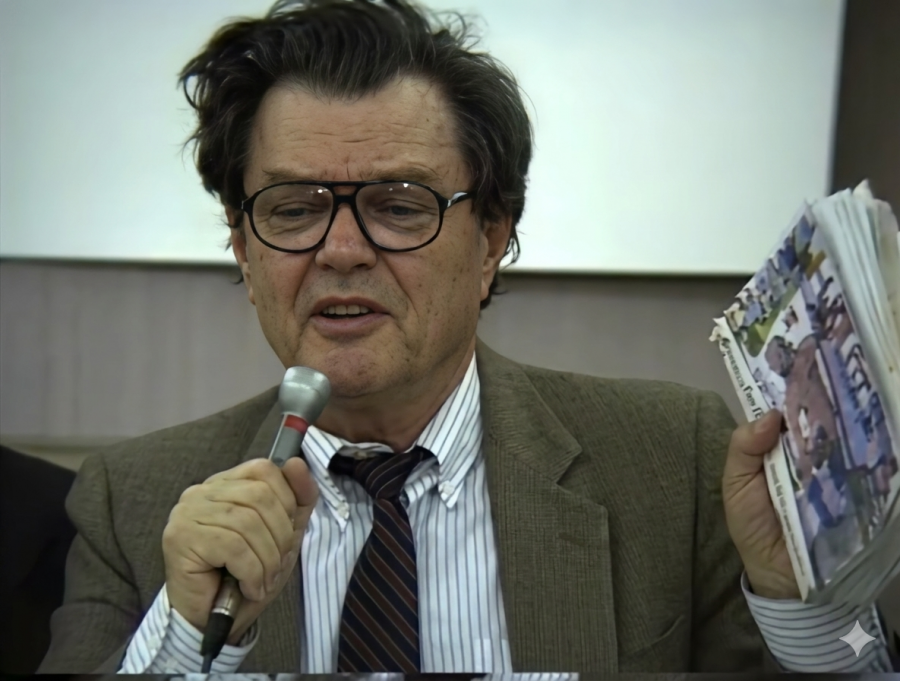
Macedonian History (Makedonska Istorija) with Tashko Belchev

Professor Belchev’s lecture remains a cornerstone of Macedonian identity studies. His work seeks to unify the ancient and modern Macedonian experiences into a single, continuous timeline. By utilizing paleolinguistics to decode ancient Balkan scripts, he provides a scientific framework for the indigenous origins of the Macedonian people. His lecture serves as both a historical revelation and a call to action for the diaspora to preserve and promote the unique cultural legacy of Macedonia.

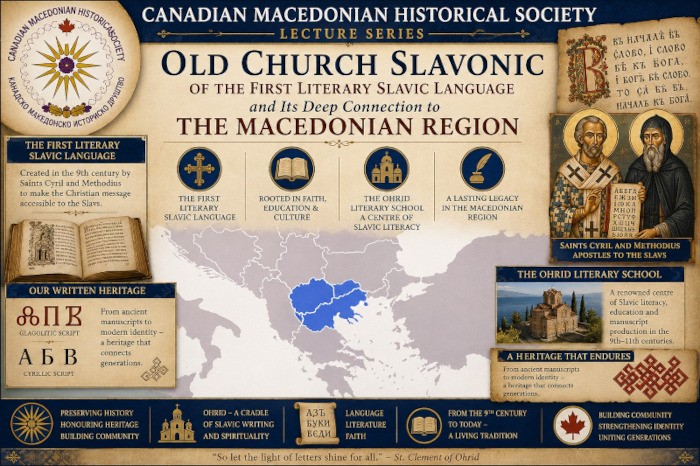
Old Church Slavonic: Language, History, and Macedonian Context

The Canadian Macedonian Historical Society lecture on Old Church Slavonic, featuring Christina Kramer and Joseph Schallert, explored the historical, linguistic, and cultural significance of the first literary Slavic language and its deep connection to the Macedonian region. The speakers examined how the mission of Saints Cyril and Methodius and the later work of Saint Clement of Ohrid and Saint Naum in Ohrid Literary School helped establish and preserve Slavic literacy, emphasizing the central role of Macedonia in this tradition. The lecture also highlighted Old Church Slavonic as a key source for understanding the evolution of modern Slavic languages, especially Macedonian language, while underscoring how language, history, and identity remain deeply intertwined in the Balkans.