

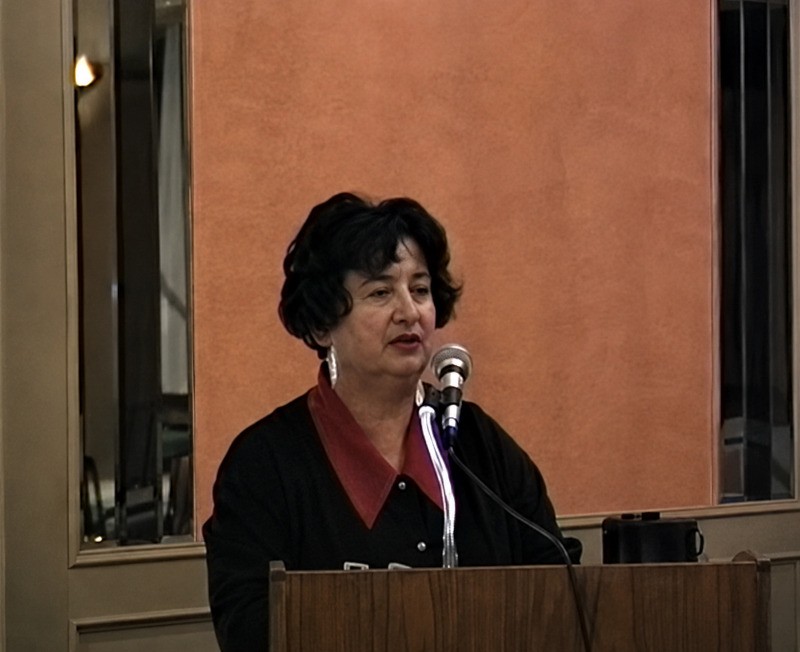


Macedonian language by Vera Antic
Organized by the Canadian Macedonian Historical Society (CMHS), the lecture on the Macedonian language by Vera Antić-Stojčevska stands as an important scholarly contribution to the understanding of one of the Balkans’ most historically layered and culturally significant languages. Preserved within the CMHS archival lecture series, this presentation examines the historical development, literary codification, linguistic uniqueness, and cultural significance of the Macedonian language, situating it within both the Slavic linguistic family and the broader historical experience of Macedonia. As a distinguished scholar of Macedonian literature and medieval texts, Antić-Stojčevska approaches the language not merely as a system of grammar and vocabulary, but as a living historical organism shaped by migration, empire, religion, and national identity. Her lecture reveals how language functions as one of the strongest pillars of cultural continuity and historical survival for the Macedonian people.
Introduction: Language as Identity
Antić begins by emphasizing that language is far more than communication; it is one of the primary foundations of identity. Through language, communities preserve memory, transmit culture, and maintain continuity across generations. In the Macedonian case, language has carried extraordinary historical weight because Macedonia’s political history was often marked by foreign domination, territorial division, and competing cultural claims. She argues that for Macedonians, language became a crucial site of preservation. Even when political sovereignty was absent, the spoken language remained the strongest marker of continuity. This made language central not only to communication but to national consciousness itself. In this sense, the Macedonian language functions as a historical archive of the people’s collective experience, carrying with it the memory of centuries of struggle, adaptation, and survival.
The Origins of the Macedonian Language
Antić situates the Macedonian language within the South Slavic branch of the Indo-European language family, explaining that it developed as part of the eastern South Slavic dialect continuum and shares historical relationships with neighboring Slavic languages while maintaining its own distinct structure and evolution. She explains that the Slavic migrations into the Balkans during the sixth and seventh centuries established the dialectal foundations from which Macedonian emerged. Over centuries, local speech patterns evolved in response to geography, political boundaries, and contact with other linguistic communities. The mountainous geography of Macedonia played a crucial role in preserving regional dialects, creating a rich internal diversity that later contributed to the formation of the standard literary language. Antić stresses that this dialectal diversity is evidence of historical depth rather than fragmentation. Modern linguistic scholarship recognizes Macedonian as a distinct South Slavic language with its own grammatical system and literary development, a recognition based on linguistic evidence rather than political interpretation.
Old Church Slavonic and the Macedonian Region
One of the most important historical points in Antić’s lecture concerns the connection between Macedonia and the earliest Slavic literary tradition, Old Church Slavonic. She explains that the work of Saints Cyril and Methodius, who came from Thessaloniki (historically Salonica), laid the foundation for Slavic literacy in the ninth century. Their missionary work among the Slavs produced the first Slavic literary language, based on dialects closely connected to the Macedonian region. Antić emphasizes that this historical connection places Macedonia at the heart of Slavic literary civilization. The creation of the Glagolitic alphabet and the later development of the Cyrillic script allowed Slavic-speaking peoples to access religious texts in their own language, a revolutionary development in medieval Europe. Antić argues that the linguistic base of these early texts reflects the speech of the broader Macedonian region, making Macedonia central to the birth of Slavic literacy and literary tradition. This connection remains foundational to Macedonian cultural history and is one of the strongest arguments for Macedonia’s central place in the Slavic world.
The Medieval Literary Tradition
Antić devotes considerable attention to the medieval literary tradition centered in Ohrid, particularly the work of Saint Clement of Ohrid and Saint Naum of Ohrid. She explains that the Ohrid Literary School became one of the most important centers of Slavic literacy and manuscript production in medieval Europe. Within this intellectual and religious center, religious texts, educational materials, theological works, and translations flourished, contributing significantly to Slavic Christianity and education. Although the literary language of the time was Church Slavonic, Antić notes that local speech patterns increasingly shaped written forms. This gradual interaction between spoken and written language contributed to the deeper historical roots of Macedonian linguistic identity. Antić stresses that medieval Macedonia was not a peripheral cultural zone but a major intellectual center that shaped Slavic literary development for centuries.
The Ottoman Period and Linguistic Survival
During the long centuries of Ottoman rule, Macedonian did not function as an official literary language, but Antić argues that it survived powerfully through oral tradition. Folk songs, oral storytelling, proverbs, rituals, and village speech preserved the language across generations. This oral continuity was essential because formal institutions of education, religion, and publishing were often controlled by Greek ecclesiastical authorities, Bulgarian educational movements, or Ottoman administration. Antić notes that many languages disappear under prolonged imperial domination, especially when they lack institutional support. Yet Macedonian survived because it remained deeply rooted in family, village, and community life. Oral tradition became the language’s shelter and protector, allowing it to survive political and institutional pressures. This period demonstrates the extraordinary resilience of spoken Macedonian as a carrier of identity and memory.
The Nineteenth-Century National Awakening
Antić highlights the nineteenth century as a decisive turning point in Macedonian linguistic consciousness. As nationalist movements spread across the Balkans, language became increasingly tied to political self-definition and national identity. Macedonian intellectuals began advocating for the recognition of local speech as worthy of literary development and national expression. Antić pays particular attention to Krste Petkov Misirkov, whose 1903 work On Macedonian Matters argued for linguistic standardization based on central Macedonian dialects. Misirkov’s work represented one of the clearest articulations of Macedonian linguistic distinctiveness and the need for a separate literary language. Antić presents this moment as foundational to modern Macedonian linguistic consciousness because it transformed spoken identity into intellectual and political argument. The nineteenth century thus marks the beginning of modern Macedonian linguistic self-awareness.
The Standardization of the Macedonian Literary Language
One of the central themes of Antić’s lecture is the official codification of standard Macedonian after the Second World War. In 1945, Macedonian was officially codified as the literary language of the Socialist Republic of Macedonia within Yugoslavia. Antić explains that this codification formalized what had already existed in spoken form for centuries. The standard language was based primarily on central dialects, particularly those around Prilep, Veles, and Bitola, chosen for their representative balance within the broader dialect continuum. Antić emphasizes the crucial role of Blaže Koneski, whose grammatical and literary work helped establish orthographic and grammatical norms. Koneski’s scholarship transformed Macedonian into a modern literary and educational language capable of supporting administration, education, literature, and academic discourse. The codification process was therefore not an invention but the formal recognition and structuring of an already existing linguistic reality.
Unique Features of Macedonian Grammar
Antić dedicates substantial time to the distinctive grammatical features of Macedonian, many of which separate it from other Slavic languages. One of the most significant is the loss of the case system. Unlike Russian, Serbian, or Polish, Macedonian relies heavily on prepositions and word order rather than extensive noun inflection. Another unique feature is the postposed definite article, attached directly to the noun rather than functioning as a separate word. This feature distinguishes Macedonian sharply from many other Slavic languages. Antić also highlights the language’s complex verbal system, particularly its use of evidentiality, which allows speakers to indicate whether information was directly witnessed, inferred, or reported. These features place Macedonian in a unique linguistic position, combining Slavic foundations with Balkan structural innovations. Antić argues that these grammatical features are clear evidence of Macedonian’s independent linguistic evolution.
Dialect Diversity
A major section of the lecture addresses Macedonian dialect diversity. Antić explains that Macedonian is rich in regional speech patterns shaped by geography, historical division, and local tradition. Dialects vary significantly in pronunciation, vocabulary, and grammatical detail. Western dialects often preserve older phonological features, while eastern dialects reflect different innovations and influences. Antić emphasizes that dialect diversity is not a weakness but a strength. It reflects the historical depth of the language and the regional richness of Macedonian cultural life. The standard literary language unified these dialects for practical and educational purposes, but the dialects themselves remain vital reservoirs of historical memory and local identity. Through dialects, communities preserve unique expressions of place and history.
Vocabulary and Linguistic Borrowing
Antić examines the vocabulary of Macedonian as evidence of centuries of historical contact and exchange. Centuries of Ottoman rule introduced Turkish vocabulary, especially in areas such as food, clothing, household life, and administration. Greek influence entered through religion and commerce, while Serbian, Bulgarian, and Albanian influences emerged through proximity, trade, and political interaction. Antić argues that linguistic borrowing does not weaken a language; rather, it enriches it by reflecting historical encounters and cultural adaptation. The Macedonian lexicon, therefore, is a historical map of the region’s interactions. Each borrowed word preserves evidence of contact, influence, and coexistence. Vocabulary becomes a linguistic archive of Macedonia’s complex historical environment.
Macedonian Literature and Language Development
Antić explains that language and literature developed together, each strengthening the other. After standardization, modern Macedonian literature flourished in poetry, prose, and drama. Writers such as Kočo Racin and Aco Šopov helped establish literary Macedonian as a vehicle for modern artistic expression and intellectual life. Literature expanded the expressive range of the language, testing its emotional, philosophical, and artistic possibilities. Antić stresses that literature transforms language from survival into creativity. Through literature, Macedonian became not only a preserved language but a productive one, capable of expressing modern human experience in all its complexity. Literature thus played an essential role in normalizing and enriching the literary standard.
Language and Political Dispute
Antić addresses the political controversies surrounding Macedonian, particularly the ways neighboring states historically challenged its distinctiveness. Throughout the twentieth century, political debates often attempted to reduce Macedonian to a dialect of another language. Antić counters these claims by emphasizing that linguistic scholarship clearly recognizes Macedonian as an independent language with its own grammatical system, historical development, and literary tradition. She argues that political disputes over language reflect broader struggles over identity, territory, and historical legitimacy. Language becomes political when identity is contested. This makes serious linguistic scholarship essential because it grounds identity claims in evidence rather than ideology.
The Macedonian Language in the Diaspora
Antić acknowledges the vital role of diaspora communities in preserving Macedonian. Communities in Canada, Australia, the United States, and Europe established churches, schools, newspapers, and cultural organizations to maintain the language across generations. For second-generation immigrants, language often becomes the bridge between ancestral memory and contemporary identity. Antić emphasizes that teaching Macedonian abroad is not simply an educational project but an act of historical preservation. Diaspora communities extend the life of the language beyond the homeland, ensuring its survival in global contexts. Through these communities, the Macedonian language becomes transnational while remaining rooted in its historical homeland.
The Role of CMHS in Linguistic Preservation
The Canadian Macedonian Historical Society’s hosting of this lecture reflects its broader role in preserving Macedonian historical and cultural knowledge. By organizing scholarly lectures on language, history, archaeology, and culture, CMHS provides diaspora audiences with intellectual access to their heritage. Antić’s lecture demonstrates that language preservation depends on institutions capable of carrying knowledge across generations. Community organizations such as CMHS function as cultural guardians, creating spaces where language can be studied, discussed, and celebrated. Their work helps sustain historical continuity in diaspora life, where cultural memory often faces the pressures of assimilation.
Conclusion
Vera Antić-Stojčevska’s lecture on the Macedonian language offers a rich and historically grounded exploration of one of the Balkans’ most significant cultural pillars. By tracing the language from its Slavic origins through medieval literacy, Ottoman survival, national awakening, and modern standardization, she demonstrates that Macedonian is far more than a linguistic system—it is a living record of historical continuity, cultural resilience, and national identity. Her analysis of grammar, dialect diversity, literary development, and political controversy reveals the complexity and distinctiveness of Macedonian as both a historical and modern language. Ultimately, her lecture reminds us that language preserves what borders often cannot: memory, belonging, continuity, and identity. For Macedonians in both the homeland and the diaspora, the Macedonian language remains one of the strongest expressions of collective existence and cultural survival.