



Old Church Slavonic: Language, History, and Macedonian Context
On September 25 Canadian Macedonian Historical Society offered an important scholarly exploration into the origins, development, and linguistic significance of Old Church Slavonic (OCS), the first literary Slavic language. Delivered by Professors Christina Kramer and Joseph Schallert—both distinguished Slavic linguists—the event examined OCS not merely as a liturgical language, but as a foundational pillar in the cultural and linguistic history of the Slavic world, including Macedonia.
The discussion was especially meaningful for Macedonian audiences because of the central role that the Ohrid literary tradition and the disciples of Saints Cyril and Methodius played in preserving and transmitting the earliest Slavic written heritage.
Historical Context of Old Church Slavonic
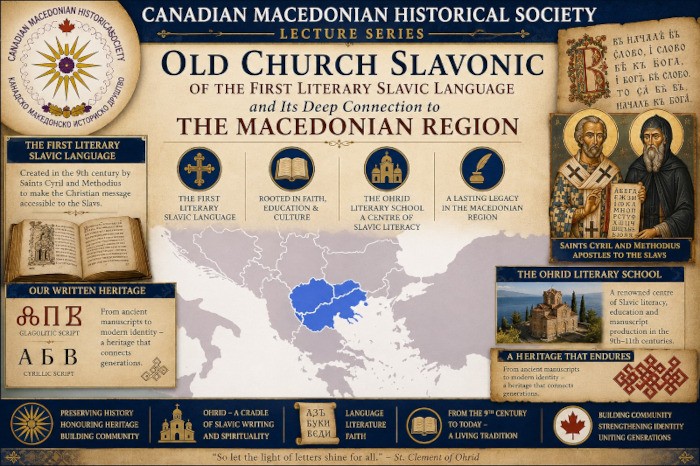
Old Church Slavonic emerged in the 9th century during the Christianization of the Slavs under the Byzantine Empire. Saints Cyril and Methodius developed the first Slavic literary system in order to translate Christian scripture into a language understandable to Slavic peoples.
The lecture emphasized that OCS was revolutionary because it challenged the dominance of Greek, Latin, and Hebrew as the exclusive sacred languages of Christianity. By creating a written Slavic liturgical tradition, Cyril and Methodius democratized religious knowledge and literacy.
Their work began in Great Moravia, but after political opposition, their disciples continued their mission in the Balkans, particularly in the region of Ohrid.
The Ohrid School and the Macedonian Connection
A major theme of the lecture was the role of the Ohrid Literary School, founded by Saint Clement of Ohrid and Saint Naum.
This institution became one of the principal centers of Slavic literacy and manuscript production. The lecturers highlighted how the linguistic features of many surviving OCS manuscripts reflect southern Balkan dialects, particularly around Ohrid and Thessaloniki, making the Macedonian region central to the formation of Slavic literary culture. Historical scholarship recognizes Ohrid as one of the earliest and most influential Slavic literary centers.
This point remains deeply significant in discussions of Macedonian linguistic heritage.
Linguistic Features of Old Church Slavonic
Professor Schallert examined the structural features of OCS:
- Complex noun declension systems
- Rich verbal aspect and tense structures
- Preservation of Proto-Slavic grammatical categories
- Early phonological features later lost in modern Slavic languages
The lecture demonstrated how OCS serves as a linguistic “fossil record” for reconstructing Proto-Slavic and understanding the evolution of modern Slavic languages such as Macedonian, Bulgarian, Serbian, and Russian.
Professor Schallert’s academic work specifically includes Old Church Slavonic, comparative Slavic linguistics, and Macedonian dialectology.
Macedonian and the Legacy of OCS
Professor Kramer focused on the relationship between OCS and modern Macedonian.
Key points included:
- The continuity between medieval Slavic writing traditions and later Macedonian vernacular texts
- The preservation of local dialectal features in manuscript traditions
- The political controversies surrounding the classification of medieval Slavic texts
Kramer argued that language history in the Balkans cannot be separated from identity and politics. The lecture touched on how modern national narratives often claim medieval texts retroactively, but linguistically the evidence points to a more fluid regional Slavic continuum. Her published work on Macedonian language history supports this interpretation.
Importance for the Macedonian Diaspora
For the Macedonian community in Canada, the lecture had broader cultural significance.
It reinforced:
- The deep historical roots of Slavic literacy in Macedonia
- The importance of preserving linguistic heritage
- The value of scholarly engagement with contested histories
The Canadian Macedonian Historical Society continues to play a vital role in creating spaces where academic scholarship and community identity intersect.
Conclusion
This lecture was more than a linguistic lesson—it was a historical reclamation of memory.
By situating Old Church Slavonic within the Macedonian cultural sphere, Professors Kramer and Schallert reminded listeners that language is not merely a tool of communication but a vessel of civilization, faith, and identity.
The event highlighted how medieval manuscripts, liturgical traditions, and regional dialects continue to shape modern understandings of Macedonian history and belonging.
For scholars, it offered technical linguistic insight. For the community, it reaffirmed a cultural inheritance stretching back over a millennium.