


Children of the Greek Civil War -Refugees and the Politics of Memory -Loring M. Danforth & Riki Van Boeschoten
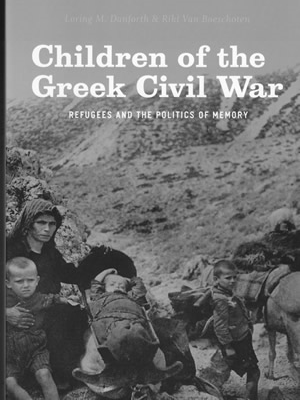
This long awaited book was launched in Toronto by the CMHS on February 12th, with a “sold out” audience. Loring Danforth, Professor of Anthropology at Bates College in Maine, USA. was present for the Toronto book launch. He has written several books, including the most recent, The Macedonian Conflict:Ethnic Nationalism in a Transnational World. Riki Van Boeschoten, co-author and Associate Professor at the University of Thessaly, Greece, was unable to attend.
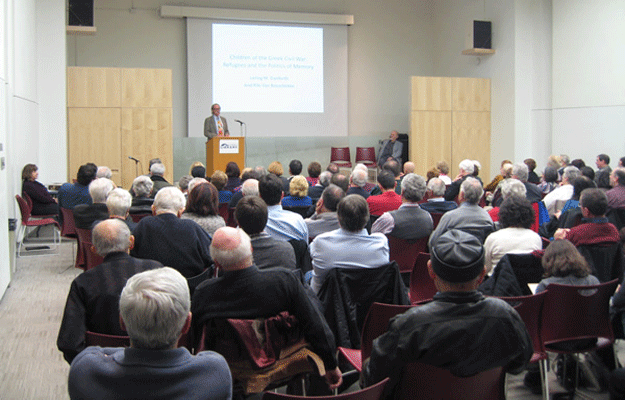
Mr. Danforth spoke about the process, selection of those interviewed and how long the research took the authors. Mary Rossos and Trajan Dimitriou were two of only seven interviewees that were included in the book, and were able to offer their insight and some of their experiences. Trajan was sent to the paidopoleis of Queen Frederica (which was the Greek version of child homes) while Mary Rossos was transported to Czechoslovakia. The stories of how the children and the “mothers” who were chosen to accompany them had to walk out of Northern Greece were heartbreaking. They were sent to various Communist countries in Eastern Europe, including Poland, Hungary, Romania, Czechoslovakia, Serbia, Albania, Bulgaria, East Germany, and Uzbekistan (USSR).
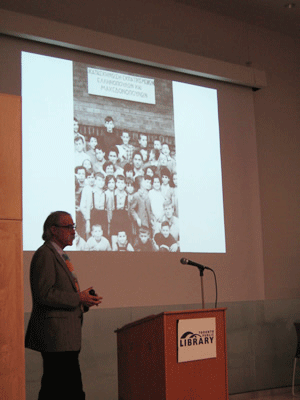
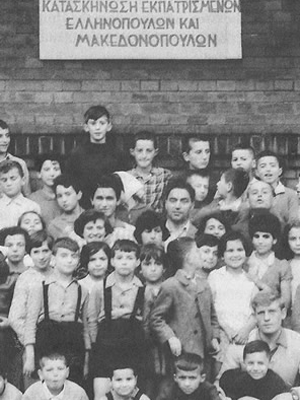
The narrative at the heart of the book is often heartbreaking, tracing the journeys of roughly 28,000 children who were evacuated from Northern Greece between 1946 and 1949. Two of the interviewees featured in the text, Mary Rossos and Trajan Dimitriou, attended the launch to share their lived experiences. They described the harrowing "walks" out of the war zones, led by "mothers" tasked with their safety. This mass evacuation resulted in a wide diaspora, with children being sent to various Communist countries across Eastern Europe and the USSR, including Poland, Hungary, Romania, Czechoslovakia, and Uzbekistan.
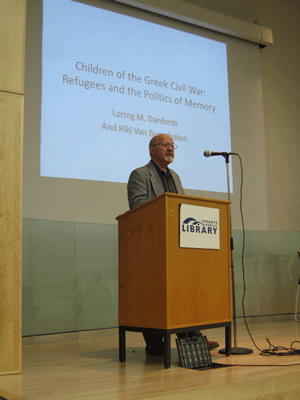
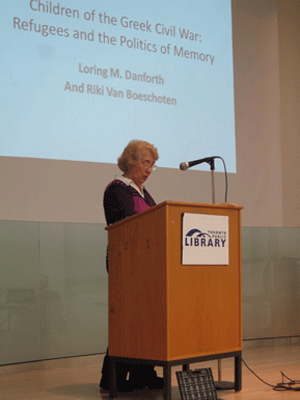
A critical focus of the book is the "politics of memory," highlighted by the contrasting experiences of Mary and Trajan. Mary Rossos was transported to Czechoslovakia, where children were often raised in environments that allowed for the retention of their Macedonian identity. In contrast, Trajan Dimitriou was sent to the paidopoleis of Queen Frederica—Greek-run institutions designed for national re-education. These two paths illustrate the complex struggle for identity that defined a generation. The book serves as a vital record of these conflicting histories, and plans are already in motion to translate the work into both Macedonian and Greek.
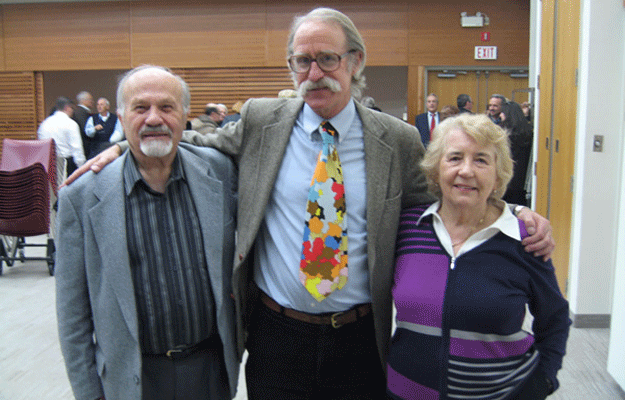
The event concluded with an engaging Q&A session, allowing the community to interact with both the author and the survivors whose stories fill the pages. Following the formal presentation, the atmosphere shifted to one of community and reflection as attendees mingled over traditional Macedonian tea and zelnikmade by our board member Paul Thomas. Though the subject matter is dense and at times challenging, the CMHS emphasized that documenting these events is essential for the community to understand its past and navigate its future.