

2000 NEWS ARCHIVES
Old Church Slavonic: Language, History, and Macedonian Context
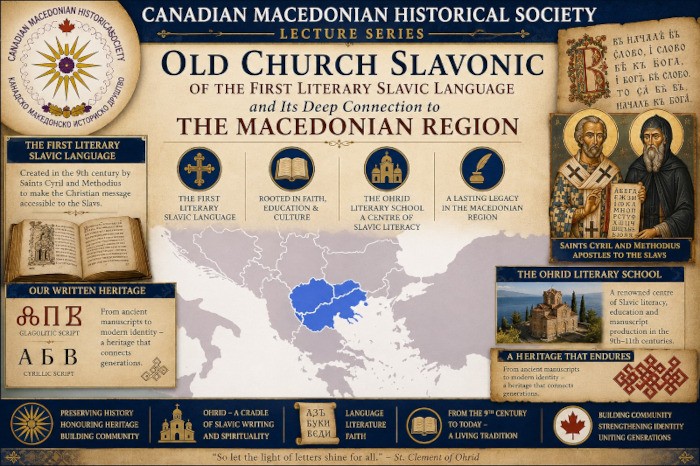
The Canadian Macedonian Historical Society lecture on Old Church Slavonic, featuring Christina Kramer and Joseph Schallert, explored the historical, linguistic, and cultural significance of the first literary Slavic language and its deep connection to the Macedonian region. The speakers examined how the mission of Saints Cyril and Methodius and the later work of Saint Clement of Ohrid and Saint Naum in Ohrid Literary School helped establish and preserve Slavic literacy, emphasizing the central role of Macedonia in this tradition. The lecture also highlighted Old Church Slavonic as a key source for understanding the evolution of modern Slavic languages, especially Macedonian language, while underscoring how language, history, and identity remain deeply intertwined in the Balkans.
Macedonian Day of Renaissance
The Macedonian Day of Renaissance, held on April 23, 1994, was a landmark cultural event organized by the Canadian Macedonian Historical Society to document and celebrate the community’s rich heritage through a comprehensive program of academic seminars and practical workshops. Throughout the day, attendees engaged with experts on a wide variety of topics, ranging from traditional kaval music and ancestral folk dancing to discussions on Canadian political life and investment opportunities in Macedonia. The event successfully bridged the gap between different generations of the diaspora, culminating in a formal banquet featuring keynote speaker Dr. Christina Kramer, who shared her unique perspective on the importance of the Macedonian language. By combining scholarly research with hands-on cultural activities, the CMHS reinforced its role as a vital archive for preserving the traditions, language, and collective achievements of the Macedonian people in Canada.
Father Nikodim Tsarknias and the Struggle for Religious Freedom
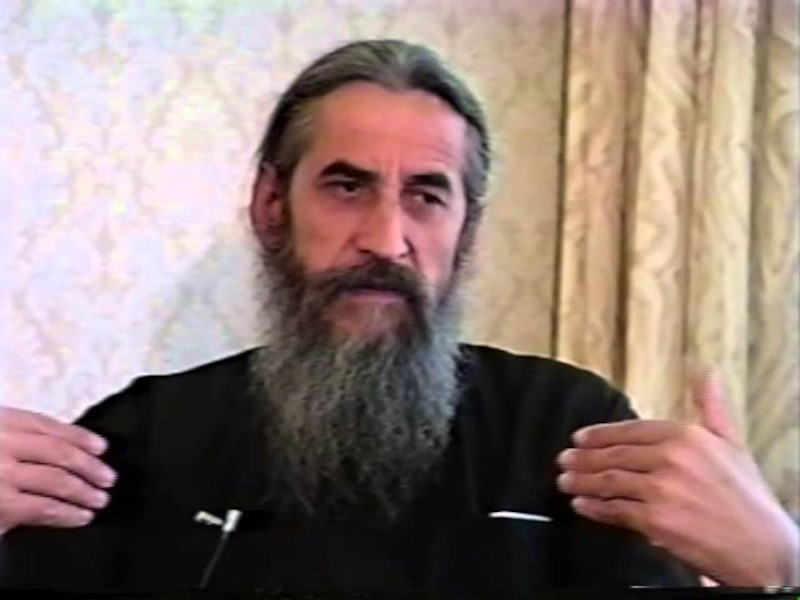
In his 1993 interview with Nickey Alexiou for the CMHS, Father Nikodim Tsarknias detailed his transition from a respected Greek Orthodox priest to a leading human rights activist for the Macedonian minority in Aegean Macedonia. He provided a firsthand account of the systematic Hellenization efforts in the Florina (Lerin) region, describing how the Greek state and church hierarchy worked to suppress Macedonian religious customs, linguistic heritage, and ethnic identity. Expelled from his post in 1991 for openly declaring his Macedonian roots, Tsarknias used the Toronto platform to appeal to the global diaspora, framing his struggle not as a political conflict, but as a fundamental fight for the right to religious freedom and the preservation of a culture being marginalized within Greek borders.
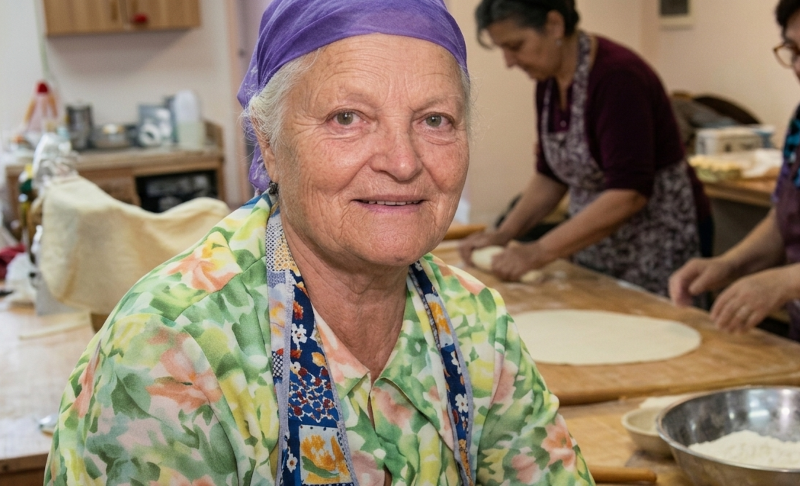
Making Macedonian Zelnik at the Canadian Macedonian Place
The 1993 Zelnik-making demonstration at the Canadian Macedonian Place served as a vital cultural gathering, showcasing the intricate, communal artistry of traditional Macedonian pastry. Led by community elders, the event highlighted the technical mastery required to hand-roll paper-thin layers of dough—often stacking up to 30 sheets—to create the iconic flaky texture of the savory pie. Participants demonstrated various fillings, including traditional greens and cheese, while emphasizing the signature pleated crust that defines an authentic Zelnik. Beyond the culinary instruction, the event acted as a "living archive," preserving a labor-intensive heritage for the Macedonian diaspora and ensuring that the philosophy of communal food preparation remained central to their identity.
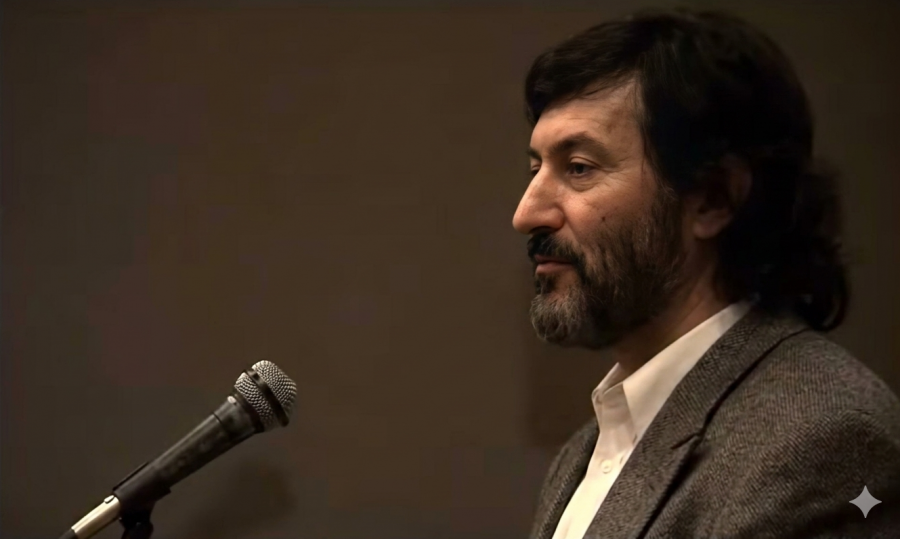
Orthodoxy Theology and the Macedonian Icons with Father David Feldin and Iconographer Georgi Danevski
The Canadian Macedonian Heritage Society’s lecture, "Orthodoxy, Theology, and the Macedonian Icons," featured Father David Feldin and iconographer Georgi Danevski in a comprehensive exploration of Macedonia’s spiritual and artistic legacy. Father David detailed the theological foundations of Orthodoxy as a "Living Tradition," addressing the vital role of the Theotokos, the equality of spiritual roles between genders, and the importance of a universal church that transcends mere ethnic boundaries. Complementing this, Georgi Danevski highlighted Macedonia's historical role as a cultural bridge, showcasing the ancient Terracotta Icons of Vinica and the "Macedonian Renaissance" as evidence of a distinct Slavic contribution to Byzantine art. Together, the presenters illustrated how ancient techniques like egg tempera and "metaphysical light" continue to humanize the divine, preserving a resilient Macedonian identity that offers a timeless message of light and Christian civilization to the modern world.
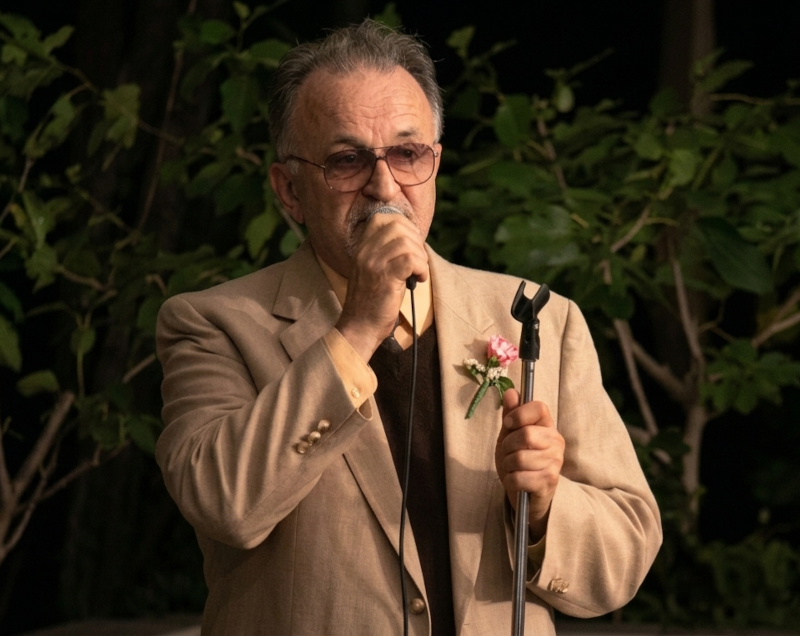
CMHS library opening at the Canadian Macedonian Place
The 1993 opening of the Canadian Macedonian Heritage Society (CMHS) Library at the Canadian Macedonian Place in Toronto was a landmark community achievement dedicated to the professional preservation of Macedonian history, language, and culture. Driven by a collaborative effort involving key figures like architect Tony Volas and secretary Virginia Stov, the facility was designed to serve as a sophisticated research hub and administrative center equipped with modern archival standards and educational resources. By establishing this center, the society aimed to provide an accurate historical narrative for future generations, fostering community identity through scholarly inquiry, public lecture series, and ambitious exhibit projects that bridge the gap between ancient Macedonian heritage and the modern diaspora experience.

Macedonian History with Professor Andrew Rossos
In this landmark 1993 lecture, Dr. Andrew Rossos provides a scholarly examination of the 150-year evolution of Macedonian nationalism, emphasizing its unique development within a hostile environment of competing Balkan interests and Ottoman theocratic constraints. He outlines four critical stages of national awakening—from the initial resistance against Greek ecclesiastical hegemony to the formal establishment of a Macedonian state post-WWII—while highlighting the "institutional homelessness" caused by the lack of an independent church. Central to his thesis is the concept of "Nashism," a grassroots peasant ideology that preserved a distinct Macedonian identity through folk traditions and shared speech, effectively insulating the population from foreign assimilation efforts. Ultimately, Rossos refutes claims that Macedonia is an artificial 20th-century creation, asserting instead that its sovereignty is the hard-won result of a persistent, organic struggle for self-determination and international recognition.

Dr. Dusko Aleksovski on Macedonian Rock Art
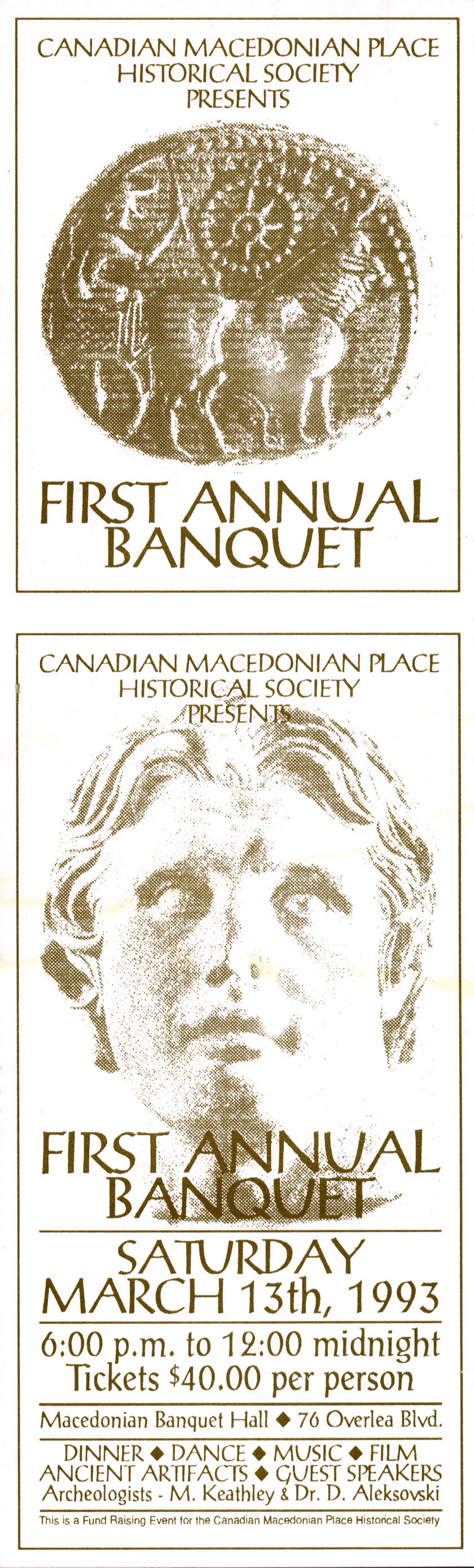
First Annual Banquet
The 1st Annual Banquet of the Canadian Macedonian Place Historical Society was a landmark event dedicated to the reclamation of Macedonian identity through scholarly evidence and community advocacy. Throughout the evening, experts and community leaders presented a multi-layered defense of Macedonian heritage, ranging from Professor Paul Robert Magocsi’s success in securing distinct Macedonian classification in the U.S. Census to Professor Michael Keathly’s archaeological proof of civilizational continuity from antiquity. The event also highlighted the cultural significance of the land through John Bitove Sr.’s discussion of unique botanical symbols and Professor Dusko Aleksovski’s pioneering research into prehistoric "stone art" found near Skopje. Ultimately, the banquet served as the formal launch of a permanent historical archive and library, signaling a strategic shift from anecdotal storytelling to the institutionalized preservation of Macedonian history in Canada.
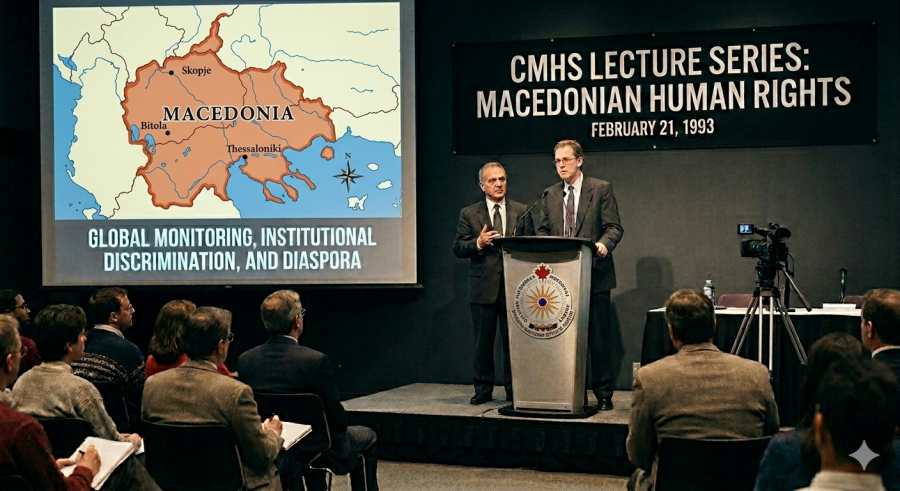
Macedonian Human Rights Lecture with Michael Craig and Trian Dimitriou
This landmark 1993 CMHS lecture provides a comprehensive analysis of the Macedonian human rights crisis during the early 1990s, featuring expert testimony from Michael Craig of Amnesty International and Trian Dimitriou of the Macedonian Canadian Human Rights Committee. The presentation meticulously documents the "human rights vacuum" in the Balkans, highlighting the imprisonment of ethnic Macedonians as prisoners of conscience and the systematic "cultural genocide" characterized by forced toponym changes, identity theft, and state-sponsored denationalization strategies. By integrating historical cartography dating back to 1477 with reports from international diplomatic missions in Helsinki and Moscow, the speakers elevated the Macedonian struggle to the global stage, while simultaneously addressing the local challenges of political harassment faced by the diaspora in Toronto. Ultimately, this archival record serves as a vital primary source that bridges the gap between historical erasure and the modern pursuit of international recognition and minority rights.