

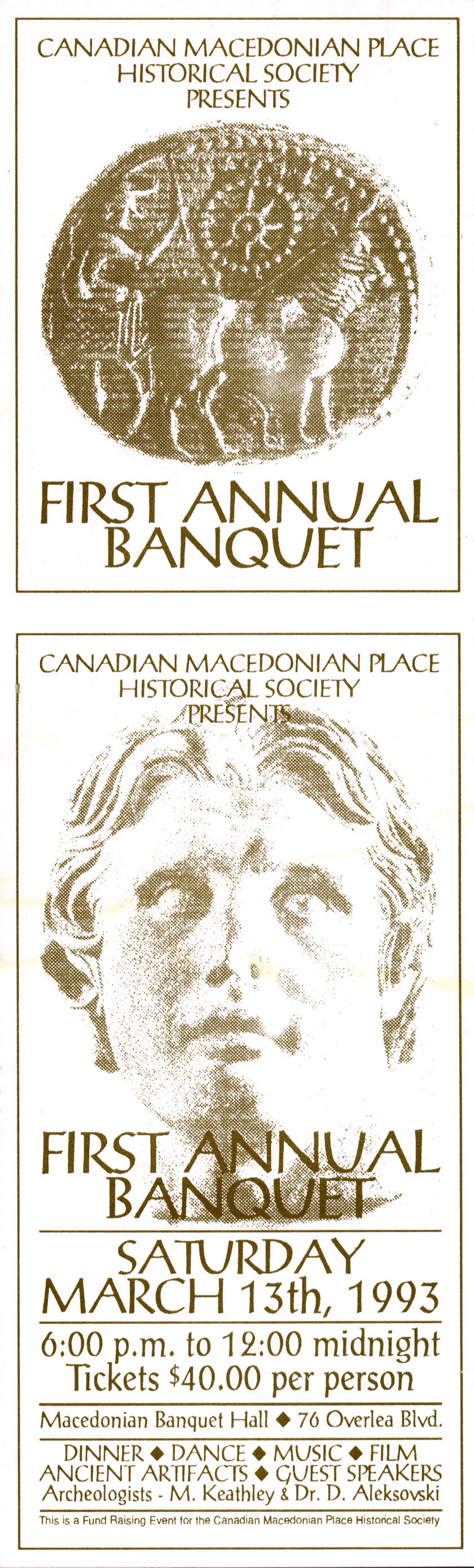


First Annual Banquet
The 1st Annual Banquet of the Canadian Macedonian Place Historical Society
Foundation and the Reclamation of Identity
The 1st Annual Banquet of the Canadian Macedonian Place (CMP) Historical Society, held on March 13, 1993, served as a foundational milestone for the Macedonian diaspora in Canada. The event was designed as a proactive response to decades of systemic cultural erasure and historical distortion. Master of Ceremonies Alex Gigeroff opened the evening by framing the society’s mission within the context of global human rights. He argued that the preservation of Macedonian history is not merely a hobby for enthusiasts but a vital act of asserting one’s humanity. Gigeroff spoke movingly about his childhood desire to "hear a story" (kazi mi edna prikazna), emphasizing that the community must now write its own story so the world can recognize the philosophy and spiritual ideas that emerged from Macedonian soil. He rejected the notion that the Macedonian identity "jumped over the clouds like a bit of fluff" in the 1940s, asserting instead a lineage that is ancient and unbroken.
Institutional Recognition and the Struggle for Legitimacy
A significant portion of the report details the administrative and academic battles required to establish Macedonian identity in North America. Professor Paul Robert Magocsi provided a comprehensive overview of his work with the Multicultural History Society of Ontario and his involvement with the Harvard Encyclopedia of American Ethnic Groups. He described the immense political pressure and lobbying efforts intended to prevent the inclusion of a distinct Macedonian category in these influential records. Magocsi detailed how, during the 1980 U.S. Census, Macedonian responses were systematically reclassified as Bulgarian, effectively erasing them from official records. His persistence and research eventually led the U.S. Census Bureau to adopt a revised schema for the 1990 Census, which officially recognized "Macedonian" as a distinct ancestry. This shift provided the community with its first accurate demographic standing and served as a vital tool for official recognition.
Cultural Continuity and the Architecture of Innovation
The historical narrative was expanded by Professor Michael S.A. Graziosi, who presented evidence of an unbroken Macedonian lineage dating back to the first millennium BC. He focused on the sophisticated artistic and architectural contributions of the ancient Macedonians, such as the stoa of Attalos in Athens and the realistic hunting mosaics found in Pella. Graziosi showcased "illusionary architecture"—the use of false marble and painted dimensions—which the Macedonians perfected and the Romans later adopted. He also highlighted the Macedonian "Sunburst" or star symbol found on the Larnax of Philip II as a consistent ethnic marker. By linking these ancient innovations to the "achiever" mindset of modern Macedonian professionals, he provided the audience with a sense of civilizational continuity, asserting that the Macedonian identity is a deep-rooted historical reality rather than a recent political construct.
The Symbolism of the Land and Biological Identity
The report also captures the emotional testimony of community leader John Bitove Sr., who discussed the unique biological markers of Macedonian identity. He spoke at length about the "Sedge" or "Treskavec" flower, which grows exclusively in the mountains of Macedonia. Bitove recounted how his wife researched the flower to find its exact color for use in the society's symbols. He explained that in the early days of the Toronto diaspora, planting this flower in a front yard was a silent identifier of a Macedonian household. Bitove used this botanical fact to challenge those who claim Macedonia has no unique identity, noting that the flower does not grow in Greece or Bulgaria. This connection to the specific flora of the homeland served as a powerful metaphor for the organic nature of Macedonian identity—something that exists in the soil and the soul.
Pioneering Discoveries in Paleo-Linguistics and Stone Art
One of the most technical and evocative segments of the banquet featured Professor Dusko Aleksovski, who presented his research into the "books in stone" found within the Republic of Macedonia. Aleksovski showcased slides of prehistoric pictographs, including representations of animals, birds, and primitive maps carved into rock faces near Skopje. He shared a particularly significant discovery: a clay tablet featuring an unidentified script that does not relate to any known language, which he believes represents a sophisticated early message. Aleksovski argued that Macedonia is one of the richest regions in the world for prehistoric art and writing. Despite his monthly wage of only $65 and the fact that he often had to crawl into dangerous caves alone to document these findings, his work provided a scientific foundation for the community’s claim to a millennia-old indigenous presence in the Balkans.
Future Mandate and the Establishment of the CMP Library
The evening concluded with a strategic call to action regarding the future of the Canadian Macedonian Place Historical Society. The organizers, including Tom Toman, highlighted the ongoing research being done through global library databases and computer networks. They announced the creation of a dedicated library and research center consisting of four rooms at the Canadian Macedonian Place. This facility was intended to house the "vaults of history"—thousands of photographs and pioneer records curated by Lillian Petroff. The library was envisioned as a permanent "window" through which both the diaspora and the broader Canadian public could access the truth of Macedonian history. By the end of the banquet, the society had transitioned from a group of concerned individuals into a formal institution capable of safeguarding the Macedonian legacy for generations to come.


