


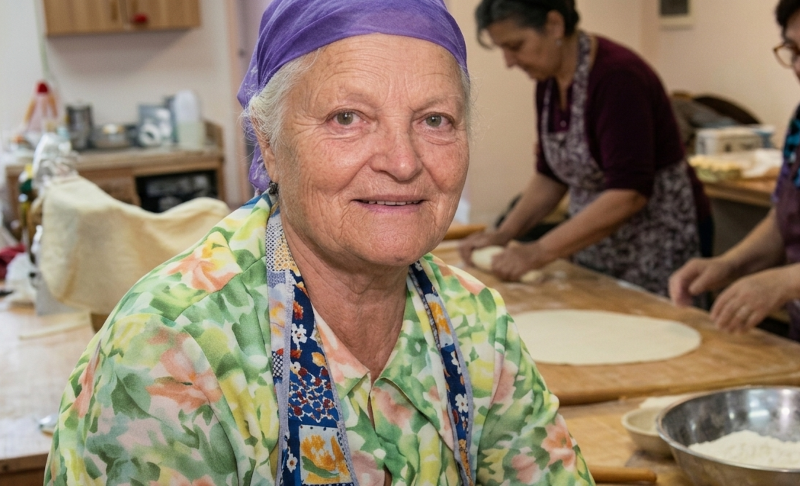


Making Macedonian Zelnik at the Canadian Macedonian Place
On December 4, 1993 the traditional art of making Macedonian Zelnik, a savory, multi-layered filo pie that stands as a cornerstone of Macedonian culinary heritage. The demonstration highlights the labour-intensive, communal process of hand-rolling dough and the specific techniques passed down through generations.
The Preparation Process
1. Rolling the Dough (The 'Kori')
The process begins with a basic dough that is divided into small balls. The women demonstrate the mastery required to transform these into paper-thin layers called kori.
- Technique: Using a thin, traditional rolling pin, the dough is rolled out until it is translucent. Experts note that for a proper Zelnik, one might stack approximately 30 layers of these thin leaves to achieve the desired flakiness [06:43].
- Layering: Small pieces of dough are often worked individually and then folded or stacked with oil to ensure the pastry "breathes" and becomes crispy during baking [06:21].
2. Filling and Assembly
While "Zelnik" traditionally refers to a filling of "zelje" (greenery like leeks, spinach, or sorrel), this demonstration also highlights variations:
- Cheese Filling: A popular version uses a mixture of crumbled feta-style cheese and eggs [22:44].
- The "Mavec": The filling is typically placed in the center of the pan, with the hand-rolled dough layers arranged around it.
- The Edges: A distinct feature of the Macedonian Zelnik is the braided or pleated edge. The outer layers of the dough are gathered and twisted around the perimeter of the pan to create a thick, crunchy crust that holds the filling in place [11:26].
3. Baking
The video showcases a large-scale production, with the community preparing dozens of pies simultaneously. In a traditional setting, the Zelnik is baked until the top is golden brown and the internal layers have puffed up into a light, flaky texture [21:54].
Cultural Significance
The 1993 gathering at the Canadian Macedonian Place was more than just a cooking class; it was an act of cultural preservation.
- Communal Effort: The video emphasizes that Zelnik is often made in groups. The speed and precision of the elders show that this skill was once a daily necessity and a source of pride [08:58].
- Traditions: Zelnik is frequently associated with holidays and special gatherings, such as New Year's Eve, where traditions like hiding a coin in the pie are practiced [27:20].
- Legacy: The demonstration serves as a bridge between the "old world" techniques of Macedonia and the diaspora community in Canada, ensuring that younger generations understand the "mechanism" and effort behind this iconic dish [06:43].
Summary of Key Components
|
Step |
Description |
|
Dough |
Hand-kneaded and rested before rolling. |
|
Rolling |
Achieved using a thin rolling pin to create translucent sheets [12:47]. |
|
Filling |
Typically leeks and greens (Zelje) or cheese and eggs [22:44]. |
|
Styling |
Decorative pleated edges that define the authentic look [11:26]. |