



Macedonian Human Rights Lecture with Michael Craig and Trian Dimitriou
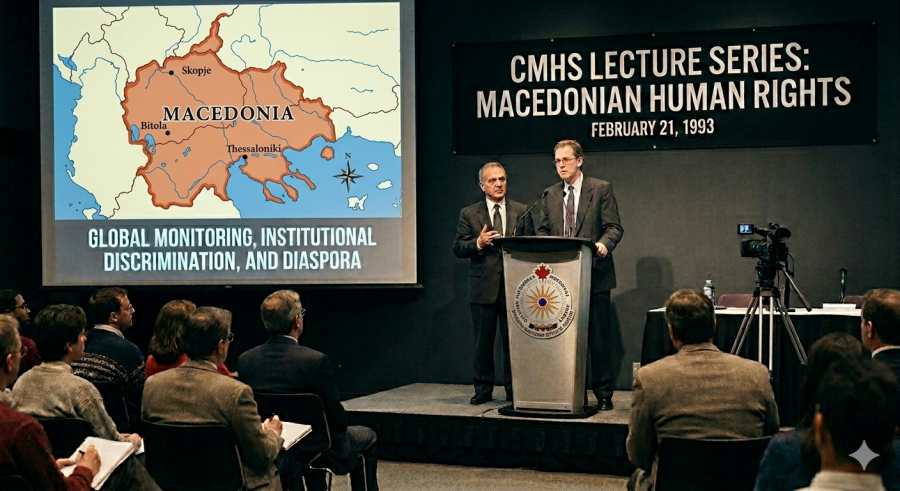
On February 21, 1993, the Canadian Macedonian Historical Society (CMHS) convened a seminal lecture in Toronto that remains one of the most comprehensive documentations of the Macedonian human rights struggle during the post-Cold War era. At a pivotal historical moment—occurring shortly after the Republic of Macedonia’s declaration of independence—this event featured a rare and powerful collaboration between a global human rights watchdog and frontline activists. The lecture provided a dual-layered analysis of institutional discrimination, cultural erasure, and the international legal frameworks available for redress. By bringing together the neutral, investigative rigor of Amnesty International with the specific, historical testimony of the Macedonian Canadian Human Rights Committee, the CMHS established a record that serves as both a legal brief and a cultural archive.
Michael Craig, representing Amnesty International, opened the proceedings by documenting a significant decline in human rights protections within Greece during the early 1990s. He provided an objective overview of what he described as a "nose dive" in state tolerance for ethnic dissent. Craig focused specifically on the plight of "prisoners of conscience"—individuals detained solely for their ethnic identity or non-violent expression of beliefs. A central example provided was the troubling case of 17-year-old student Milis Habakus, who was arrested and convicted for distributing leaflets that advocated for peace and self-determination. Under the Greek legal climate of the time, such acts were categorized as disseminating information "injurious to the state." Furthermore, Craig presented sobering evidence of systemic ill-treatment and physical abuse within police stations. While perhaps not a formal government policy against all political dissidents, these documented realities illustrated a pervasive "human rights vacuum" where ethnic Macedonians were particularly vulnerable to state overreach and judicial bias.
Complementing this global oversight, Trian Dimitriou, President of the Macedonian Canadian Human Rights Committee, delivered a detailed account of the institutional efforts to erase Macedonian identity through state-sponsored Hellenization. He traced the roots of this struggle back to the 1913 Treaty of Bucharest, which partitioned the Macedonian region and initiated a century of systematic cultural erasure. Dimitriou explained how this resulted in the forced renaming of thousands of villages, mountains, and rivers (toponyms) to eliminate Slavic historical footprints. He also described a profound "personal identity theft" forced upon the diaspora; many Macedonians in Canada were required to adopt and maintain Greek surnames to preserve their property rights in the old country or to travel to their home villages without being blacklisted by border authorities. A significant portion of his testimony involved the exposure of a 1982 confidential Greek security report. This document outlined chilling strategies for the "denationalization" of the Macedonian minority, even suggesting financial incentives for Greek officials to marry Macedonian women to dilute the community's ethnic identity. Dimitriou argued forcefully that these coordinated actions constituted a form of cultural genocide designed to dismantle the very foundations of the Macedonian people.
The lecture further sought to elevate the "Macedonian Question" beyond local ethnic disputes and into the realm of international law and objective history. The speakers detailed their extensive diplomatic lobbying efforts at various Conference on Security and Co-operation in Europe (CSCE) meetings—the precursor to the OSCE—in Helsinki, Moscow, and Copenhagen. At these forums, the committee advocated for the fundamental right of individuals to self-identify without fear of state reprisal. To ground these legal arguments in historical reality, the presentation included an extensive slideshow of cartographic evidence. By showcasing maps dating back as far as 1477, the speakers demonstrated that "Macedonia" was recognized as a distinct geographic and ethnic entity by global cartographers centuries before modern geopolitical disputes began. These primary sources were used to provide an irrefutable historical basis for the community’s claims to recognition, countering the revisionist narratives prevalent in the early 1990s.
Finally, the presentation addressed the direct and often overlooked impact of Balkan tensions on the Macedonian diaspora in Canada. Dimitriou recounted specific instances where cultural events in Toronto, including those held at Mel Lastman Square and on The Danforth, faced administrative harassment, permit threats, and cancellations due to external political pressure. These incidents served as a stark reminder that the struggle for human rights was not confined to distant borders but required constant vigilance from Macedonian-Canadians to protect their own cultural rights and freedom of assembly within Canada. He concluded with a call to action, emphasizing that the preservation of history is a prerequisite for the attainment of justice. Today, this lecture remains a vital archival resource for researchers and community members alike, documenting an era where ethnic identity was criminalized and providing the essential foundational context for the ongoing pursuit of minority rights and international recognition.