Canadian Macedonian Heritage Society Canadian Macedonian Heritage Society Become a member!

Tagged “Macedonian Language”

Browse Tagged “Macedonian Language” from the Canadian Macedonian Heritage Society archive, library and community collections.

Preserving Macedonian Dialects with Professor Marjan Markovikj

This lecture by Professor Marjan Markovikj highlights the importance of Macedonian dialects in preserving the continuity and development of the Macedonian language. Despite being standardized relatively late, the language has evolved naturally through its dialects and long-standing interaction with other Balkan languages. These dialects remain vital, continuously enriching modern Macedonian through everyday use. The presentation showcases this evolution through maps, recordings, and digital resources, while emphasizing the role of dialectology and linguistic research in safeguarding Macedonian linguistic heritage.
YOU (MIGHT) KNOW MORE MACEDONIAN THAN YOU THINK YOU DO!

The Canadian Macedonian Historical Society hosted a lecture by Christina Kramer titled “You (Might) Know More Macedonian Than You Think You Do!” which explored how elements of the Macedonian language persist within the diaspora, even among those who no longer speak it fluently. Through a community questionnaire, Kramer revealed that Macedonian words and phrases often remain embedded in everyday life, especially in emotional or cultural contexts. The talk emphasized the importance of heritage language—how it is retained, used, and passed on—and encouraged reflection on preserving Macedonian identity and linguistic traditions within families and communities.

Spero Thompson - MACEDONIANA; OUR TREE OF LITERATURE

From our origin in the garden of Eden man has a close relationship with trees. In contemplation of our group of writers The Brothers Miladinov Macedonian Poetry Society it occurred to me that we are very much like a tree, a tree of Literature Like a tree we have four parts, roots, trunk, branches and leaves. Also as an expression of life we produce fruit ( our writings) As to our genus we are of the Macedonian Oak ...

Spero Thompson - SPOKEN TO IN MACEDONIAN ANSWERING IN ENGLISH

I consider myself fortunate in having had a happy childhood. I lived and grew up in the Regent Park area of Cabbagetown in the City of Toronto. In the 1940`s this area was heavily populated with immigrant Macedonian families. They liked to live in close proximity to St. Georges Macedonian Church located on the corner of Regent Street and Sutton Avenue. My Father was an immigrant from the village of Oshchima in ...

Spero Thompson - ODE TO MACEDONIA

ODE; Literally, is a song, marked by exaltation of feeling, style, varying lengths of line and complexity of stanza form. Prologue I personify Macedonia as having a Body, Soul and Spirit Chorus The word Macedonia, when written is as a magnet to my eyes, drawing interest to the context in which it is written. The word Macedonia spoken is as music to my ears. It is as familiar as my own name. SONG OF THE BODY The body ...

Spero Thompson - SPIRIT OF MOTHER MACEDONIA (sweet singer of song)

Dear patriotic spirit and Mother of the people Many children emigrated from you with deep regrets To their new lands, languages and hope No matter distance; it`s Mother no child ever forgets. With song you nourish your peoples soul As when you sang at Ilinden That day the Narod rose up to say We are not Bulgars, Greek or Serb, we are Macedonian Mother Macedonia sweet singer of song Please sing us a song for today ...

Spero Thompson - LANGUAGE AND THE MACEDONIAN WOMAN (Keeper of the Linguistic Flame)

Macedonians of today are proud of their heritage Especially the role of women in keeping language alive During a violent century, it was the Macedonian speaking home That held together the Macedonians as a distinct people Who held the people together? She who was the preserver of the Macedonian language The teacher is honoured by the child`s first word “Majka” Words to infants are seeds planted, which grow to become ...

16 Century Macedonian Lexicon Found at the Vatican

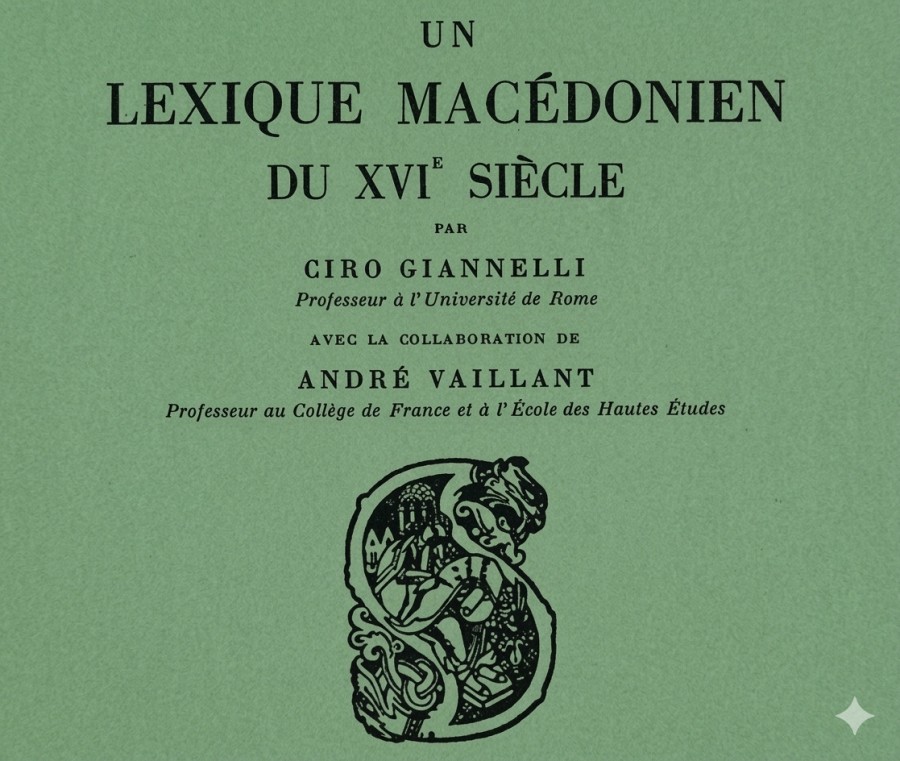
On October 27, 2013, the Canadian Macedonian Historical Society hosted a lecture at the East York Civic Centre featuring professors Joseph Schallert and Kosta Peev, who presented a significant 16th-century Macedonian lexicon discovered in the Vatican archives. Originally found in the late 1940s and written in the Greek alphabet, the manuscript was eventually identified as the Old Kostur dialect of Macedonian rather than Greek, as evidenced in the 1954 study Un Lexique Macédonien du XVIe Siècle. Odyssey Belchevsky, the Director of Cultural Events, noted that a copy of this scholarly work was personally delivered to the Society by Macedonian President George Ivanov, serving as vital historical proof of the Macedonian language's long-standing existence centuries before the formation of the modern state.

Reassessing the Demotic Text of the Rosetta Stone

On Sunday, May 15, 2011, the Canadian Macedonian Historical Society (CMHS) hosted a landmark inaugural Skype lecture featuring Dr. Tome Boshevski and Dr. Aristotel Tentov, who presented their pioneering research into the middle text of the Rosetta Stone. The researchers identified this script—historically categorized as Demotic—as the language of the ancient Macedonians who ruled Egypt during the Ptolemaic period. Utilizing a "wiring for sound" methodology to identify 27 consonants and 8 vowels, they revealed a sophisticated syllabic script with a complex grammatical structure that shares characteristics with modern Slavic languages. This methodology was successfully applied to other ancient artifacts, such as the Canopus Decree and items from the Vincha culture, suggesting a remarkable linguistic continuity dating back to 3000 B.C. The lecturers concluded that the Rosetta Stone served as a multi-ethnic communication tool, with the Macedonian text providing significantly more detail than the Greek version, thereby offering profound new implications for the study of historical linguistics and the enduring legacy of the ancient Macedonian language.

Patsy Sider - THE LETTER "Z"

At the church of St. Panteleimon, in Lerin I was going to get the Lord's blessing. The church choir chant sweetly. The church choir chant softly and angelic. Every Sunday in the church I felt a particular joy. I felt peaceful Because I Love the Christian believes. I admired the icons, the paintings. What liveliest expressions were these! The faces of the Saints were painted with skill Which were called the highest ...