


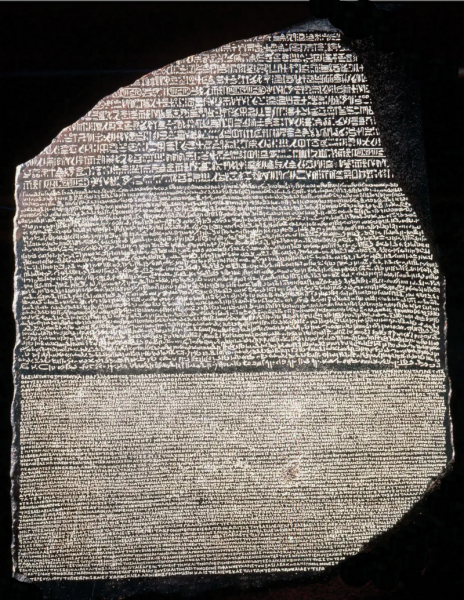


Reassessing the Demotic Text of the Rosetta Stone
On Sunday, May 15th, 2011, the Canadian Macedonian Historical Society (CMHS) hosted a landmark inaugural Skype lecture featuring Dr. Tome Boshevski of the Macedonian Academy of Arts and Sciences and Dr. Aristotel Tentov of the University of Cyril and Methodius, who presented their revolutionary research on the middle text of the Rosetta Stone.
The Deciphering of the Middle Text
The central focus of the lecture was the identification and decoding of the Rosetta Stone’s middle text, which the researchers argue is written in the script and language of the ancient Macedonians. As the "living masters of Egypt" during the Ptolemaic era, the Macedonians utilized this script for official state business. The researchers successfully identified the script as syllabic—primarily of the consonant-vowel type—and determined that it is written and read from right to left. By identifying 27 consonants and 8 vowels, they were able to "wire the text for sound," revealing a highly sophisticated linguistic structure.
Linguistic and Grammatical Findings
The researchers uncovered a complete grammatical system within the text that mirrors structures found in modern Slavic languages. Their analysis identified:
-
Noun and Adjective Forms: Clear distinctions between singular and plural nouns, as well as the use of basic and superlative forms for adjectives.
-
Verbal Complexity: The identification of both active and passive verb forms.
-
Narrative Depth: The study revealed that the middle text contains significantly more detail and nuance than the ancient Greek text on the same stone, providing a more comprehensive look at the decree’s original intent.
Implementation Across Historical Artifacts
A major component of the report was the successful application of this decoding methodology to other historical sites and documents. The researchers demonstrated that the same script and phonetic rules could be used to read the "demotic" text of the Canopus Decree. Furthermore, they applied their findings to ancient stone artifacts found in the Republic of Macedonia and the Vincha culture, some of which date back to 3,000 B.C., suggesting a remarkable consistency in the language over several millennia.
Conclusion of Broader Implications
The lecturers concluded that their findings have profound implications for our understanding of ancient history and communication. They posit that the three scripts on the Rosetta Stone were not merely translations of one another, but deliberate efforts by the pharaohs to communicate with three distinct ethnic communities in Egypt using different linguistic styles and religious approaches. Ultimately, the research suggests that the ancient Macedonian language remained a vital and stable medium of communication across a vast geographic and chronological span, a conclusion the researchers maintain is firmly supported by existing archaeological evidence.
Click below to view the power point presentation.