

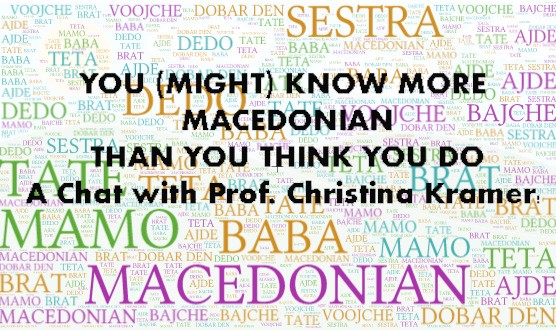


YOU (MIGHT) KNOW MORE MACEDONIAN THAN YOU THINK YOU DO!
The Canadian Macedonian Historical Society hosted an engaging and thought-provoking lecture titled “You (Might) Know More Macedonian Than You Think You Do!” presented by Professor Christina Kramer on April 7, 2022. The event invited members of the Macedonian diaspora to reflect on their personal relationship with the Macedonian language—especially those who may no longer speak it fluently or pass it on actively to younger generations.
At the heart of Kramer’s talk was the concept of heritage language—the language of one’s family and cultural background that may not be fully spoken but continues to live in fragments, memories, and emotional expression. She posed powerful questions to the audience: even if Baba or Dedo are no longer with us, what linguistic traces remain? Why do certain Macedonian words or phrases still surface naturally in moments of joy, grief, humor, or tradition? These moments, she suggested, reveal that language is not only a tool of communication, but also a deep carrier of identity, memory, and cultural belonging.
To explore this idea more concretely, Kramer conducted a community-based questionnaire, gathering responses from individuals who either actively speak Macedonian or have only passive familiarity with it, as well as from their children. The results were revealing—many participants underestimated how much Macedonian they actually retained. Words, expressions, and patterns of speech persisted across generations, often tied to family life, food, traditions, and emotional experiences. Even those who considered themselves “non-speakers” demonstrated a meaningful connection to the language.
The lecture, complemented by insights from her broader work on the Crossroads of Macedonian Language, highlighted how Macedonian exists at the intersection of history, migration, and cultural exchange. Within diaspora communities, the language evolves—sometimes fragmenting, sometimes adapting—but rarely disappearing entirely. Instead, it survives in hybrid forms, code-switching, and symbolic usage, continuing to shape identity in subtle but powerful ways.
Kramer emphasized that preserving a heritage language does not require perfect fluency. Rather, it begins with awareness, intentional use, and intergenerational engagement—whether through simple phrases at home, storytelling, cultural practices, or community events. Her findings encouraged families to recognize and value the linguistic knowledge they already possess and to find meaningful ways to pass it on.
The lecture concluded with a call to action: to support institutions like the Canadian Macedonian Historical Society that are dedicated to preserving Macedonian language, history, and culture in one place. Through membership, participation, and community involvement, such organizations ensure that future generations remain connected to their linguistic and cultural roots.
Overall, the presentation was both affirming and inspiring—reminding attendees that even when a language seems distant, it often remains closer than we think, embedded in memory, identity, and everyday life.