



Preserving Macedonian Dialects with Professor Marjan Markovikj
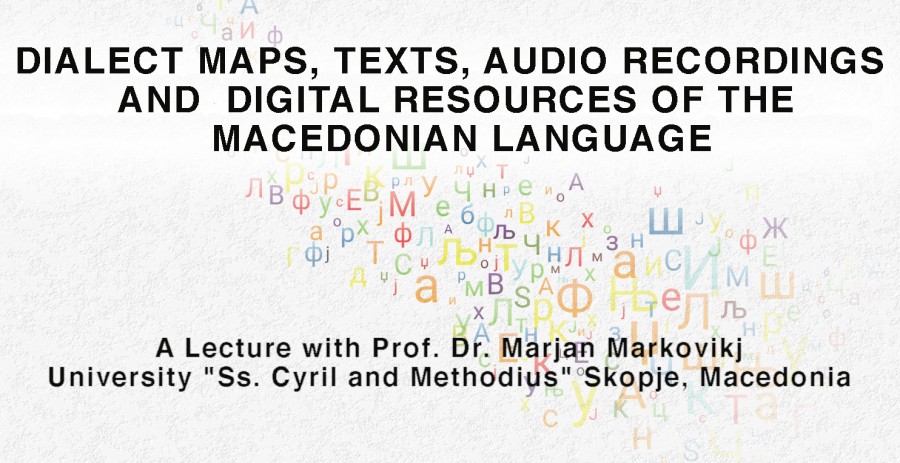
The Canadian Macedonian Heritage Society lecture, “Preserving Macedonian Dialects – Past and Present,” delivered by Professor Marjan Markovikj, explored the historical development, significance, and preservation of Macedonian dialects within the broader context of Balkan linguistics. He emphasized that Macedonian is a South Slavic language rooted in inherited Slavic grammar and vocabulary, yet shaped over centuries through close interaction with non-Slavic neighboring languages. This interaction—primarily occurring through its diverse dialects—situates Macedonian within the Balkan Linguistic League, where languages share structural and conceptual similarities despite different origins.
A central theme of the lecture was the continuity of the Macedonian language. Although it was standardized relatively late and often lacked formal institutional support such as statehood or official norms, Macedonian persisted and evolved organically through everyday spoken dialects. This “living communication” allowed the language to naturally absorb contact-induced changes and adapt to its environment. As a result, Macedonian developed alongside other Balkan languages, converging with them in ways that reflect shared cultural and historical experiences.
Professor Markovikj highlighted the ongoing importance of dialects in enriching the modern standard language. Regional speech patterns, vocabulary, and expressions continue to shape contemporary Macedonian, demonstrating that dialects are not relics of the past but active contributors to linguistic vitality. To illustrate this, the lecture incorporated dialect atlases, linguistic maps, and audio recordings from various regions, offering insight into the geographic and phonological diversity of the language.
In addition, the presentation introduced key digital resources developed by the Macedonian Academy of Sciences and Arts (MANU), including online dialect databases, linguistic atlases, and research platforms that support both academic study and public access to Macedonian language materials. These tools play a crucial role in documenting and preserving dialectal variation for future generations.
Professor Markovikj’s work, grounded in his expertise in dialectology, areal linguistics, and language contact, underscores the importance of continued research and international collaboration. His involvement in major projects such as the Atlas Linguarum Europae and the Common Slavic Linguistic Atlas reflects a broader effort to position Macedonian within global linguistic scholarship while safeguarding its unique heritage.
In addition, the presentation also included Macedonian language digital resources:
1. http://drmj.manu.edu.mk/en/