

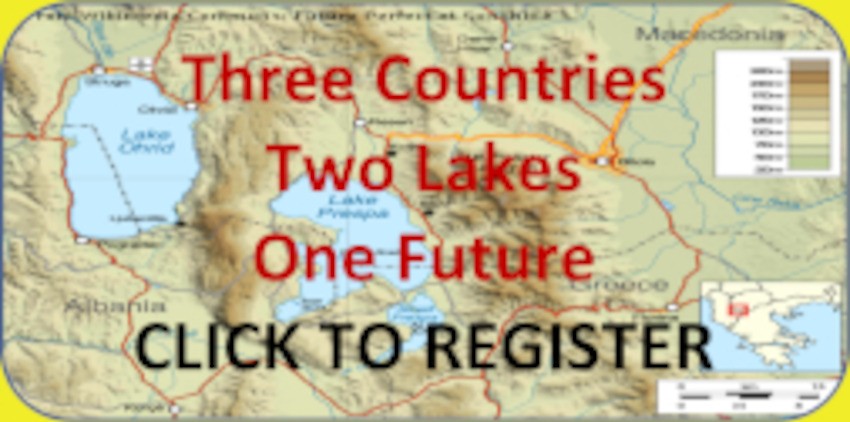


"Three countries, two lakes, one future" with Prof. Loring Danforth
Professor Loring M. Danforth Presents: “Three Countries, Two Lakes, One Future”
Event Report
The Canadian Macedonian Historical Society continued its virtual lecture series with an insightful and timely presentation by Professor Loring M. Danforth on February 24, 2021, titled “Three Countries, Two Lakes, One Future: The Prespa Lakes and the Signing of the Prespa Agreement.” Drawing from his chapter in the book Macedonia and Identity Politics After the Prespa Agreement, edited by Vasiliki P. Neofotistos, Professor Danforth offered a rich historical and anthropological examination of the Prespa region and its symbolic importance in the modern political landscape of the Balkans.
Professor Danforth explored the historical significance of the Prespa Lakes region, a unique borderland shared by Greece, North Macedonia, and Albania. He examined how this region, often seen as peripheral, has repeatedly occupied a central place in Balkan history. From serving as the first capital of Tsar Samoil’s medieval state to becoming a focal point in the drawing of modern Balkan borders, Prespa has long been a site where politics, identity, and history converge.
A major focus of the lecture was the 2018 Prespa Agreement, signed on the shores of Lake Prespa by the foreign ministers of Greece and the Republic of Macedonia, resulting in the country’s official name change to the Republic of North Macedonia. Danforth examined the political, social, and historical conditions that led to this agreement and its far-reaching implications for national identity, language, citizenship, and historical memory.
Particularly compelling was Danforth’s discussion of Prespa as a symbolic landscape—one that has served many historical roles: as the capital of Tsar Samoil (969–1018), as a contested border zone during the formation of Balkan nation-states, as the center of “Free Greece” during the Greek Civil War, and later as the home of the Transboundary Prespa Park, an ecological initiative promoting cooperation across national borders.
The lecture also revisited debates surrounding Tsar Samoil and the historiographical disputes over his state and identity. Drawing on historical scholarship, Danforth addressed competing national narratives regarding Samoil’s kingdom and the later construction of the “Bulgar-slayer” myth surrounding Byzantine Emperor Basil II. These discussions highlighted how historical interpretation remains deeply connected to contemporary identity politics in the Balkans.
Professor Danforth proposed an alternative way of understanding the region—through the ecological metaphor of the Transboundary Prespa Park. Rather than seeing borders as rigid lines of separation, he encouraged attendees to imagine Prespa, and Macedonia more broadly, as a transboundary space of shared history, interconnected identities, and common futures.
The presentation provided attendees with a deeper understanding of the complexities surrounding the Prespa Agreement and its broader implications for identity politics in the region. Through his interdisciplinary lens, Professor Danforth demonstrated how history, politics, and geography continue to shape the lived realities of the peoples of Macedonia and the wider Balkans.
The Canadian Macedonian Historical Society extends its sincere thanks to Professor Danforth for sharing his expertise and offering such a thoughtful exploration of one of the most important contemporary issues affecting Macedonia and the Balkans.