


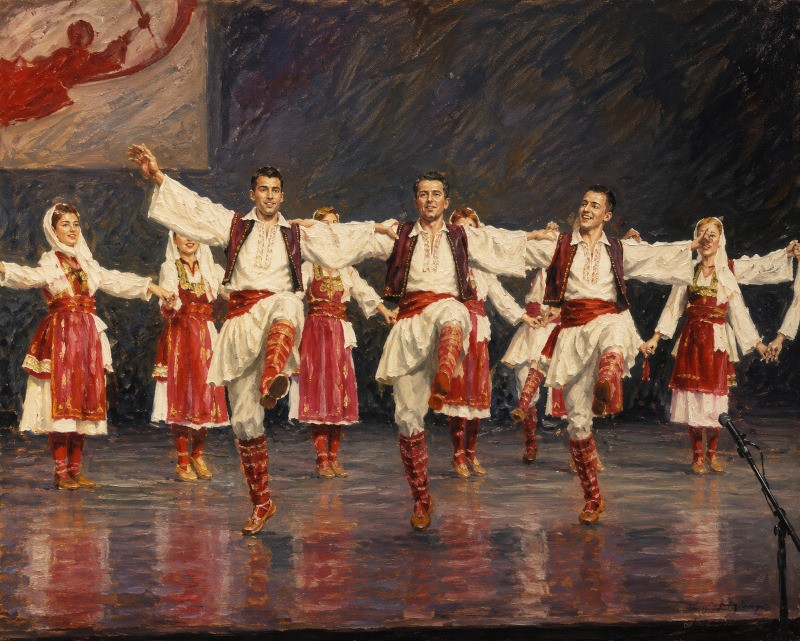


Rhythm and Dance by Z. Chesky Neceski
Detailed Report on the Canadian Macedonian Historical Society Lecture
Macedonian Rhythm and Dance
Lecture by Z. Chesky Neceski (June 1, 1997)
Organized by the Canadian Macedonian Historical Society (CMHS) on June 1, 1997, the lecture Macedonian Rhythm and Dance by Z. Chesky Neceski stands as an important cultural and ethnographic contribution to the study of Macedonian folk traditions, specifically examining the inseparable relationship between music, rhythm, movement, and communal identity in Macedonian village life. Preserved in the Society’s archival lecture series and accessible through the event’s recorded presentation on YouTube, the lecture offers a rare and detailed examination of Macedonian dance traditions as living historical documents—forms of embodied memory that preserve regional identity, social structure, and collective history across generations. Rather than treating dance as entertainment alone, Neceski frames Macedonian rhythm and dance as a cultural language—one through which communities express emotion, history, spirituality, resistance, and belonging. His lecture reveals that traditional Macedonian dance is deeply tied to geography, village structure, ritual life, and musical complexity, making it one of the richest dance traditions in the Balkans.
Introduction: Dance as Cultural Memory
Neceski begins by emphasizing that in Macedonian tradition, dance cannot be separated from community life. Unlike staged performances or choreographed spectacles, village dancing was historically a social institution. It marked celebrations, weddings, religious feast days, harvest gatherings, and communal festivals. Dance was one of the primary spaces where social relationships were reinforced and where cultural continuity was maintained. He explains that in traditional Macedonian society, to dance was not simply to perform movement—it was to participate in collective identity. The dance circle represented the community itself: united, interdependent, and continuous. This opening framework is important because it moves the audience away from viewing dance as folklore and toward understanding it as social history.
The Importance of Rhythm in Macedonian Tradition
A major focus of Neceski’s lecture is rhythm, which he identifies as the defining characteristic of Macedonian musical and dance traditions. Unlike Western European musical traditions that are dominated by symmetrical meters such as 2/4, 3/4, or 4/4 time, Macedonian music is famous for its asymmetrical rhythms. Neceski explains that Macedonian rhythms are built around irregular beat patterns, often grouped in combinations such as 3+2+2, 2+2+3, 2+3+2, and 3+2+2+2. These rhythmic structures create a distinct movement quality that feels uneven yet highly structured. He notes that this asymmetry reflects a broader Balkan musical inheritance but reaches a particularly sophisticated form in Macedonian folk traditions. The uneven rhythm creates a dynamic tension in the body—one that dancers learn instinctively through repetition and community participation rather than formal instruction.
Understanding the Oro (Circle Dance)
The central dance form in Macedonian tradition is the oro, the communal circle or line dance that serves as the foundation of village social life. Neceski explains that the oro is not merely a dance structure but a social arrangement. Dancers connect physically—through hands, shoulders, belts, or handkerchiefs—forming a visible symbol of communal unity. The circle itself represents continuity and equality, though leadership within the dance often reflects social hierarchy or skill. The lead dancer traditionally carries responsibility for rhythm, variation, and energy, setting the pace and tone for the entire group. Neceski points out that in many villages, the quality of a dancer was judged not by flamboyance but by control, endurance, and sensitivity to rhythm. In this way, the oro becomes a metaphor for village life itself—communal, interdependent, and continuous.
Regional Variations in Macedonian Dance
One of the most fascinating aspects of the lecture is Neceski’s examination of regional differences across Macedonia. He explains that dance styles vary significantly from region to region because geography, history, and local customs shaped movement traditions differently. Dance therefore becomes an ethnographic map of Macedonia itself, revealing local histories through bodily movement.
Western Macedonia
In regions such as Lerin, Kostur, and Bitola, dances tend to be heavier, grounded, and slower in tempo. The movements emphasize controlled footwork and a strong physical connection to the earth. Neceski suggests this groundedness reflects mountain village life and a culture shaped by endurance, agricultural labor, and resilience. The movement style mirrors the environment itself—rugged, deliberate, and strong.
Eastern Macedonia
In eastern regions such as Strumica and Štip, dances often feature lighter steps, quicker rhythms, and more agile transitions. Neceski notes that these dances reflect different agricultural patterns and social rhythms. The movement vocabulary here tends to feel more fluid and energetic, shaped by flatter landscapes and different cultural exchanges.
Central Macedonia
Central Macedonian dances often blend characteristics from both east and west, showing transitional cultural influences. Neceski uses these regional examples to demonstrate that dance serves as a living archive of Macedonian ethnographic diversity, preserving local identities through movement patterns that remain recognizable across generations.
Dance and Gender Roles
Neceski spends important time discussing gender roles within traditional Macedonian dance. Historically, men and women often danced together, but their movement styles differed significantly according to social expectations. Men’s dancing tended to emphasize strength, precision, stamina, and leadership, often requiring strong physical presence and endurance. Women’s dancing, by contrast, often emphasized grace, balance, continuity, and rhythmic subtlety. However, Neceski is careful not to reduce these roles to stereotypes. He notes that women’s dances often carried remarkable rhythmic complexity and emotional depth, requiring exceptional discipline and precision. In many communities, dance was one of the few socially accepted spaces where gendered expression could be public and visible. Dance encoded social expectations while simultaneously allowing for individual expression.
The Relationship Between Music and Movement
Neceski emphasizes that Macedonian dance cannot exist independently of its music. Traditional instruments such as the gaida (bagpipe), tapan (drum), and kaval (flute) create the rhythmic framework that dancers follow. The tapan, in particular, serves as the heartbeat of the dance, its rhythmic pulse anchoring the dancers’ bodies and giving structure to the movement. The gaida provides melodic direction and emotional atmosphere. Neceski explains that dancers do not merely follow music—they embody it. The relationship between musician and dancer is reciprocal: musicians respond to dancers’ energy, and dancers adjust to musical variation. This creates a living dialogue between sound and movement, making each performance unique.
Dance as Social Communication
One of Neceski’s most compelling points is that dance functions as social communication. In village life, dance communicated interest, courtship, status, strength, and belonging. Young people often met through dance circles, and families observed prospective spouses through dancing. Skill in dance reflected discipline, social competence, and character. Neceski explains that dance functioned almost as a public language. Without words, individuals communicated identity, emotion, and intention. This social dimension made dance central to community life and ensured its continued importance across generations.
Wedding Dances and Ritual Importance
A substantial portion of Macedonian dance traditions revolves around weddings. Neceski explains that weddings featured specialized dances marking different stages of the ceremony. These dances often symbolized union, transition, family alliance, and fertility. Wedding dances were highly ritualized and varied regionally, with movement patterns carrying symbolic meaning. Certain steps reflected blessing, continuity, and prosperity. Neceski highlights that wedding dances preserved some of the oldest layers of Macedonian ritual tradition, functioning as both celebration and sacred social performance.
Religious Feast Days and Dance
Dance also played an important role in religious celebrations. Village feast days dedicated to saints often included communal dancing after liturgical services. Neceski explains that this blending of sacred and social life reflects the deep integration of Orthodox Christianity into village culture. Dance after worship symbolized communal renewal and reinforced social cohesion. The feast-day dance circle united the spiritual and the earthly, creating a ritual continuity between religious devotion and communal celebration.
Ottoman Influence and Cultural Survival
Neceski situates Macedonian dance historically within the Ottoman period. Under Ottoman domination, many forms of public political expression were restricted. Dance, music, and oral tradition became important spaces for preserving identity. Neceski argues that rhythm itself became a form of cultural continuity. Even when language or political institutions were suppressed, dance carried memory. Village dances became repositories of identity, preserving historical consciousness and communal belonging. This historical survival function gives Macedonian dance deeper political significance, showing that cultural traditions can function as acts of resistance.
Complexity of Macedonian Meter
One of the more technical parts of the lecture deals with the mathematical sophistication of Macedonian rhythm. Neceski explains how asymmetrical meter challenges dancers both physically and mentally. Unlike symmetrical Western dance rhythms, Macedonian rhythms require internalized counting that feels natural only after long exposure. The body learns the rhythm through repetition; it cannot be understood intellectually alone. This embodied mathematical sophistication is one reason Macedonian dance traditions are internationally admired by ethnomusicologists and dance scholars.
Dance in the Diaspora
Neceski acknowledges the importance of Macedonian dance among immigrant communities, especially in Canada. Diaspora communities preserved dances through cultural organizations, festivals, and church gatherings. For communities separated from their homeland, dance became a form of continuity. It preserved village identity, dialect, and memory. Neceski notes that many second-generation Macedonians first encounter their heritage through dance rather than language or formal historical study. This makes cultural organizations essential to historical preservation. For the Canadian Macedonian Historical Society, documenting and preserving these traditions becomes part of preserving historical consciousness itself.
Preservation and Transformation
Neceski addresses an important challenge: preservation versus change. Traditional dance evolves over time, and stage performance often changes village dance. Professional ensembles standardize local variations, increasing visibility but sometimes flattening regional diversity. While staged performance helps preserve interest, it can transform authenticity. Neceski argues for the preservation of authentic village forms alongside staged interpretations. Without ethnographic documentation, many local dances risk disappearing. This is one of the lecture’s strongest preservationist messages and speaks directly to the importance of cultural documentation.
The Emotional Power of Dance
Beyond technique, rhythm, and history, Neceski emphasizes the emotional dimension of dance. Dance carries joy, grief, longing, celebration, and remembrance. It marks life’s major transitions—birth, marriage, feast days, and mourning. The emotional memory of dance often outlives verbal memory. For many Macedonians, hearing the rhythm of a tapan immediately activates ancestral memory and emotional connection. Dance is remembered in the body. This embodied memory makes dance uniquely powerful as a carrier of history and identity.
The Importance of the Lecture for Macedonian Studies
Neceski’s lecture is significant because it treats dance as serious cultural history. Too often folk dance is dismissed as performance rather than studied as historical evidence. This lecture restores its intellectual importance by showing that dance reveals migration patterns, social organization, regional identity, historical survival, and cultural continuity. For Macedonian studies, these are essential themes. Dance becomes archive. The body becomes historical text. Through movement, historical experience is transmitted across generations.
Conclusion
Z. Chesky Neceski’s 1997 lecture for the Canadian Macedonian Historical Society on Macedonian Rhythm and Dance is a rich and vital contribution to the understanding of Macedonian cultural history. By examining rhythm, regional diversity, ritual significance, gender roles, and historical continuity, Neceski demonstrates that Macedonian dance is far more than artistic tradition—it is a living archive of collective memory. His lecture reminds us that dance preserves what written history often cannot: feeling, rhythm, social connection, and embodied memory. For Macedonians in the homeland and diaspora alike, dance remains one of the strongest forms of cultural continuity—a circle unbroken across generations.