




Petroff, Lillian Sojourners: CMHS Lecture Series
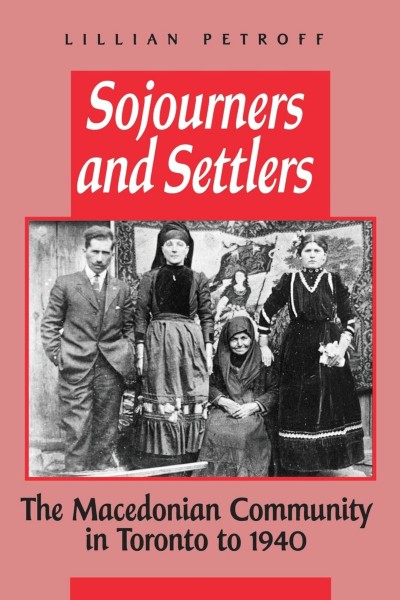
On June 7, 1992, the Canadian Macedonian Historical Society (CMHS) hosted a lecture featuring Lillian Petroff, who discussed her extensive research on the first history of Macedonian immigrants to Toronto from the turn of the century to the beginning of World War II. Drawing on interviews, letters, memoirs, the records of societies, and the observations of Anglo-Canadians, Petroff outlined the scope of her work that transformed raw archival data into a narrative of urban adaptation and identity. This landmark research would eventually be published in 1995 under the title "Sojourners and Settlers: The Macedonian Community in Toronto to 1940," and it remains a vital contribution to Canadian ethnic studies.
The "Sojourner" Phase (Gurbet)
The lecture explored the concept of gurbet—the tradition of men leaving their villages to work abroad temporarily. Petroff explained that most originally arrived as "sojourners," intending to earn enough money to buy land or pay off debts back home in the Ottoman Empire and later territories of Greece, Bulgaria, and Yugoslavia. However, the reality of history intervened; the instability of the Balkan Wars and World War I turned these temporary stays into permanent migrations, shifting the community’s focus toward a permanent future in Canada.
Economic Foundations: The "Macedonian Niche"
A major focus of Petroff's research was how these immigrants carved out a specific economic space in Toronto. Initially, men worked in high-risk environments like the Ontario Silver Foundry or Canada Packers. Petroff tracked the evolution from factory labor to small business ownership, specifically the restaurant and confectionery industry. By the 1930s, Macedonians were a dominant force in Toronto’s "greasy spoons" and corner cafes, a legacy that persisted for decades and defined the community's early economic success.
The Role of Mutual Benefit Societies
Because they were often viewed with suspicion by the Anglo-Canadian establishment, the community relied on internal structures for survival. Village-based societies, such as the Oshchima Benefit Society or Zhelevo Benevolent Brotherhood, provided essential insurance, burial costs, and social support. Petroff highlighted the founding of Saints Cyril and Methody Macedono-Bulgarian Orthodox Church in 1910 as the pivotal moment when the community transitioned from a collection of laborers into a settled urban neighborhood in areas like Cabbagetown and the East End.
The "Anglo-Canadian" Gaze
Petroff utilized records from Toronto social workers, public health nurses, and mission workers to show how the "Macedonian Colony" was perceived by the broader public. She noted the intense assimilation pressures where Anglo-Canadians often grouped Macedonians into the broad, sometimes derogatory category of "foreigners" or "Bulgarians," frequently ignoring their nuanced regional identities. Her research also highlighted the role of the Central Neighborhood House and other settlement houses in "Canadianizing" the second generation through direct intercultural contact.
Transition to "Settlers" and Methodology
The lecture concluded by examining the arrival of women and children through the "chain migration" process. Petroff used oral histories to describe the "boarding house" culture where Macedonian women acted as "house-mothers," cooking and cleaning for dozens of bachelors; this served as the community's primary social unit before traditional nuclear families became the norm. Petroff’s work is celebrated for its unique methodology, prioritizing over 100 interviews with original pioneers, community ephemera like wedding invitations and society minute books, and photographs documenting the visual transition from village dress to Toronto business suits.