



Macedonian National Experiences in Medicine Throughout the Centuries
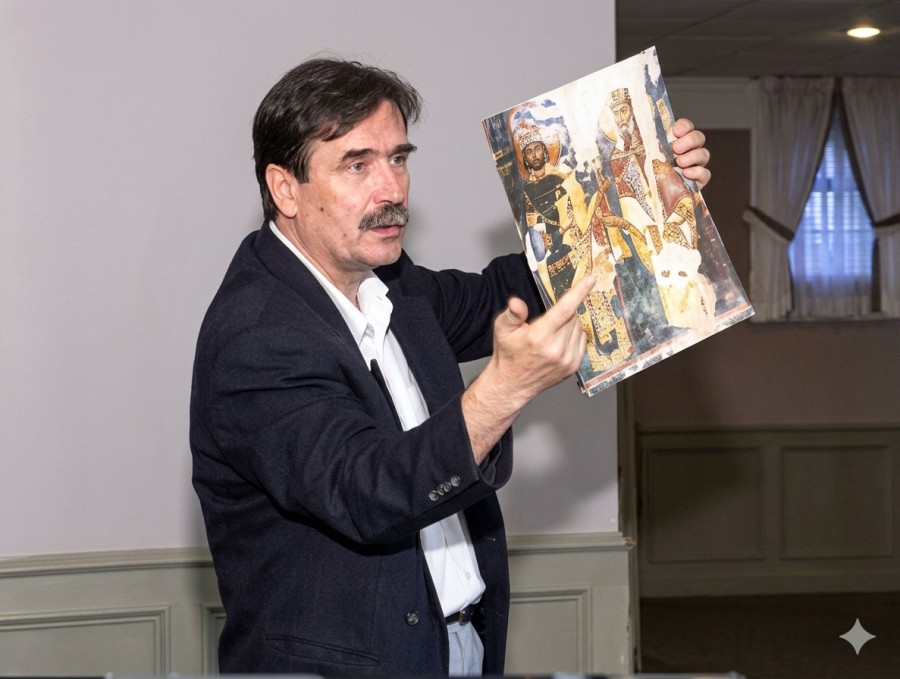
On June 27, 1996, the Canadian Macedonian Historical Society (CMHS) hosted a fascinating installment of its lecture series titled "Macedonian National Experiences in Medicine Throughout the Centuries," presented by Dr. Gradimir Zdravković and Professor Vladimir Vuksan.
1. Medieval Medical Advanced Knowledge (11th–13th Century)
This section of the lecture challenges the common historical narrative that medical science was dormant during the Middle Ages. Dr. Zdravković uses Macedonia's "stone archives"—its ecclesiastical frescoes—to prove a high level of clinical sophistication that predates Western European discoveries by centuries.
- Pharmacology and the "Dose": In the 11th-century frescoes of the Ohrid Archbishopric, figures are depicted with sophisticated medical kits containing various bottles and vials. Dr. Zdravković argues that the concept of Dosis (the precise measurement of medicine required to heal) was practiced in Macedonia 800 years before Paracelsus, the "father of toxicology." This suggests a systemic approach to pharmacology where herbs were measured scientifically rather than applied randomly.
- Visual Diagnostics and Quarantine: A fresco at the Lesnovo Monastery (14th century) serves as a rare medieval "medical chart." By accurately depicting the physical symptoms of Variola Vera (smallpox) on a father and son, it provided a visual diagnostic tool for the community. More importantly, the lecture highlights evidence of early quarantine practices—the separation of the contagious from the healthy—long before the famous maritime "Lazarettos" of Venice.
- The Scalpel and Surgical Discipline: The depiction of Saint Damian holding a scalpel in a 13th-century painting is highly significant. While much of Europe still relied on superstition and non-intervention, this iconography suggests that the Macedonian region recognized and practiced surgery as a specialized medical discipline.
2. Herbal Traditions and the "Macedonian Garden"
This section focuses on the "living history" of Macedonian medicine—the transition of knowledge from professional medical clergy to the everyday household.
- Cultural Identifiers through Botany: Dr. Zdravković posits that certain herbs are so deeply ingrained in the Macedonian lifestyle that they serve as cultural markers. He recounts an anecdote of meeting a man who claimed to be from elsewhere, but his intimate knowledge of how to cultivate and use Dill (Dram) revealed his Macedonian roots. In Macedonian folk medicine, these herbs were essential for digestion, respiratory health, and overall wellness.
- Analgesics in Iconography: The presence of the Opium Poppy (Aon) in the Kurbinovo Monastery (12th century) indicates that the clergy, who often served as the community's primary physicians, had a sophisticated understanding of pain management. They utilized these plants both for physical healing and as symbols of "divine sleep" or medical relief.
3. Alexander the Great and the "Herbal Road"
This section connects ancient Macedonian military prowess to early global trade and nutritional science.
- The Pre-Silk Road Trade: Professor Vuksan introduces the theory of the "Herbal Road." Research into ancient Chinese archives suggests that trade between the Far East and the Macedonian Empire began as early as the 4th Century BC. The primary commodity of this early route was not luxury silk, but medicinal herbs intended for health and performance.
- Physiology of the Phalanx: The Macedonian army was legendary for its speed and endurance. Vuksan suggests this was not merely a result of training, but a specific nutritional regimen. By analyzing ancient records of shipments containing honey, royal jelly, and specific cereal grains, the researchers reconstruct a "high-performance" diet that allowed soldiers to cover vast distances without the burden of heavy, slow-moving supply trains.
4. Modern Application: The "Alexander the Great" Health Line
The report concludes by bridging the gap between ancient history and modern clinical research conducted at the University of Toronto.
- Nutritional Synergy: Professor Vuksan explains that their research isn't just a historical reenactment; it is an investigation into nutritional synergy. By combining the 20+ herbs documented in Alexander’s era with modern understandings of carbohydrates and electrolytes, they created a prototype that boosts immunity and stamina.
- Clinical Testing and Branding: The lecture highlights that these ancient formulas have been subjected to modern clinical trials, specifically looking at energy levels and metabolic health. The proposed "Alexander the Great" healthy food line was envisioned as a way to honor Macedonian medical legacy by transforming historical data into a tangible, global health brand.