



"Let Me Tell You a Story...": CMHS Immigration Symposium and Book Re-Launch
On November 25, 2007, the Canadian Macedonian Historical Society (CMHS) hosted a landmark symposium entitled “Let Me Tell You a Story…” This event provided an intimate, "up close and personal" look at the Macedonian-Canadian experience, bridging the gap between academic history and lived reality. Moderated by the esteemed Dr. Lillian Petroff, the afternoon featured five speakers representing three distinct waves of immigration, alongside the official re-launch of Prof. Harry Herman’s seminal work, Men in White Aprons.
A Mandate of Diversity and Documentation
The Macedonian-Canadian community is defined by its layered history. While many early immigrants from the late 19th and early 20th centuries hailed from the Aegean region, subsequent decades saw arrivals driven by the wars, ethnic cleansings, and political upheavals of the 20th century. Today, the community continues to grow with newcomers from the Republic of Macedonia.
The CMHS exists to record these periods of transition. While Dr. Petroff’s 1995 book, Sojourners and Settlers, provided the definitive academic record up to 1940, this symposium aimed to capture the human element of more recent history.
Three Eras of the Macedonian Journey
1. The Pioneers (Turn of the 20th Century to 1945)
The symposium opened with stories of the earliest settlers:
-
Joanne Lynes: Offered a vital perspective on regional settlement. While many associate the diaspora with Toronto or Montreal, Joanne’s family settled in Welland, Ontario, proving that Macedonian grocery stores and restaurants were the lifeblood of small towns across Canada.
-
Katherine Kizoff Gill: Shared a remarkable family odyssey. Her paternal grandfather emigrated from Gabresh, Kostursko in 1905, traveling via Cuba before eventually making his way to Toronto—a testament to the circuitous and daring paths taken by early "pechalbari" (migrant workers).
2. The Post-War Wave (1945–1990)
This era saw the community establish deep economic roots:
-
Danny Maleganeas: Represented the 1950s generation. His parents arrived during this period and quickly established themselves as prominent Toronto restaurateurs, a hallmark of the Macedonian success story.
-
Niki Lazarova: Shared a harrowing and poignant journey. As a Begaltsi (refugee child from the Greek Civil War), Niki lived in several countries before finally finding a permanent home in Canada in the 1970s.
3. The Modern Era (1990–Present Day)
-
Dr. Katerina Belazelkoska: Provided insight into the contemporary diaspora. Prompted by safety concerns in the Republic of Macedonia in 2001, she completed graduate studies in the U.S. before choosing Canada for its opportunities and established community support.
The "Men in White Aprons" Re-Launch
A highlight of the event was the reprint and re-launch of Prof. Harry Herman’s Men in White Aprons. This project, spearheaded by Alex Nitsis, was made possible through the major sponsorship of the Macedonian Canadian Restaurant Coop.
The new edition includes expanded material and rare photographs of early Macedonian-owned establishments. During her moderation, Dr. Petroff shared poignant oral testimonies from her research, including the harsh realities faced by Macedonian workers in Greek-owned restaurants, where ethnic tensions often led to exploitation. These stories underscored why owning their own businesses became a matter of both economic survival and cultural dignity for Macedonians.
Preserving the Legacy
The symposium concluded with a communal gathering over Macedonian tea (planinski čaj) and cookies, as attendees had their books signed by Prof. Herman.
The CMHS emphasized that these stories are fragile; without a dedicated place to reside, family photos are often lost and traditional costumes undervalued by younger generations. By documenting these five unique perspectives, the Society reaffirmed its commitment to ensuring that the community "stands on the shoulders" of those who came before.
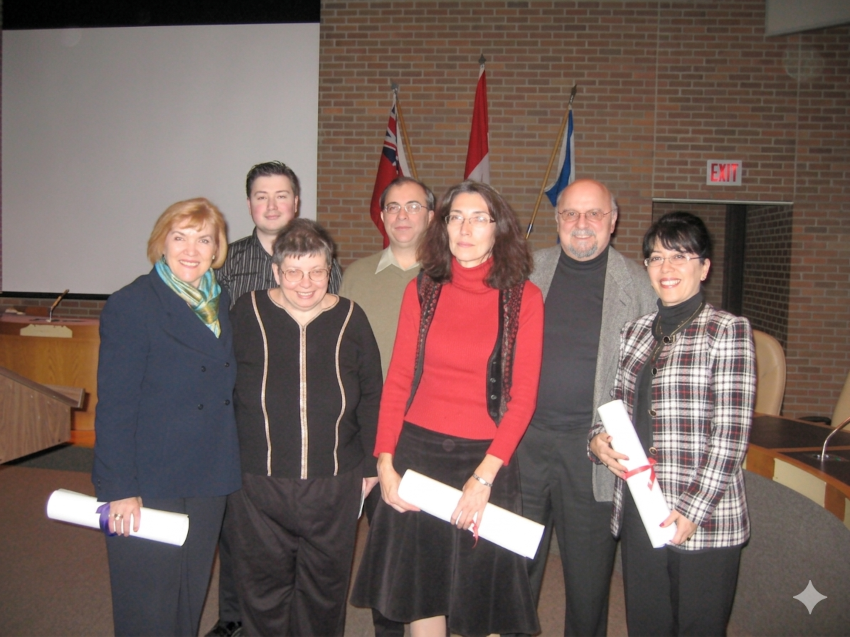
Symposium Participants (L-R): Niki Lazarova, John Thomas (CMHS President), Dr. Lillian Petroff, Danny Maleganeas, Joanne Lynes, Prof. Harry Herman, and Dr. Katerina Belazelkoska.