


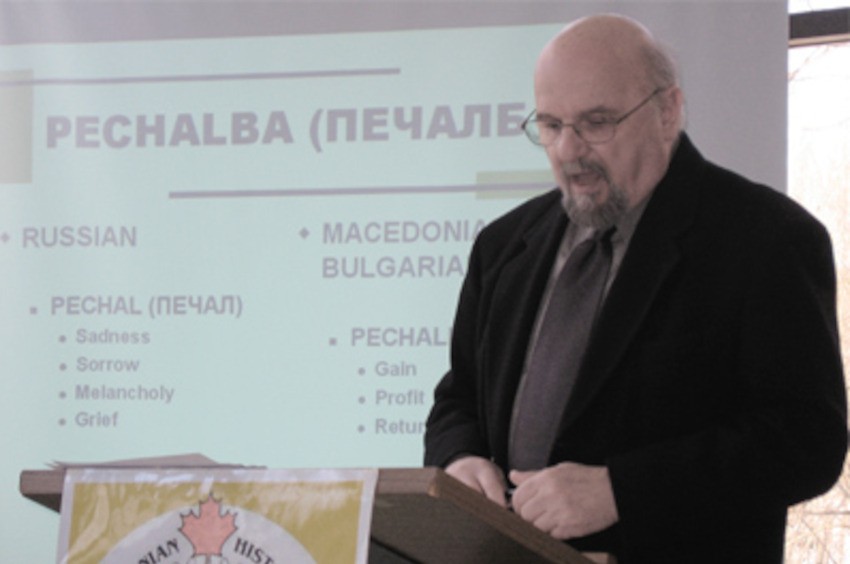


Lecture by Harry Vjekoslav Herman MEN IN WHITE APRONS
Men in White Aprons: A Study of Ethnicity and Occupation – Macedonian Restaurant Owners in Toronto
Sunday, February 26, 2006
The concentration of particular occupations within specific ethnic communities has long been a subject of anthropological and sociological study. This phenomenon—often referred to as occupational clustering or ethnic niche economies—reveals how immigrant communities adapt to new social and economic realities while preserving networks of kinship and mutual support. In this illuminating lecture, Professor Harry Vjekoslav Herman revisited his groundbreaking 1978 ethnographic study, Men in White Aprons: A Study of Ethnicity and Occupation, which examined the remarkable prominence of Macedonian immigrants in Toronto’s restaurant industry. The book was originally developed from his Master’s dissertation and later published as part of a broader study of immigrant occupational specialization in Canada.
Professor Herman detailed the methodology behind his research, which included extensive interviews, participant observation, and archival work within Toronto’s Macedonian community. He acknowledged the invaluable support and openness of many Macedonian Torontonians, including community members such as Zorka Basil, whose firsthand experiences contributed significantly to documenting this social history.

Professor Harry Vjekoslav Herman
At the heart of Herman’s research was an attempt to understand why Macedonian immigrants became so heavily concentrated in the restaurant trade. He explored how this occupational specialization emerged from earlier migration traditions rooted in the Balkan institution of pečalba—temporary labor migration undertaken by men who left their villages to earn money abroad and support their families back home. This longstanding tradition of labour mobility helped prepare many Macedonian migrants for the economic uncertainties of immigration and shaped their adaptability in Canada. The concept of pečalba forms a central historical theme in Herman’s study.
The lecture also traced the broader political, economic, and social conditions that drove Macedonian emigration in the late 19th and early 20th centuries, including Ottoman decline, the Balkan Wars, political fragmentation of Macedonia, economic hardship, and later postwar migration patterns from Yugoslav and Greek Macedonia. Upon arriving in Canada, many Macedonian immigrants faced language barriers, limited formal education, and labour market discrimination. The restaurant industry, however, offered an accessible path to economic mobility because it required relatively little formal accreditation and relied heavily on trust-based kinship networks.
Professor Herman explained how many newcomers began in entry-level positions—washing dishes, bussing tables, or working as cooks—before gradually advancing to ownership through partnerships with relatives and fellow villagers. These kinship-based business structures created powerful support systems that enabled later arrivals to secure employment, housing, and community integration. By the 1970s, Macedonian-owned restaurants had become a visible and influential part of Toronto’s urban landscape, contributing significantly to the city’s food culture and small business economy.

Men in White Aprons Lecture
An important aspect of the lecture focused on the social consequences of this occupational concentration. Herman discussed both the opportunities and limitations it created: while restaurant ownership offered economic independence and upward mobility, it also demanded long hours, family labour, and often limited broader social integration. He also examined how the second generation—the children of these immigrants—frequently pursued higher education and professional careers, marking a transition away from the restaurant trade and illustrating classic patterns of immigrant social mobility.
The lecture concluded with a lively discussion on ethnicity, identity, and integration. Questions explored how Macedonian immigrants maintained cultural identity while adapting to Canadian society, and how economic participation through entrepreneurship became a major vehicle for community stability and recognition within multicultural Canada.

Zorka Basil asks a Question as Virginia Stoymenoff Listens Attentively
Following the presentation, John Thomas, president of the society, presented Professor Herman with an honorarium and expressed gratitude to all those who attended and contributed to the event.
In recognition of the lasting historical and cultural importance of Herman’s work, the society republished Men in White Aprons: A Study of Ethnicity and Occupation on Sunday, November 25, with generous support from the Canadian Macedonian Restaurant Co-Op. Special thanks were extended to Angelo Argiro for financing the republication project, ensuring that this important record of Macedonian immigrant history in Toronto remains available to future generations.
Herman’s work remains one of the most important studies documenting the intersection of migration, ethnicity, labour, and entrepreneurship within the Macedonian Canadian experience, preserving a vital chapter in the history of both Toronto and the wider Macedonian diaspora.