


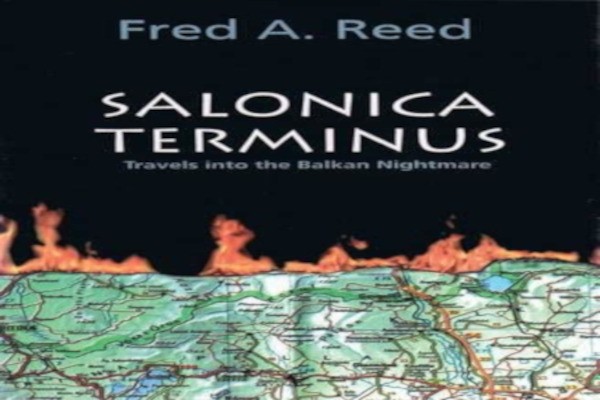


Fred A. Reed and his book, Salonica Terminus, Journey into the Balkan Nightmare
Fred A. Reed and Salonica Terminus: Journey into the Balkan Nightmare


Organized by the Canadian Macedonian Historical Society as part of its historical lecture series, this lecture featuring Fred A. Reed on his book Salonica Terminus: Travels into the Balkan Nightmare offers a penetrating exploration into the historical, political, and human realities of the Balkan wars and the collapse of Yugoslavia, using Thessaloniki (historically Salonica) as both an entry point and symbolic endpoint into one of Europe’s most fractured regions. The lecture, preserved in the CMHS archival YouTube series, reflects Reed’s unique position as both journalist and traveler, allowing him to move beyond conventional historical narration and instead reconstruct the Balkan tragedy through lived experience, political analysis, and historical excavation.
Introduction
Fred A. Reed approaches the Balkans not merely as a historian but as a witness to a region repeatedly broken and remade by empires, wars, and nationalist reinvention. In this lecture, he introduces Salonica Terminus as more than a travel book—it is an attempt to understand why the Balkans, particularly in the late twentieth century, descended into extraordinary violence after decades of relative Yugoslav stability. Reed immediately challenges the dominant Western narrative that the Balkan wars were the result of “ancient ethnic hatreds,” arguing instead that this explanation is intellectually lazy and politically convenient. His central argument is that the violence was modern, constructed, and heavily influenced by economic collapse, political opportunism, and international intervention.
The Canadian Macedonian Historical Society’s decision to host this lecture is especially significant because Reed’s work touches directly on Macedonia’s historical and geopolitical position within the Balkan puzzle.
The Central Thesis: Beyond “Ancient Hatreds”
At the heart of Reed’s lecture is the argument that the Balkans were misunderstood by the West. He strongly rejects the popular idea that Serbs, Croats, Bosniaks, Macedonians, Albanians, and others were destined to fight because of centuries-old tribal animosities. Reed explains that such narratives ignore long periods of coexistence and cooperation and instead turn history into destiny. He insists that the Balkan nightmare was not inevitable; it was manufactured by political elites who weaponized identity for power.
This is perhaps Reed’s most important contribution. He reframes the Yugoslav wars not as the awakening of buried hatreds, but as the collapse of a modern political structure under immense economic and geopolitical pressure. This perspective forces listeners to reconsider who benefited from Yugoslavia’s disintegration and why.
Historical Foundations of the Balkan Crisis
The Ottoman Legacy
Reed spends considerable time explaining the Ottoman inheritance in the Balkans because he sees it as foundational to understanding modern Balkan complexity. Under Ottoman rule, the Balkans functioned as a mosaic of communities organized less by nationality and more by religious and communal identity. Orthodox Christians, Muslims, Jews, and various linguistic groups coexisted within a system that, while hierarchical, allowed for layered identities.
This matters because modern nationalism imposed rigid definitions onto societies that historically lived with ambiguity. Reed argues that much of the violence in the twentieth century came from trying to force clear national boundaries onto populations that had never lived according to such strict lines. Macedonia, in particular, embodies this complexity. Its people historically existed at the intersection of multiple imperial and national claims.
The Balkan Wars and Territorial Division
Reed places great emphasis on the Balkan Wars of 1912–1913 as the beginning of the modern Balkan disorder. These wars marked the retreat of Ottoman power and the aggressive expansion of neighboring nation-states into Ottoman territories. Macedonia became one of the most contested prizes.
Reed explains how the partition of Macedonia among Serbia, Greece, and Bulgaria fundamentally shaped the region’s future. The division created displaced populations, competing national narratives, and deep historical grievances that continued into the twentieth century. Rather than solving the “Macedonian question,” partition intensified it.
For Reed, the Balkan Wars were not merely military conflicts; they were the beginning of modern identity engineering in the region.
Yugoslavia: A Fragile Multinational Experiment
Tito’s Political Balancing Act
Reed speaks of Josip Broz Tito with a certain historical respect, not because Tito created a perfect state, but because he managed to maintain balance among competing national groups. Tito understood that Yugoslavia could only survive through federal compromise and suppression of extreme nationalism.
Under Tito’s leadership, Yugoslavia became a rare example of a functioning multinational federation in the Balkans. Regional identities remained, but they were politically contained. Reed argues that Tito’s greatest achievement was not ideological socialism, but political equilibrium.
When Tito died in 1980, that equilibrium collapsed because no institution or leader could replace his authority.
Economic Breakdown and Social Fracture
One of Reed’s strongest analytical points is his insistence on economics as a driver of war. He explains how Yugoslavia’s debt crisis in the 1980s, combined with IMF austerity programs, created severe economic inequality across the republics. Wealthier republics like Slovenia and Croatia increasingly resented subsidizing poorer regions, while poorer republics faced rising unemployment and despair.
Economic crisis created fertile conditions for nationalist leaders. Reed shows how politicians redirected economic frustration into ethnic resentment. Instead of blaming structural economic collapse, populations were encouraged to blame neighboring ethnic groups.
This economic reading makes Reed’s work particularly sophisticated because it shifts attention from identity alone to material conditions.
Media and Mythmaking
Reed devotes substantial criticism to Western journalism and how it framed the Yugoslav wars. He argues that international media simplified the conflict into digestible moral categories, often depicting the Balkans as inherently violent and irrational. Terms like “tribal warfare” and “ancient hatred” dominated headlines.
According to Reed, this framing dehistoricized the conflict. It erased the economic causes, the political manipulations, and the role of foreign recognition policies. Media narratives, he argues, became part of the conflict itself by shaping international opinion and policy.
This section of the lecture is especially powerful because Reed speaks as a journalist criticizing his own profession.
Bosnia and the Failure of International Diplomacy
In discussing Bosnia, Reed portrays the war as the most tragic and internationally visible consequence of Yugoslavia’s collapse. He explains that Bosnia’s multiethnic character made it especially vulnerable when nationalist politics intensified. Unlike other republics, Bosnia’s population was deeply interwoven.
Reed argues that international recognition of Bosnia as an independent state occurred without adequate mechanisms for protecting it. This political recognition, without strategic preparation, accelerated conflict.
He also critiques international intervention as inconsistent and selective. Humanitarian rhetoric often masked geopolitical calculations. Bosnia became a symbol of the international community’s inability to prevent mass violence even when it was visible to the entire world.
Macedonia: The Quiet Front in a Violent Region
One of the most important parts of Reed’s lecture for CMHS audiences is his treatment of Macedonia. Reed notes that Macedonia avoided the scale of violence seen in Bosnia and Croatia, but this relative peace should not be mistaken for stability. Macedonia remained under intense pressure from neighboring states and internal ethnic tensions.
He discusses the naming dispute with Greece as more than diplomatic disagreement—it was, in Reed’s analysis, a struggle over history, identity, and legitimacy. The Macedonian question remained unresolved because surrounding states continued to contest Macedonian historical and national claims.
For Reed, Macedonia represents the unfinished business of Balkan history.
Salonica as Symbolic Geography
Why Salonica? Reed explains that Thessaloniki (Salonica) represents the Balkans in miniature. Historically, it was one of the most cosmopolitan cities in Europe—Ottoman, Jewish, Greek, Slavic, and international all at once. It embodied coexistence and pluralism.
But the twentieth century transformed it. Population exchanges, war, nationalism, and homogenization erased much of its plural character.
The railway station—the “terminus”—becomes Reed’s symbol for the end of one Balkan world and the beginning of another. It is the place where empires ended, nations began, and identities hardened.
This metaphor gives the book and lecture their emotional force.
Reed’s Method: Travel, Memory, and Political Inquiry
What distinguishes Reed’s work is his interdisciplinary method. He travels through the places he writes about, speaks with ordinary people, and reconstructs history through geography. This makes his analysis more intimate than conventional political history.
His travel narrative allows readers to encounter the Balkans physically—roads, borders, ruined towns, railway stations, conversations. Geography becomes history.
At the same time, Reed combines this with rigorous political critique. He constantly asks who benefits from conflict, who writes history, and who controls memory.
Major Themes of the Lecture
History is Active, Not Dead
Reed repeatedly emphasizes that history in the Balkans is not simply remembered; it is politically activated. Historical events are used as weapons in modern political battles.
Identity is Political Construction
National identity in the Balkans is often presented as ancient and fixed, but Reed demonstrates that identity is fluid and historically contingent.
Economics Shapes Conflict
War is never just about culture. Economic inequality and collapse create conditions for political extremism.
International Powers Matter
Foreign governments and international institutions were not neutral observers. Their decisions shaped outcomes.
Importance for Macedonian Historical Studies
For Macedonian audiences, Reed’s work is particularly important because it situates Macedonia within broader Balkan processes instead of treating it as isolated. He shows how Macedonia’s contested identity is part of larger regional patterns of partition, nationalism, and historical appropriation.
For organizations like the Canadian Macedonian Historical Society, preserving and discussing these histories is essential because diaspora communities often carry historical memory across generations.
CMHS serves as an important space where these questions remain alive.
Critical Assessment
The strength of Reed’s lecture lies in its complexity. He refuses simplistic explanations and instead presents the Balkans as a deeply layered historical landscape shaped by empire, economics, nationalism, and foreign intervention. His firsthand travel gives his work authenticity, while his political analysis gives it depth.
Some critics might argue that Reed places too much emphasis on international structures and economic systems at the expense of local agency. But even this criticism acknowledges the richness of his framework.
His work remains valuable precisely because it complicates easy narratives.
Conclusion
Fred A. Reed’s lecture for the Canadian Macedonian Historical Society on Salonica Terminus is an extraordinary intellectual intervention into how Balkan history is remembered and understood. By dismantling the myth of inevitable ethnic violence, Reed restores history, politics, economics, and human agency to the story of Yugoslavia’s collapse. His use of Salonica as both literal place and symbolic endpoint captures the tragedy of the Balkans—a region where coexistence gave way to division, and where the past remains an active force in the present.
For students of Balkan history, Macedonian identity, and the politics of memory, Reed’s lecture remains essential listening.