

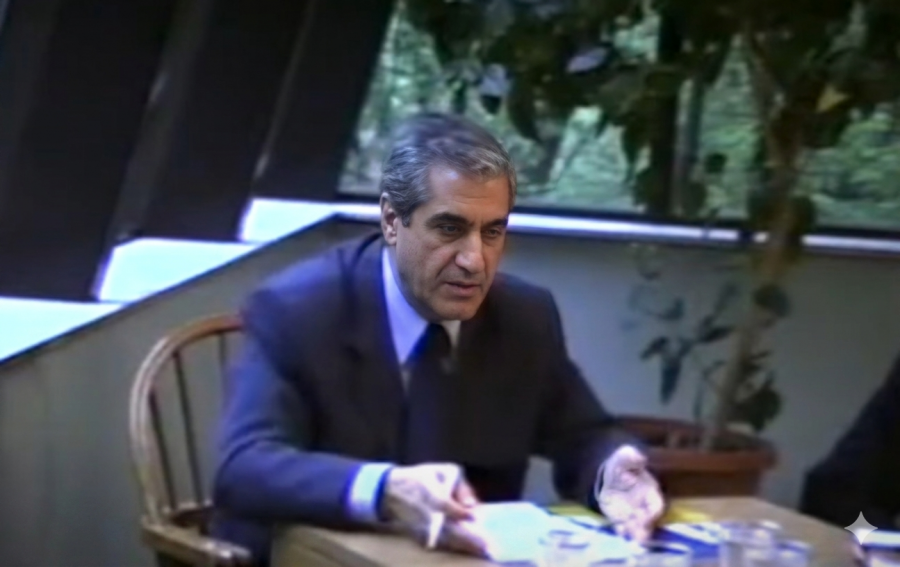


Ethnic Culture of the population of Macedonia by Aleksandar Stoimilov
The lecture delivered on May 3, 2001, was not merely a historical retrospective but a "situation report" delivered at the height of the 2001 insurgency in Macedonia. Professor Stoimilov, speaking from his authority as a geographer and senior academic at the University of Ss. Cyril and Methodius, sought to bridge the gap between the academic world in Skopje and the diaspora in Toronto. His primary objective was to provide a scientific basis for Macedonian statehood at a time when the country’s internal security and international identity were under extreme duress. The summary of his address highlights a transition from traditional history to "applied geography," where the mapping of people and ethnicity becomes a tool for national survival.
Expanded Political and Geopolitical Context
Stoimilov’s expansion on the "Balkan neighbors" was rooted in the concept of negationism. He argued that Macedonia is unique in Europe because it faces three distinct types of denial from its neighbors.
The Territorial Denial (Serbia): He explained that the Serbian view of "Old Serbia" was a 19th-century imperial hangover that hindered the demarcation of modern borders until the very year of his lecture (2001).
The Identity Denial (Bulgaria): Stoimilov went into detail about the "Linguistic Dispute," explaining that by Bulgaria recognizing the state but not the language, they were effectively treating Macedonia as a "second Bulgarian state," which he argued undermines the sovereign distinctiveness of the Macedonian people.
The Name and Heritage Denial (Greece): He characterized the Greek position as an attempt to monopolize the historical "brand" of Macedonia. This, he argued, created a diplomatic blockade that prevented the Republic from integrating into European structures, thereby weakening its internal ethnic cohesion.
Comprehensive Breakdown of Population Classification
The most academic portion of Stoimilov’s lecture was his rigorous categorization of the population, which he argued is the only way to maintain a functional state.
The Nation (Constitutional Subject): He posits that the Macedonian people are the "owners" of the state identity. Without this central pillar, he argued, Macedonia would cease to be a sovereign entity and become a "territory" managed by others.
National Minorities: He defined these as groups that are legally and culturally protected but have a primary "political center" in a neighboring state (e.g., Tirana for Albanians, Belgrade for Serbs). He argued that the rights of these minorities must be respected, but they cannot supersede the "state-building" status of the majority nation.
Ethnic Groups (The Stateless): By highlighting the Roma and other groups, Stoimilov illustrated a "pure" form of cultural identity that is not tied to a competing geopolitical project, contrasting them with national minorities whose political loyalties can sometimes be pulled toward neighboring mother-states.
In-Depth Demographic and Statistical Overview
Stoimilov used the contrast between Republic Macedonia (25,713 $km^2$) and Geographic Macedonia (68,000 $km^2$) to explain the "Macedonian Syndrome"—the feeling of being a fragmented people.
The Urban-Rural Divide: He presented a grim view of "demographic desertification." As the Macedonian youth moved to Skopje or emigrated to Australia and Canada, the vital "biological fabric" of the borderlands began to tear.
The "Tapia" System: He invoked the Ottoman-era concept of the Tapia (land deed). In Stoimilov’s geographic view, a land without a resident population eventually loses its political character. He warned that "census wars" are fought not just with pens, but with physical presence in the villages. If the Macedonian population retreats from the mountains and borders, the state’s effective sovereignty shrinks to the city limits of Skopje.
The Diaspora’s Role: Strategic Investment and Preservation
The final expansion of the lecture focused on the "Active Diaspora." Stoimilov argued that the Macedonian community in Canada should not just be a "museum of culture," but a "strategic reserve" for the homeland.
Counter-Migration Strategies: He suggested that the diaspora should buy homes and land in areas where the Macedonian population is thinning. This is not for personal profit, but to act as a "demographic anchor."
Political Lobbying: He emphasized that the diaspora has the freedom to speak and lobby in Western democracies in ways that the citizens of the Republic, constrained by fragile diplomacy, cannot.
Preserving the "Title": The closing sentiment was that the "Macedonian Question" will be decided by who owns the land and who lives on it. He challenged the audience to ensure that their children remain connected to the soil of Macedonia, even if they are born in the "leafy suburbs of Toronto."
Conclusion and Academic Legacy
The lecture concludes that Macedonia’s "Ethnic Culture" is not a static collection of folk songs and costumes, but a dynamic and vulnerable political reality. Stoimilov’s legacy, as presented in this report, is the insistence that geography is the foundation of history. For the Macedonian people to survive the "Nightmare" of the 21st century, they must master the statistics of their own population, defend the legitimacy of their language, and maintain a physical presence across the entirety of their geographic landscape.