

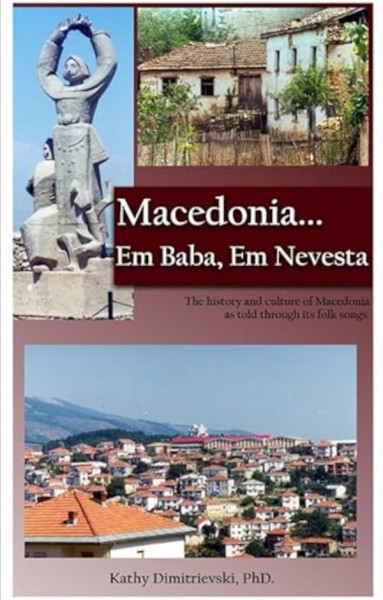


Em Baba, Em Nevesta aLecture by Dr. Kathy Dimitrievski
On Sunday, October 16, 2005, the Canadian Macedonian Historical Society launched its seasonal lecture series with a deeply resonant presentation by Dr. Kathy Dimitrievski. Titled after her seminal work, "Macedonia... Em Baba, Em Nevesta" (Macedonia... Both Grandmother and Bride), the lecture provided a unique scholarly yet soulful exploration of the Macedonian identity. Dr. Dimitrievski’s work is celebrated for its multidisciplinary approach, blending ethnomusicology with oral history to prove that for a people often denied formal education and political sovereignty, music was the primary vessel for historical truth.
The Scholar and Her Inspiration
Dr. Dimitrievski’s path to becoming a foremost researcher in Macedonian folk music is a testament to the universal power of the culture. An American by birth, she was introduced to the tradition through her husband, Josif, who is of Macedonian descent. What began as a social engagement at community dances evolved into a profound academic passion. She found herself captivated not just by the complex 7/8 and 11/8 time signatures of the music, but by the raw emotional narratives embedded in the lyrics. This fascination led her to complete a doctoral dissertation that treated folk songs not merely as entertainment, but as primary historical documents that recorded the lineage of a nation.
The Scope of "Em Baba, Em Nevesta"
The book and lecture chronicled the Macedonian experience across several distinct geographic and temporal landscapes. Published in 2001, her research was exhaustive, drawing from:
-
Regional Perspectives: Oral histories from Macedonia (the Republic), Pirin (Bulgaria), Egej (Greece), and Mala Prespa (Albania).
-
The Diaspora: Insights from the vibrant Macedonian communities in the United States and Canada.
-
Modern Methodology: The integration of early internet surveys and testimonies, which was a pioneering approach in the late 1990s.
A crowning achievement of her research was the inclusion of interviews with the "titans" of Macedonian folk music. Attendees were treated to insights from legendary figures such as Aleksander Sarievski, Vaska Ilieva, and Petranka Kostandinova—all now deceased—as well as the celebrated Violeta Tomovska. These artists were more than performers; they were the guardians of the izvorni (authentic source) songs that preserved the collective memory of the people.
Songs as "Unwritten History"
The core of Dr. Dimitrievski’s lecture addressed a critical historical gap: because Macedonians lacked formal education in their own language until the mid-20th century due to various occupations and prohibitions, their history was rarely captured in state archives. She argued that the folk song became the "educational tool" of the masses.
-
Struggle and Sorrow: Songs documented the Ilinden uprising, the partitions of the Balkan Wars, and the pain of the Pečalba (migrant labor).
-
Joy and Tradition: Music preserved the rituals of weddings, harvests, and village life.
By analyzing these lyrics, Dr. Dimitrievski showed how the Macedonian people maintained a consistent cultural thread from ancient times through the modern era, despite external pressures to assimilate.
An Immersive Community Experience
The event at the Historical Society transcended a typical academic lecture through its multisensory format. After the presentation, guests gathered over Planinski Čaj (Macedonian mountain tea), a staple of village hospitality, creating an atmosphere of "Muabet" (communal conversation). The highlight for many was the screening of videotaped interviews. Seeing both elderly survivors and young children sing the same traditional songs provided "living proof" of the generational continuity Dr. Dimitrievski described.
The lecture also served as a call to action for the preservation of local history. The Canadian Macedonian Historical Society utilized the event to remind the public of its own extensive Oral History Project, which houses over 50 tapes containing hundreds of hours of interviews. These archives, open to the public on Sunday afternoons, continue to serve as a vital resource for those looking to explore the personal stories of the Macedonian-Canadian pioneers who brought these songs and traditions to their new home.
