



Detsa Begaltci at the Fairview Library Theatre
Detailed Report: The Plight of the Macedonian Refugee Children (1948)
On October 4, 1992, the Canadian Macedonian Heritage Society (CMHS) convened a historic session at the Fairview Library Theatre. This event was dedicated to documenting the oral histories of the Begalci—the approximately 30,000 children evacuated from Aegean Macedonia during the Greek Civil War. The lecture provided an exhaustive look at the systemic persecution of the Macedonian people and the lifelong trauma of displacement.
The Historical Erasure of Macedonian Identity
Speaker: George Plukovski
George Bukovski provided a dense historical framework, asserting that the evacuation of 1948 was the final result of a decades-long campaign of ethnic cleansing. He traced the roots back to the 1913 Treaty of Bucharest, which he described as the "partition of the living body of the Macedonian nation," and the 1919 Paris Peace Treaty, where the League of Nations ignored the Macedonian plea for independence in favor of regional powers.
Bukovski’s message focused heavily on the dictatorship of General Metaxas (1936). He detailed how the Greek state attempted to erase the Macedonian language from existence, implementing laws that forbade it even in the privacy of one's home. He shared a poignant anecdote of an 80-year-old man on his deathbed who could not ask for God’s forgiveness because the priest did not speak Macedonian and the man did not speak Greek. He also described the absurdity of "language police" who arrested farmers for giving commands to their donkeys in Macedonian. By 1948, Bukovski argued, the Macedonians joined the Greek Civil War not for communist ideology, but as a desperate final stand for physical and cultural survival.
The Anatomy of the Exodus: Chaos and Separation
Speaker: Mary Rossova
Mary Roseova’s testimony moved the audience by detailing the harrowing mechanics of the flight. She challenged the misconception that the evacuation was a forced "kidnapping," clarifying that for the vast majority of families, it was a heartbreaking voluntary decision made to save children from the napalm and fragmentation bombs being dropped by the Greek government forces.
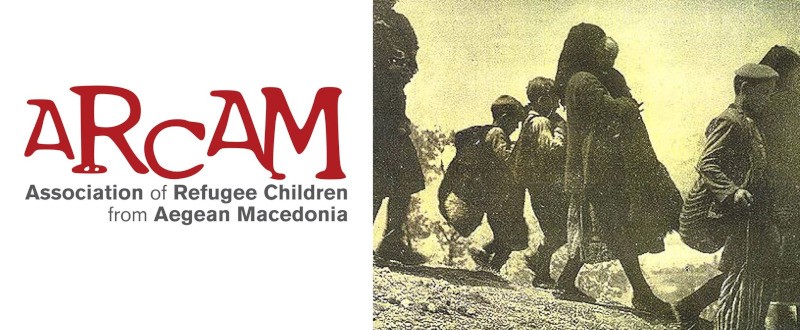
She described the "dark night" of March 1948, where children aged 2 to 15 were gathered in village squares. They carried small "torbi" (bags) filled with whatever food their mothers could scrape together—pogacha, chicken, or cheese. Rossova detailed the psychological trauma of the "last goodbye," where grandmothers and mothers squeezed their children one final time, often never to see them again. She recounted the journey through the frozen mountain passes, where older children carried the toddlers on their backs, and the group hid in bushes during the day to avoid detection by circling aircraft. A key point of her message was the accidental separation of families; as children reached the borders, they were processed into different groups and sent to different nations (Poland, Hungary, Romania, etc.), causing siblings to lose contact for decades.
Survival and the "Big Brother" in Exile
Speaker: Chris Karafilov
Chris Carilo expanded on the lives of these children once they reached the Eastern Bloc. He painted a picture of a "lost generation" that showed immense resilience. He noted that while countries like Czechoslovakia were rebuilding from the ruins of WWII, they shared their meager resources to provide the refugees with medical care for tuberculosis, malnutrition, and the mental scars of war.
Karafilov’s most critical message concerned the political pressure within the host countries. He explained that while the children finally gained the right to an education, they were still under the thumb of the Greek Communist Party (KKE). The KKE attempted to maintain the children as "political soldiers," censoring their mail and insisting they use Greek versions of their names. In a shocking detail, he recounted how 1,200 of the older refugee children (ages 14-15) were mobilized and sent back to the front lines of the civil war in 1949, where many were killed or captured. His message was one of academic triumph—thousands of refugees eventually became doctors, engineers, and teachers—but it was a success achieved despite being treated as "Slavophone robots" by political actors.
The Modern Struggle for Human Rights and Repatriation
Speaker: Risto Cackirovski
Risto Speaker: Risto Cackirovski, a key founder of the Refugee Association, delivered a powerful message regarding the ongoing legal status of the Begalci. He addressed the audience as a representative of the 1992 reality, where Greece continued to categorize these former refugees as "Security Risks" and "Personas Non Grata."
Cackirovskii detailed the discriminatory laws (such as Greek Law 154) which stipulated that only those who declare themselves "Greek by birth" can return to reclaim their ancestral properties. He shared his own experience of being turned away at the Greek border despite carrying a Canadian passport. His core message was that the 1988 World Reunion in Skopje was a turning point that transformed a group of traumatized refugees into a global human rights movement. He argued that the "Name Issue" and the Greek blockade of the newly independent Republic of Macedonia were modern extensions of the same 1948 policy: the total denial of Macedonian existence. His conclusion was a firm demand: there can be no peace in the Balkans until the refugees are granted their basic human right to return home.