


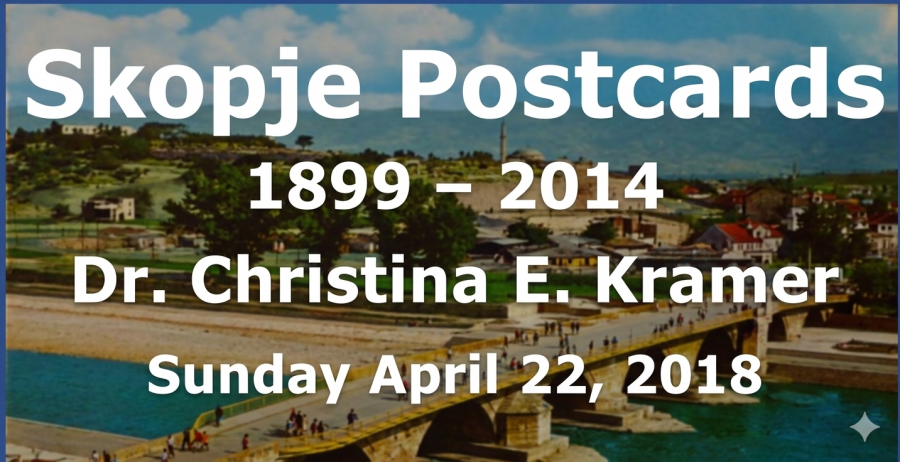


Archives of the Mobile Lanscape: Skopje Postcards, 1899-2014by Prof. Christina Kramer
On Sunday, April 22, 2018, the Canadian Macedonian Historical Society (CMHS) hosted its Annual General Meeting. Following the official proceedings, members were treated to a captivating presentation by Dr. Christina Kramer, Professor Emeritus of Slavic and Balkan Languages at the University of Toronto.


Skopje Postcards: 1899–2014
Professor Kramer’s lecture offered an exclusive preview of her forthcoming book (under contract with McGill-Queen’s University Press), which explores the evolving cityscape of Skopje through the lens of the postcard. Her research demonstrates how the narrow frame of a postcard provides a profound interpretation of urban life across shifting regimes and centuries of upheaval.
Rather than simple souvenirs, these postcards serve as both visual and written archives of a century defined by war, occupation, independence, and the devastating earthquake of 1963. Professor Kramer focused her analysis on four iconic sites that form the city’s historic and social backbone:
- The Kale Fortress: The ancient sentinel overlooking the Vardar.
- The Stone Bridge: The physical and symbolic link between the city’s Ottoman past and its modern development.
- The Central Square: A stage for political theatre and public life.
- The Old Bazaar (Stara Čaršija): The enduring heart of commerce and tradition.
:

A Century of Rebranding
The presentation highlighted how these sites have been renamed, reframed, and recast to fit various national narratives. For example, the central square—the city's literal epicenter—has seen its identity fluctuate with the tides of history. It has been known successively as Kaiser Wilhelm Square, King Peter’s Square, Marshal Tito Square, and finally, Macedonia Square.
Professor Kramer showcased a rare card from the early 20th century produced by Max Fruchtermann, a legendary postcard publisher during the Ottoman Empire, illustrating the square’s early layout. The ideological shifts were even more visible in the history of the bank building on the square's east corner. Postcards from the early 1940s show the building sporting a swastika during the Bulgarian occupation; by the 1950s, the same facade bore the hammer and sickle of the Yugoslav era. Though the building was bombed in WWII and finally lost to the 1963 earthquake, the current Makedonski Telekom building stands as a modern architectural homage to its predecessor.

Voices from the Past
Beyond the architecture, the presentation delved into the "human" history found on the back of the cards. The changing languages—from Ottoman Turkish and French to Serbian and Macedonian—and the messages written by French soldiers in 1918, young Yugoslav conscripts in the 1970s, and international travelers, provide a polyphonic account of a city in flux.
Through these "frames," we gain a deeper understanding of a city that has survived remarkable cycles of man-made and natural destruction, proving its resilience through constant rebuilding and reimagining.

The new Mac Telecom building that sits on the site can now be seen as
paying homage to the history of the building that stood there before:

The changing languages on the cards, the changing images, and the messages—written by

Kale Fortres

The Bridge

The Square

The Old Bazzar Market