Tagged “Human Rights”
Browse Tagged “Human Rights” from the Canadian Macedonian Heritage Society archive, library and community collections.
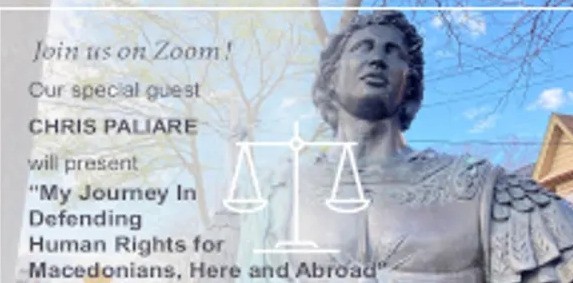
Chris Paliare Presents: “My Journey in Defending Human Rights for Macedonians, Here and Abroad”
The Canadian Macedonian Historical Society was pleased to host Chris Paliare for an engaging presentation, “My Journey in Defending Human Rights for Macedonians, Here and Abroad.” Paliare reflected on the early years of Macedonian human rights advocacy in Canada during the 1980s, when speaking publicly for Macedonian identity and rights was both rare and challenging. He shared his experiences working alongside Mary and Trian Dimitriou and international delegations to bring attention to the human rights struggles of Macedonians in Greece and Bulgaria, efforts that helped shape the formation of the Macedonian Human Rights Movement International in 1986. Through stories of advocacy at both grassroots demonstrations in Toronto and international forums in Helsinki, Warsaw, and Moscow, Paliare reminded attendees that meaningful change begins when individuals choose to stand up, speak out, and defend human rights for future generations.
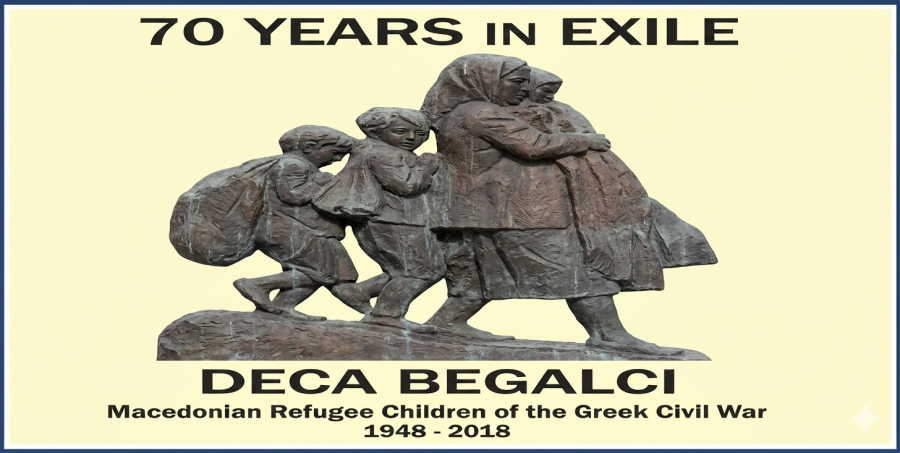
70 Years in Exile: Macedonian Child Refugees of the Greak Civil War
70 Years in Exile: Macedonian Child Refugees of the Greak Civil War On Saturday November 9th, 2019, the Canadian Macedonian Historical Society honoured the plight of the Macedonian Refugee Children of the Greek Civil War at the City of Toronto Arc...
Steve and Lilly Pliakes
Steve Pliakes or Stefo Plakov, as he prefers to introduce himself, is a Canadian Macedonian, or Macedonian Canadian whose origin is from the beautiful Macedonian village of Zeleniche, in the region of Lerin, from the Aegean part of Macedonia. He is well recognized among the Macedonians in Canada and in the United States.

Democracy & The Rule of Law in Macedonia
At a well-attended community lecture on April 6, Macedonian parliamentarian Pavle Sazdov provided a detailed overview of the political and electoral system in the Republic of Macedonia, focusing on the role of the diaspora in the democratic process. Speaking as the elected representative for Macedonians in North and South America, Sazdov explained voter registration requirements, the structure of parliament, the role of political parties, and the functions of the president and judiciary. He emphasized the opportunities available to Macedonians abroad to participate in elections through newly established consular offices, while noting that voter turnout among the diaspora remains low despite these efforts. The presentation also explored Macedonia’s multi-party political landscape, the historical development of its democratic institutions, and the challenges of engaging a globally dispersed population. Attendees welcomed the opportunity to ask questions and gain a better understanding of contemporary Macedonian politics, highlighting the importance of such educational events in strengthening connections between the diaspora and their ancestral homeland.