
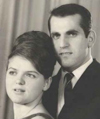
Steve Pliakes or Stefo Plakov, as he prefers to introduce himself, is a Canadian Macedonian, or Macedonian Canadian whose origin is from the beautiful Macedonian village of Zeleniche, in the region of Lerin, from the Aegean part of Macedonia. He is well recognized among the Macedonians in Canada and in the United States.
Businessman Steve Pliakes is a prominent Macedonian who has initiated, organized and fought for the affirmation and the defense of the Macedonian name, and its people. His spiritual connection and involvement with the Macedonian Orthodox Church as past president reminds him of the call to Apostle Paul to come to Macedonian and free it from Roman occupation.
This emotion and patriotism for his grandfather's country of Macedonia has motivated him to become a defender and promoter of the history and honor of the Macedonian people. Steve is particularly active in promoting democracy in Macedonia to protect the Macedonian name, flag, constitution and he is a promoter for the recognition of Macedonia as a sovereign, independent and self-governed state in the Balkans and around the world.
Steve Pliakes love for history has encouraged him to defend the continuous link between ancient and modern Macedonia. With his commitment to preserve the ancient Macedonian roots he has been a voice to the truth about Ancient Macedonia worldwide. Together with Professor Michael Dimitri, in 1995 Steve travelled to Pakistan visited the Kalesh people who are considered descendants of Alexander III of Macedonia (the Great).
His work and perennial creative engagement with a strong desire and appreciation within the Macedonian community in Canada, and also, now in Florida, are an example for others to follow. This commitment includes the organization of humanitarian activities for sponsoring research activities in the field of history, culture, spiritual living, sports, gatherings, picnics and other activities to promote the Macedonian cause in the Diaspora.
After the independence of the Republic of Macedonia, Mr. Pliakes was actively involved in the political scene, locally and at the international, fighting for the preservation and fostering of the national interests of Macedonians in Macedonia, in the Balkans and worldwide. He pays particular attention to the national and common progress and coexistence of all Macedonians, regardless of their political, religious, economic and other geographical perspectives. Therefore, he consistently says that we have only our Macedonia, which is the one and is irreplaceable for all Macedonians.
As the president of the "United Macedonians" in Toronto, one of the oldest Macedonian organizations in North America Steve mastered his political voice as defender of the Macedonian people of the North American diaspora. During his mandate as president he advocated for the expelled Macedonians from the (Greek occupied) Aegean part of Macedonia.
In addition, he was president and organizer of the Canadian-Macedonian Olympic Committee in Canada, who gave significant financial support to sponsor Canadian-Macedonian Athletes to compete with the Macedonian Olympians at the 2004 Olympics in Athens, and Beijing in 2008. Steve Pliakes was the man who carried the Macedonian flag in front of Macedonian athletes at both Olympics, which made him the happiest Macedonian in the world.
Among other activities in Canada, Steve became a member of the Masonic Lodge in Newmarket.
As a Mason, he became renowned as an advocate for human rights, and especially the rights of Macedonians in Canada, and the world. He continues to collaborate with Canadian authorities to promote the rights of Macedonians in Canada and foster a bridge between Canada and the Republic of Macedonia.
Steve Pliakes was born on June 2nd 1940 in the village of Zeleniche, in the region of Lerin, in the Aegean part of Macedonia. He witnessed the Macedonian partisan movement for freedom, at the same time, he was also a witness to the Greek fascist movement who’s policy was to erase the Macedonian people and identity from northern Greece. This began during Steve’s grandfather’s time during the Ottoman occupation before 1912 and after 1913, the start of Greek occupation and assimilation. Steve was witness to the Greek assimilation of Macedonians and this is what drove his father and family out of their homeland.
In Canada, Steve Pliakes and his wife Lilly were free of discrimination and oppression from the Greek state. Therefore, they have been committed to the democratic and multicultural Canadian society. This has given them the chance to be great benefactors and donors to many important national and cultural events in Canada and the United States where many Macedonians from all parts of Macedonia reside.
Steve Lilly’s love for their Macedonian compatriots worldwide includes donating funds for humanitarian purposes such as dialysis machines to the Republic of Macedonia. They have sponsored news media, portals, organizations, churches and other associations in their homeland and elsewhere in the world where Macedonians live.
They have also challenge other Macedonia business people to promote the Macedonian name.
Their contribution includes naming their shopping center "Macedonian Plaza" in Newmarket.
Therefore, it is right to say that Steve Pliakes is a true Macedonian who’s dedicated himself to our national cause. Guided by the love of Macedonia, its people and history.
Since the independence of the Republic of Macedonia in 1991, he’s been advocating for Macedonia in the Diaspora, particularly in Canada and the United States. He has actively involved himself in the political and economic scene locally. Internationally, he has been directly engaged in the preservation and fostering of business interests of Macedonians in Canada and worldwide.
Edited with permission from: Steve Pliakes Monograph by Slave Katin
Steve and Lilly
Part of Steve Pliakes’ Life
Steve Pliakes who comes from the Aegean part of Macedonia is a respected, appreciated and virtuous Macedonian. He is a recognized and proven lover of his homeland; an outstanding promoter of his Macedonian origin, his roots, name and Fatherland; a businessman and traveler of the world.
He is an extremely great, well known, easily recognized and unavoidable figure of the Macedonian Diaspora and in Macedonia. He is without doubt one of the most financially successful Macedonians in Canada. Although he’s been living long in Newmarket, Ontario, he is deeply and strongly linked with the destiny, the truth and the events in Macedonia since his arrival on the American continent up to now. Steve Pliakes is a Macedonian by nationality, a respected Canadian, one of the Macedonian masons on the north-American continent, but an Orthodox Christian by faith. Businessman Pliakes is a great defender of the Macedonian name and promoter of the history and honor of the Macedonian people and Macedonia throughout the world, especially in Canada.
Steve (Stevo) Pliakes (Plakov) was born on June 2, 1940 in the beautiful village of Zeleniche, region of Lerin in the Aegean part of Macedonia, his father Lambro and his mother Gena. This year he celebrates his seventh year of his birth, his 77th year of his turbulent life and successful career. Steve came into the world as a beloved baby, first male child whose parents were immensely happy. His sister Mary (Marika) was born before him, while his sister Toula and brother George were born after him. As a small child he was very lively, bright child that enchanted the people around him with his perceptions and points of view .
In beautiful Zeleniche, through the local wide fields and flowering meadows, through alleys and yards, along the river and on the hills around the village, Steve spent his first 12 years. In this village he spent his childhood days filled with games and fantasy, because instead of carelessness, joy and tranquility, those early years were times of anxieties and ordeals. First, during the Second World War, and then during the Greek Civil War, when the plight of the Macedonians that experienced some of the most tragic periods in their long and very rich
history took place. The various experienced developments and testimonies on the spot about the symptoms and struggling existence had left indelible marks, scars and memories on the fragile child's soul.
The family of Pliakes pressed by difficult economic conditions and faced with terrible political turbulence of the Macedonians in Aegean Macedonia, decided reluctantly to leave behind their century-old hearth and home. Forced parting with the homeland, leaving it forever, was a very difficult decision and an open road to unknown destinations on the North American continent.
Their choice was moving to the great country of Canada. As a boy who has just started in life, Steve together with his beloved ones – his mother, two sisters and the brother, left one early morning, on May 5, 1952, leaving behind his homeland. He turned back once again to look and say goodbye to his home and its blossoming garden, to whose flowers, trees and early fruits, each of them, he’d rejoiced so much and so often.
That morning a swarm of tears rolled down the face of a child who was leaving his home and who was heading into a different new world and among unknown people and remote regions. He hugged his friends with whom he’d played along the alleys, in the school yard and through the fields, who came to send his favorite peer in that early dawn. A sad scene of farewell, an unforgettable memory since he was to leave forever his centuries-old ancestral doorstep and treasured birth place. As the bus began leaving behind his birthplace, Steve looked back and saw his second cousin Karl Nitsis taking sheep up the mountain side. This was the last person he saw leaving Zelenic
The traveling family saga of the Pliakes began even in Zeleniche on their way to Athens, from where departed for Halifax, in distant Canada by boat through the Mediterranean waters and the great Atlantic Ocean. In the long days and nights while sailing on the blue expanses, Steve did go up on the deck many, many times and while staring at the endless wide open place so many thoughts passed through his mind as if in dream and reality.
Shortly after Halifax, their new destination was the city of Windsor, in the province of Ontario. A city that is an entrance door when from the US Michigan and car maker Detroit one arrives in Canada through underwater tunnel or across the bridge. At 30 km north of Windsor, in place Colester, his father Lambro had already had a farm of about 3 hectares of land, around 10 acres. In that place, Essex County various vegetables were planted, which even then were genuine eco food, so it is no coincidence that they were highly valued and constantly sought after.
Being friendly and good family people, the Pliakes acquired many friends and their family became highly appreciated and respected, especially among the Macedonians from Aegean Macedonia, living in many areas outside of Windsor. This family “went off the pattern” and brought innovative content, gatherings and events in their daily life routine.
Thus, in 1953 the family, together with other Macedonian families organized a picnic on their farm, which was an extraordinary act of the All-Macedonian friendship, understanding and unity. They did their best to make it an event to be remember, because all who attended left satisfied, wishing again to return to such good hosts.
As time went on, so increasingly as Steve matures the knowledge that this place, this business and other circumstances are not a dueling ground for the big plans he’s designed for his future. For several reasons, he ended his the farming business after six years spent in the Windsor region to continue a new search and looking for new emerging destinations.
Steve Pliakes and his family faced a new challenge. After various analyzes, thoughts and plans they made a family decision and in 1958 they completely left Windsor. They settled down in the big city of Toronto, which was a new beginning and a new challenge in Canada.
As an 18 old year industrious and very bright boy, Steve decided to start a garage business by himself just to start from somewhere. He was doing it very well and after a while he became a representative of the car giant "Ford" to sell their vehicles. Managers in this business recognized the talent, resourcefulness and ability of this young boy, Steve, and therefore he got such a working engagement that opened up his roads to the business.
However, as time went by so his visions and plans for a different tomorrow got more ambitious and greater because Steve had the capacity to create new values, to embark on a far more effective project. Toronto had many options and offered alluring opportunities but he, however, decided to look for happiness in the nearby towns of metropolitan Toronto.
Thus, in 1974 he packed his belongings and went to the town of Newmarket. That place has remained his longtime private and family wharf. And there is Steve today. Together with his faithful life companion with a big heart, a charming and serene Lilly Pliakes, еxactly in Newmarket they live for ages. Тhis is the place that’s elevated their business. Also, here is the oasis of their personal and family peace, where they really live happily and enjoy with the families of Margaret and Jeannie. At the same time, Newmarket is their first step for all their trips around the meridians worldwide.
With the funds from his first business in the automotive work, and as a dealer of services and car sales, Steve acquired a building plot across the road, where they built their family home. However, the restless soul of Steve still wasn’t calm. He searched for new businesses, other jobs, his own road and future. So, after a while he sold his automotive service center, leaving quite successful automotive work and entered into real estate business, where his life experience and knowledge of the English language came to light; needless to say that the sales of properties is especially lucrative business in Canada. At the same time, the financial assistance from the family of his wife was of great importance.
All his activation in several areas was an interesting mix. As a result, it all allowed him to be involved in politics that was already a significant step forward in his rich and very impressive biographical pages. Thus, in the 1987-88 election cycle Steve was elected in the department "Police Service" as a member of the federal party NDP (New Democratic Party).
As in every engagement until then, Steve did well and achieved great success in the long run. He is therefore a respected member and activist in Newmarket where he was elected, but also beyond receiving many compliments, recognition and satisfaction for the commitments on political plan.
But still, his first and main occupation was business. Along with Lilly he opened the Lilcris Industries Limited in Newmarket, together with Jim, a Macedonian from the village of Besvina, Aegean Macedonia. However, in 2000, Steve and Lilly bought the part of their partner and friend Jim and went on independently towards their happy future. After separation, i.e. after he got full ownership of the company, Steve added a new impetus, new energy and initiated new activities and expansions. As a holding company this company has grown into a powerful business
center in Newmarket, whose president and CEO is Steve Pliakes. Under his control are also the stock exchange trends, transactions and actions. Altogether, a very interesting mix in the field of business that their daughter Jeannie and son-of-law Aleck successfully run getting great support from Steve and Lilly.
The famous Macedonian activist and businessman Steve Pliakes and his wife Lilly are also major benefactors and philanthropists to many persons, associations and significant Macedonian cultural and other events in Canada, the US and the Republic of Macedonia.
Steve Pliakes has been working many years for Macedonia, the Macedonians and the Macedonian issue, uniting Macedonian immigrants and the Macedonians in the neighboring countries. They are sponsors of a number of socio-cultural events, including folk festivals, sports events and more. Therefore, it is rightly to say that Steve Pliakes has managed perfectly well in Canada. However, driven by the love of Macedonia and its son, he’s been active in Macedonia like Alexander the Great.
In addition, Steve Pliakes is one of the Macedonians on the North American continent that is a mason, or free mason. As an explanation, Freemasonry is a fraternal organization that emerged in the late of 16th and early 17th century. Freemasons exist today in various forms around the world, with a membership of about five million people, including half a million in England, Scotland and Ireland, and about two million in America, where it is largest by number.
According to Steve Pliakes, all forms of Masons share the same moral and metaphysical ideals, which in most cases include a statement of belief in God. The fraternity is administratively organized into major lodges, each of which has its own jurisdictions. There are also additional bodies which are closely related to the Freemasons by their organization, but they have their own independent administration.
The first Grand Lodge of England was founded on June 24, 1717, when four existing Lodges met in London at dinner, while the Lodges of Ireland and Scotland were formed in 1725 and 1736 respectively. Freemasonry was also spread in the British colonies in North America and in Canada during the 1730's, where various local Grand Lodges were set up. It should be emphasized that there are no real differences between Masonic practices of the lodges in the past and today.
The oldest jurisdiction in continental Europe, however, has the Grand Lodge of France, established in 1728. Most lodges of the English-speaking countries severed contacts with this Lodge around 1877 - when the Grand Lodge of France changed the requirement for its members in connection with the belief in God and has accepted atheism. So usually it said that Freemasonry is composed of two branches: the Grand Lodge of England (UGLE), and the Grand Lodge of France (GLDF).
In our longer conversation with Steve about Freemasonry, he’s said that Freemasons are often called "secret societies", adding that this term is more suitable than the term "esoteric society" because most of their activities are secret. Secret activities in modern lodges are also the ways of recognition among members, as well as certain parts of the rituals. We were assured of this in Izmir, Turkey, when Steve did not feel well, but he and another mason recognized each other through their masonry rings, and he promised he could do everything for Steve.
As an explanation, any candidate-mason has to enter the lodge of his state. He is to be asked a question by an already member-mason if he wants to be a Mason. If positive, he becomes a candidate for membership. In some lodges it is practiced that a possible candidate would be asked three times. The other members approve his membership by placing "white balls" in a ballot box. If there is only one "black ball", the candidate will be denied. The number of negative votes rejecting the candidate is not the same with all lodges, but mostly one vote against is sufficient.
Some of the general requirements for becoming a Mason, inter alia, are: joining the organization by their own free will; belief in a supreme being; any candidate should enjoy a good reputation, have good moral values; be psycho-physically healthy; be able to accept the basic rules of the lodge, and more. Derogation of one or more of these conditions is considered as an indicator of rejection of Masonic organization.
It is Interesting to mention that since 1723, it is accepted that Mason can only be a man. Most lodges do not accept women in their ranks. However, before 1723, there were several women who became Masons. Nowadays, women-masons establish their own lodges following the example of the men’s lodges, and they practice the same rituals. Women's Masonic organizations are spread worldwide.
Lilly Pliakes – Steve’s Life Companion
Businessman, gentleman and at the same time a man who is dedicated to Macedonia and the Macedonian people, Steve Pliakes and his life companion Lilly, write a lovely common patriotic, personal, family, professional and national saga have been together about fifty years.
It is often said that a woman is the right hand of a man. This is confirmed in their marital life, in their life together for a period of five decades in which they’ve been sharing joy and sorrow, successes and failures, and beautiful moments, trips, gatherings, opening new paths of life and survival, of which they cherish beautiful memories of a harmonious and happy Macedonian marriage.
Lilly Pliakes was a Canadian of Macedonian origin. She was born on October 10, 1947 in the Macedonian famous village of Zhelevo, in the region of Lerin. On her birth certificate she was registered as Lefa from her parents Michael (Mijajle) and Petsa, who carried out the act of baptism of Lefa in the village’s Orthodox Church. Their daughter came in this world in the turbulent years of the second half of the forties of the last century, when in Aegean Macedonia the consequences of the civil war in Greece were felt, when the end of the beginning of the extermination of the Macedonians from their grandfathers' roots started. It was a time when at the age of just two, Lefa, together with her loved ones, left her native Zhelevo forever and picked unhappy moments from her birth place in the Aegean part of Macedonia.
In that war period, instead of growing up in carefree childhood days, she left the ancestral threshold and headed, together with her grandmother Tena (Trendafilka) and her mother Petsa, to the village of Porodin, region of Bitola, in 1949 to save themselves from the military unrest. There they remained a year and a half and returned to Zhelevo again. Unfortunately, only after a short time, in August 1949, she was again forced to leave her native Zhelevo and to take only a bag with her torn children's clothes and a dry flower from Grandma’s yard as fond memory in the fragile child's soul. She joined the river of the expelled refugees from Aegean Macedonia and the road took them through Prespa in Albania, and from there to Poland.
In the new homeland Poland, they were accommodated at the shelter for refugees from Greece in the city of Zgozelec. In this place Lefa’s family commenced new adaptation and dealing with the life in a new environment. There the basis for the future of the new life was laid down. In Zgozelec Lefa learned Polish and Greek. It seems that the wisdom, goodness, resourcefulness and the natural gift of her grandmother Tena (Trendafilka) helped them greatly to go through a better and happier life.
Their life as refugees continued in Poland too. In fact, her father Michael (Mijajle) had left his birthplace Zhelevo in 1952 and emigrated to Canada with his father Tanas who’d already was in Toronto about fifteen years. From there he established contacts with their loved ones in Poland and started the procedure for withdrawal of his family to Canada. And so it happened. On February 10, 1955 Tena (Trendafilka), Petsa and Lefa, with the help of the Red Cross, left Poland and came by plane through England as migratory birds in Toronto.
Their joy had no end. The reunion of the family of the Kostovci in Toronto after seven years of separation was both happy and sad, with hugs and many tears. At these moments, the joy did not allow the members of this family, now happy, to speak. It was the beginning of a new happy life in the new democratic environment in Canada away from the birthplace in their native Macedonia.
The name ‘Lilly’, which was transformation of the name “Lefa” in Canada, was a new identity from the very outset in the new environment. So, Lilly began his primary education in English immediately after their arrival. Every beginning is hard, and Lilly had difficulties with the language, but as gifted Macedonian girl, the language barrier was quickly overcome.
Upon successful completion of primary education, Lilly entered high school where she spent two successful years. However, as a result of the family financial conditions she had to leave her education at the age of 16 and start working and to make money in the family budget respectively for a better tomorrow. Her first job was at the TTC (Toronto Transport Company) where she worked as a clerk in an office. There she taught typing and shorthand, which later would open doors to a better position when she became a secretary in the firm. All this helped Lilly to successfully fit into private business.
In was the time when she met Steve Pliakes, when the first love sparks ignited between these two beautiful young persons that was an introduction into new challenges, into a married life. Thus, the year 1965 would be recorded in golden letters in the lives of Lilly and Steve Pliakes. It was the year when they got married at the Macedonian Orthodox Church “St. Clement of Ohrid” in Toronto and when they began a life together and happier tomorrow for the years to come.
Lilly Pliakes was a noble Macedonian that with all her pure essence, with her heart and soul, was devoted to her family - to Steve, daughters Margaret and Jeannie, sons-of-law George and Alec, but mostly to their grandchildren Angela, Christopher, Steven and Stephanie, who were her bright jewels, the beauty in her life. At the same time, she is a Canadian of Macedonian origin who was actively involved in the Macedonian and Canadian community in Toronto and Newmarket.
Therefore, Lilly Pliakes was known and recognized Macedonian coming from a Macedonian patriotic family. She was one of the most active in the Macedonian community in Toronto, especially in the church of St. Clement of Ohrid. She had several functions at the Ladies Auxiliary. On the committee at St. Clement of Ohrid Church where a number of actions were taken that enriched the church and national life of the Macedonian community. Lilly was also on the Board of Directors at the Canadian-Macedonian Place where she was an instrumental part of all their fund rising events and promotion of the seniors’ home for Macedonians. Lilly was also on the Committee of the Canadian-Macedonian Historical Society. She pays particular attention to the preservation of the Macedonian identity, customs, song and dance and many other values brought from her native Macedonia. In doing this, she devotes meticulous attention to traditions that the Macedonians keep and enrich in Canada.
It is undoubtedly true that when writing about the historical development of the woman in the Macedonian community in Toronto, then the name and work of Lilly Pliakes is closely connected with the activities and work on the national and spiritual level. She was a Christian belonging to the Macedonian Orthodox Church and with her industriousness, chastity, diligence, humanity and philanthropic relationship, she leaves deep imprints among the young generations and she was a roadmap for expansion of the Macedonian spirit and love among people.
Although Lilly left her birthplace Zhelevo when she was only two and had only fading memories, she is proud of her ancestral country and her Macedonian descent. She has transferred such pride among her family members too. All their goings to and partings with her native Zhelevo, as well as Macedonia, the country of their origin and their roots, are very emotional and touching, remaining deeply engraved in her memory, in her remembrance.
Lilly Pliakes was an example of a Canadian woman of Macedonian origin that not only works hard in their own business, but is also active in organizing various visits, gatherings, friendship bonds, as well as picnics, and other Macedonian get-togethers. At the same time, she was the woman who financially supports the Macedonian community, especially the Macedonian Orthodox churches, and she was a great humanist and benefactor to many individuals and associations.
She was an initiator, organizer and financial supporter of numerous trips of the Macedonians of Toronto, especially the Ladies Auxiliary. Among other things, on the occasion of the 75th anniversary of the partition of Macedonia, she was the organizer of the trip to the UN in New York in defense of the Macedonian name and Macedonia.
This noble and wonderful person kept with exceptional feelings the memories and events from her life paths, both of childhood and her youth, of those early battles she had to fight to succeed at all costs when it was difficult and, of course the feelings and memories of her most beautiful period – the long marital life with her Steve. She cherishes these memories as a legacy. Unfortunately, she died on July 18th, 2016.
Much more could be written about this shared idyll, joys, successes, moments of burden, enviable reputation and status, starting from the middle of the 20th century, and now well into the first decades of this century, as well as about all subsequent decades that God for lived a happy life with their family – their daughters, sons-of law, and the greatest joy – their grandchildren.
50 Years of Married Life
In the life paths of Steve Pliakes there is a special place for his marital idyll, marital years contained in the beautiful story with his wife Lilly. It's really a life "constellation" of several decades which continues to be a harmonious, beautiful story – then, now and forever. There is much to write and speak about the years they’ve been sharing thus far, but on this occasion the author of these lines would try to portray at least a portion of the marital happiness of Steve and Lilly.
In the beginning the love between young Steve Pliakes, at the age of 25, born in Zeleniche and juvenile Lilly Gianou, at the age of 16, from the village of Zhelevo, region of Lerin, took place when their eyes met for the first time. The beautiful girl and the handsome boy got to know each other and the first sympathies of the future couple immediately aroused. Great love was born, rings were exchanged, and engagement was announced. Soon after a lavish wedding took place and their joy was intensified by the newborn babies, the two daughters, Margaret and Jeannie, and their marriage with the son-in-law’s George and Alec. The families of their daughters have made their story very interesting and, in many ways, specific, making their marriage homogeneous and so happy, especially enriched with the birth of their grandchildren: Angela, Steve, Christopher and Stephanie.
Since many personal-marital and family mosaics are intertwined and embedded in the life story contained it this biographical work, we are going to select part by part of the events to round out them as if a movie about the family saga of the Pliakes (Pljakovcis) of Canada.
We return to the wedding of Lilly and Steve. Namely, on 24 January, in midwinter of 1965, the young and beautiful couple of Lilly and Steve said their - yes. Finally, they entered the marital waters. They stood in front of the church altar and mystical podium at the Macedonian Orthodox Church "St. Clement of Ohrid'' in Toronto, receiving a blessing for a long, happy, and productive life together. It was a very big day for them, for both families and their relatives and friends. It was an exceptional act when they made a vow of fidelity and when they directed their prayers to God for happiness, joy and success in the years to come, in their future life.
They entered the history of St. Clements’s temple in Toronto as the second couple who was registered at the first Macedonian Orthodox Church in Canada. The priest at this service Atanas Popov, famous Prespa man born in Bitola, immortalized the extremely joyous moment with biblical words, those who are read from the canons when a couple enters the marital waters. And when Steve and Lilly formally put their signatures in the church book pledging that from that moment onwards they would be together forever, a long applause resounded spontaneously.
Relatives and friends who were attending that glorious act, over 200 of them, heaped them with a million good wishes and sincere congratulations to lifelong marriage. They wholeheartedly wished the newlyweds happy years together, and to continue the family line with their offspring. Then a banquet followed with the catering service of the Bitola famous Van Petroff. The wedding food and drink was rich in various Macedonian-Canadian international specialties. Good enough to satisfy the most demanding tastes of everyone present.
The happy groom and bride shared their emotions with their closest ones, with their families and friends. And all this took place before the icon of the Most High God and Mother of God, in the Macedonian temple and with Macedonian priests, in front of saints and angels soaring above them in the temple. All in all, memorable moments that remain cherished deeply in the beautiful wedding memories of Lilly and Steve.
Over the years and decades nothing’s faded, on the contrary. They remember with great feelings almost every detail of that glorious day, when they were standing before the altar of the St. Clement's spiritual temple in Toronto. They were young and in love. They entered into a joint life with infinite confidence and with a pledge to be and remain together forever.
That was the beginning. That was the beginning of five marital decades thus far to be lined up on and on, like anniversaries, diamond weddings, jubilees, gatherings and other family joy. Their fifty years in the marital waters were solemnly celebrated and remembered; this is a very different story for Lilly and Steve Pliakes that is also celebrated a rich, interesting, and in many things unusual.
Their significant date was the January 24 January 1965. Amid the winter in cold Canada. Now half a century later, here follows a monographic document about the past and present of this famous and recognized Macedonian couple in Canada. A book that immortalizes a wonderful life that is likely to be a strong incentive, motivation and inspiration for future couples. To commit themselves to one another when life is cheerful, happy and exciting, and also when burdens, difficult situations and days burden the life. Therefore, such literary works like this monograph are recommended to shed light on life story and the truth about the Macedonian people so that other Macedonians worldwide would follow the example of Lilly and Steve Pliakes.
The wedding at the Macedonian Orthodox Church "St. Clement of Ohrid" in Toronto helped to Steve and Lilly to enrich the feeling and love one to other, towards Macedonia, Macedonian roots and everything what is Macedonian.
In the past 50 years Steve and Lilly lived first in Toronto and then moved to Newmarket. However, in the last ten years in summer they live in Markham or travel to Macedonia and to many places around the world, while in autumn and winter they are among the Macedonians who move as migratory birds from Canada to Florida It should be emphasized that Lilly and Steve Pliakes are among the most active persons in the Macedonian community in Toronto. Among others, Steve Pliakes, who hails from the village of Zeleniche, district of Lerin was president of the "United Macedonians" and one of the most active during the maintenance meeting of Refugee Children from Aegean Macedonia in 1988, held in the Republic of Macedonia. He was president of the Macedonian Orthodox Church "St. Clement of Ohrid" in Toronto and is the first Macedonian who went to visit Hunza in Pakistan to discover and left an eternal mark in each of the descendants of Alexander the Great the Macedonian, and the Macedonian Empire.
Lilly and Steve Pliakes were among the sponsors of the Olympians from the Republic of Macedonia in the Olympic Games in Athens and Beijing, where Steve wore Macedonian flag and besides athletes, he was the proudest of all proud Macedonians worldwide.
Lilly Pliakes, life companion Steve, meanwhile, was born in the village of Zhelevo, district of Lerin, when she was less than two years old left her native place and the roads took her to Poland, and then came to Canada. She is very active in the women's sections of the Macedonian Orthodox churches in Canada and Florida and other associations known and recognized by Macedonian.
Lilly, along with Steve, among other things, donated a dialysis machine to a hospital in Skopje, financial supporters of many activities of the Macedonians in Canada and the US, as well as the Macedonian Orthodox churches, folklore groups, media and various Macedonian Associations in Macedonia in the Aegean, Pirin, Albania and other places around the world where Macedonians live.
Also, Steve and Lilly Pliakas their family and their businesses play a significant role in Canadian society. However, it seems that they are especially known for their mall named "Macedonian Plaza" in Newmarket, in Canada one of its kinds in the Macedonian Diaspora.
Edited with permission from: Steve Pliakes Monograph by Slave Katin
Family trees
Aegean Macedonia
Steve’s father - Lambro (1912-1999) was also born in the village of Zeleniche in the region of Lerin. Faced with difficult life, with no prospects he left in 1948 to work in the US city of Pittsburgh. He joined his brothers Kole and Slave who were already there as older migrant workers and united good brothers. Later, they would assist Lambro with buying a farm in Canada.
As an explanation, Lambro was very diligent and worked painstakingly to make money and
fight for his own way in the new surroundings, and four years later he brought his entire family
in Ontario. Fortune seeking tradition of this family goes back to his ancestors.
Steve's grandfather, Vane, crossed the great water in the early years of the last century to the
eastern shores of the North American continent, where he remained for about three years. With the money he earned and many ideas to improve their lives, he returned back to the village.
However, in addition to money Vane returned with an extreme patriotic sentiment. He came
with a great desire to do something together with like-minded people and heroes for the freedom of his people, for the liberation of Macedonia. Informers were always behind his heels. They measured his every single word, registered each contact and recorded his actions. In 1943 gendarmes caught him and he was sentenced to three years in prison. The reasons were his libertarian and patriotic ideas. He served his sentence in an awful prison, but he finally came out from behind the bars. But nevertheless his grandfather Vane was not still. Everyone knew and respected him. Vane created a network of Macedonian patriotic-cells in the Aegean part of Macedonia with dedication and secretly, very secretly.
Just to underline that, according to the family tree, Steve’s Great Grandfather, Vane's father
came from Albania.
According to Steve’s words, Vane was the best grandfather ever who held in his lap Steve and his brothers. He used to tell them stories for long and make them asleep on his chest.
And certainly that the ancestors by his grand - grandfather and by his grandfather line had a
strong influence on the development and formation of the young Steve. He simply absorbed
all learning from his ancestors. And it is not by pure chance that he holds in himself such patriotic spirit unremittingly as something sacred, something most strongly. His grandfather and father were telling Steve the truth about their people through various legends, stories, songs and events, and they conveyed ideas and vows, as a sort of family tradition.
Steve finished the sixth grade in the village school with his many peers after World War II.
Then moving and going to the Canadian country followed. In 1958, when he was already gone
from his birthplace in the Aegean, he received an invitation to go back to serve his military service in the Greek army formations. However, he didn’t go, without surprise. Nothing could make him go back and be a soldier in the country he left. A Solomonic solution was found. He paid the fine and closed the case.
Meanwhile, he was making successful steps through life and business routes in Canada. He
quickly dealt successfully with his perseverance, courage, skill and capacity regardless of what
kind of business he went into. He chose those businesses that brought him a beautiful perspective, profit, name and reputation there in the immigrant environment.
With the woman in his life, Lilly, they decided for the first time in 1972 to cross the Atlantic
Ocean and come to Europe, and thus to visit the Republic of Macedonia and their hearth and
home in Aegean Macedonia.
It was also their first arrival on the Macedonian soil following the partition of this ethnic
country. First they arrived in Croatia, and Zagreb was their staging post, from where they
drove along the Adriatic coast by car, visiting Dubrovnik, Split and other cities and towns
along the Adriatic. They came to Macedonia via Montenegro. Here they felt at home, as if they’d belonged here for ages.
During their 30-day stay in Macedonia, they spent most of the days walking through villages
and visiting towns, amazed by the beauty of their motherland. They had great, wonderful
time in Skopje, Bitola, Ohrid, Prilep, Gevgelija, Heraklea, Pelister, Stobi, Prespa and anywhere
they went. Millennium traces of civilization in time and space were the most faithful identity
card for their people and their biblical land.
They traveled in Aegean Macedonia too. For the first time since their moving to Canada, together they visited their birthplace, the village of Zeleniche, which according to literature belongs to Lerin as a municipality, but spiritually, it belongs to Kostur by its church. Again after
many years, Steve walked through the neighborhoods and alleys of his childhood, reflected
upon his early days and he stood with nostalgy on the house threshold where tears cannot be
stopped. In Zeleniche he shared memories from the past with Lilly, telling detail after detail of memories that continually flooded back in those moments.
During the meetings with his beloved fellow villager’s great grief remained in Steve’s soul
because they didn’t want to speak in their native Macedonian language, frightened that they
could be denounced to the Greek authorities, something that he’s never forgotten, experiencing it as a curse when you are banned from the most sacred.
They left Europe and returned to Canada where they carried many memories supported
with countless photos. All this was shown told and shown to their loved ones and many friends.
For them that trip was an everlasting memorial which opened the path of truth and love of
Macedonia.
ZELENICHE – THE NATIVE PLACE OF STEVE
After those unpleasant moments in Lerin, we decided to continue our trip through the Aegean Macedonia and to visit the native place of Steve Pliakes. And we did so. After we left Lerin, we took the new road to Thessalonica, the town which was named after the sister of Alexander the Great, and built by her husband Cassander.
During the trip we started to talk about one of our visits to Thessalonica, which is a nice, seaside city and being a trade centre it attracts and even seduces the visitors with its beauty, Mediterranean climate, neighboring sandy beaches and numerous monuments. It is located on the Halkidiki Peninsula and it is famous for its many green areas, White Tower of Thessalonica (Beas Kule), the Salonica assassins, the numerous other cultural monuments, as well as for the monasteries at the Mount Athos (Sveta Gora), where a number of monks from the Republic of Macedonia have also spent a part of their lives.
But, not only Thessalonica with its location, trade, and coast and as a capital of Belomorska
Macedonia, but also the entire Macedonian country is wonderful. What can one admires the
most? The mystic Pella – the ancient Macedonian metropolis – through the divine waterfalls
in Voden, the landscapes of Kostur, the beauties of the churches and the frescoes which are built in the rocks throughout the coasts of Mala Prespa? This serenity and openness is also enriched with the green areas of the mountains divided by the borderline, and the visitor can enjoy the shine of the numerous Macedonian mountains which look like a pearl.
That is the reason why the ancient Macedonians had built their metropolis in Pella which is
at a distance of about hundred kilometers from Zeleniche, the native place of Steve Pliakes. One part of Pella is today available to the visitors, but its major part, according to the older inhabitants of Postol (Pella) is still under the ground. Because of the glory of the ancient metropolis of the Macedonian kings Philip and Alexander the Great who had set the Macedonian seed, in the tourist brochures the Greeks call that entire region Pella with its capital Voden (Edesa).
Each day a large number of tourists pass through Pella, and they keep for years their
memories and the scent of the marble over which the great Philip and his son had walked as
leaders of the ancient Macedonians.
We quickly left Lerin and took the road which led us to Voden, Pella and Thessalonica. We
passed by a number of villages and reached Banica, from the west side. We used the new road
to enter this large Macedonian village which is neither a village nor a town. In the centre of
Banica we noticed several newly built buildings, including a hotel, and we recalled the memories of our last visit which was around 20 years ago. We also recalled the image of our friends in Toronto who originate from Banica and who are proud that being from Banica, they were the first Macedonians who had established a bank in Canada. Banica is a village with lot of beauties, and the inhabitants of Banica are characterized not only by prestige and progress, but also by controversies.
We left behind Banica and took the road which run beside the quarry and continued our
trip using the three-line highway which climbs up to the hill and leads toward Kostur. After
approximately 10 kilometers from Banica we connected to the junction toward the old road
which led us straight to Ajtos. It took us short time to arrive in that large and beautiful Macedonian village which we have also visited about 20 years ago and had a pleasant time in the restaurant owned by our friends and our parents’ neighbors in Toronto. As soon as they
came from Canada, they opened a restaurant in Ajtos, but from some reasons they closed their
business and went back to Canada.
We drove along the main street in Ajtos and we stopped by to ask a young lady to direct us
to Zeleniche. She spoke in English, but when she realized where we were from, she began to
speak in Macedonian, in a dialect characteristic for Lerin area. She was very kind and informed
us that the village of Zeleniche was the second village in row counting from Ajtos to Kostur. We
thanked her and continued the trip to our final destination.
We headed to Zeleniche along the road which runs through a small but colorful canyon which
hills are mainly woodless. Unfortunately, on that road we saw neither a vehicle nor a passenger, which can be explained with the fact that in such hot afternoons Greek people, like the people in Spain prefer to take a rest or to stay in a restaurant.
We climbed fast to the plain on which the village of Zeleniche is located. The first thing
we have noticed was the sign with the changed name of Zeleniche – Sklithron written in Greek
and Latin alphabet. During that long and at moments unpleasant trip only our great wish to visit the native place of our friend Steve Pliakes gave us a strong motivation and we finally
arrived in the famous Zeleniche.
The village of Zeleniche is located about 50 kilometers south-western from Ajtos (where it belongs) and 3 kilometers western from the Zazerci Lake, in the valley which is spread in the foot of Kereta Mountain, which is a part of the Vich Mountain, on the main road from Sorovich (Amindeo) to Kostur. The village lies in a valley which is surrounded from all sides with high hills. It is considered that the village of Zeleniche has got its name because of the abundance of green vegetation around it. It is populated by Macedonians and Orthodox Turks (Prosvigi).
Zeleniche is one of the oldest villages in that region established before 1300. This village is
mentioned for the first time in the Ottoman Ledger (Defter) from 1481 under the name
Zhelenich. In XIX century Zeleniche is a large multiethnic village populated by Macedonian
and Turkish population.
According to some Bulgarian documents, in 1900 in Zeleniche there were approximately
1,800 Orthodox Macedonian inhabitants, approximately 500 Turks and approximately 70
Roma, or, in total approximately 2,400 inhabitants. In that period the Macedonian Christians
of Zeleniche were under the jurisdiction of the Bulgarian Exarchate. On the other hand, according to the Greek data, at the beginning of the last century there were 150 Muslim families, 150 exarcists and 65 patriarchists. But the truth is one and only. Zeleniche was from the beginning populated by Macedonians, and therefore there are two churches in Zeleniche – “St. Demetrious” (1864) and “St. George” (1867), which under all of those jurisdictions endured to watch over the Macedonian population in this large, beautiful and important Macedonian village.
According to the written documents, in 1912 there were 2,232 inhabitants in Zeleniche, and
2,219 inhabitants in 1920. After the emigration of 170 families, or 1,100 members of Turkish
population in 1924, the village was inhabited by the refugees from Asia Minor, but there were
also around 350 refugees from Caucasus and Istanbul. In 1927, like the all toponyms in the
Aegean Macedonia, the village was renamed Sklitron, Despite the fact that the village was
inhabited by refugees in the 1930es of the last century, the number of the citizens in the villages showed decrease due to the massive emigration of the Macedonians in the overseas countries, as well as in Bulgaria.
Due to the Civil War, approximately 60 families had left the village, of which about 30 families
had gone over to the Former Yugoslavia, and around 30 families emigrated in the Eastern European countries. As a result, according to the 1951 Census, the number of inhabitants of the
village was 1,153, in 1961 – 1,084, and in 1971 –853 inhabitants. Today there are approximately
600 inhabitants in the village, most of them being Macedonian Christians. The occupation of
the inhabitants of Zeleniche is mainly connected to agriculture, especially growing potatoes and
clover, and there are a number of families which are engaged in cattle breeding. It is interesting
to mention that every year in August there is a Potato Festival.
The Macedonian people in Zeleniche, as well as in the entire Aegean or Belomorski part of
Macedonia, based on its characteristics and customs, linguistically and ethnically is strange to
the Greeks (Prosvigi). That was the reason why the Greek bourgeoisie, from the first moment
after it had established its governance over Aegean Macedonia, had structured its policy toward physical extermination of the Macedonian people and alternation of the ethnical composition in Greek interest. Therefore, the national composition of the population in this part of the Balkans has gone through major ethnical changes, especially after the Balkans Wars and the division of Macedonia.
Before the Balkans Wars the Macedonian population in Aegean Macedonia was dominant.
The Macedonians under the Greek rule were and still are exposed to the assimilatory torture and forceful emigration, in order to change the ethnical composition of Macedonia. Nonetheless, the Macedonians not only were there, but they are still there and they will be there, because it is not easy to disrupt one people from the place where it has lived with centuries despite all acts of violence and denationalization.
In the Aegean part of Macedonia, as well as in Zeleniche, the native place of Steve Pliakes, the
crimes, the assimilatory policy over the Macedonians and the inhabitation with strangers (Turkmens) only of Orthodox confession continued all in order to change the ethnic composition of the population and to reduce the number of Macedonians.
Thousands of Macedonians who were expelled and moved away are forbidden to visit
their native places in that country of “democracy and miracles”, the phrase which was used by
a journalist of the newspaper “New York Times”.
When we reached Zeleniche, we stopped at the parking of the hotel which was located on the both sides of the road to Kostur; there was a restaurant on the right side, and the hotel rooms were on the left side of the road. The view from the hotel was marvelous and one could see the Vich Mountain which is headed toward the sky and hides many secrets about the truth of Aegean Macedonia and Macedonian people, about the victories and losses during the Civil War in Greece.
We walked through the steep street to the village, next to the hotel facilities. We had an
opportunity to enjoy the beautiful view on the village, the village church and the street which
is characteristic for that type of dense villages. The road leads to the both sides of the village.
We chose the right side and approached the river. There are old and new houses, kindergarten
and a number of different constructions, among which three drawbridges. We went to the end
of the village and visited the home of a cattle breeder, an Asian Turk, who was very polite.
When we asked him a question in Macedonian, he explained us in Greek using his hands and
mimics, how to return to the main road, thinking that we have been lost in the village.
We returned along the western street of the village which led as by the beautiful new
houses, among which was the house of the local priest. We could see big houses on the right side, and a fertile field on the left side, and we quickly reached the main road to Kostur, where there was another restaurant.
At that moment we were convinced why Steve Pliakes, like any other person, has felt strong desire for his native place. But God is almighty. God rewards and punishes; at the same
time God nurtures the Macedonian seed all over the world, because it was spread since the time of Philip and Alexander, since the time of the Apostle Paul, and God nurtures it until nowadays. Therefore, everyone who has described Macedonia whether it was through traditions and legends, or through the traces on the rocks, constructions, archeological items, papyrus or whether it was an author of travel pieces and historian or a plain mortal, experiences the country as a biblical one, and they are fascinated by its richness and beauty, magic and pride.
We were curious to see the village once again. This time we passed by the village church
and turned to the left. We made U-turn on the northern side of Zeleniche and we went back to
the main road where the hotel was located. We entered the restaurant where the polite manager together with his associates welcomed us being aware that we were foreigners. We explained him that we arrived there in order to visit the village of Steve Pliakes and that he has
recommended that restaurant to us. I wanted and asked to talk to the general manager of the
hotel. The young man who was a son of the hotel owner spoke English and he told us that we were welcome and he offered us delicious drinks and food specialties of the house. Then we spoke in Macedonian with the owner who was very kind and although he was very busy, he devoted some of his time to talk with us about Steve’s village and to answer some questions of our interest.
After the abundant lunch we thanked the young man to his kindness, paid our bill and we
gave him the books we had problems with at the border crossing. We asked him to hand over
the books as a gift to his father in order to put them in the hotel because we wanted to make a
contribution in the honor of this Macedonian village which is the native place of our great friend Steve Pliakes.
It was afternoon when the Sun was falling over the mountains on the west when we left behind
the village of Zeleniche, the native place of Steve Pliakes. We made one more tour through
the village only to see how it looked like in the afternoon hours and we took the road to Kostur
on our journey to the native place of Lilly Pliakes, the village of Zhelevo.
From Zeleniche to Kostur we passed through the colorful slopes of the Vich Mountain, where
are located several villages, among which is the Vlach’s village of Vlahovi. It is the native village
of many distinguished persons of the Greek society who had been enemies of the Macedonian
people, like it was Dora Bakoyani, the greatest female Greek minister of foreign affairs with
Vlach’s origin. But, there is also the revolutionary village of Zagorichani. It is a famous Macedonian village, especially after the 1905 Andart slaughter. We mentioned and reminded of our friend Lefter Manche MD, who originates from Zagorichani and lives in Ottawa, Canada. He is a man of the world who with his knowledge, intellect, patriotic spirit and love toward his native land Macedonia has established the foundation “Dzidrovi Brothers” in memory of his brothers who had given their lives for Macedonia.
That part of Aegean Macedonia is abundant with many gorgeous places which must be seen.
It looks like it was the village of Zeleniche which made great impression to us as one beautiful
Macedonian area where Steve Pliakes originates from. He should be proud to be a Macedonian
originating exactly from Zeleniche.
THE BLOODY WDDING IN ZELENICHE
On November 13, 1904, during the wedding held in the Zeleniche village in Florina, the Greek Andartes killed 13 Macedonians. Among the victims were the bridegroom, his friends, two children, and the activist of the Macedonian Revolutionary Organization Pando Mechkarov, a total of 13 people. Since then 113 years have passed, but the Greek genocidal policy
toward the Macedonian people has not changed. And today, the Macedonian people are requested to change its name, identity, history ...!?
The appearance of Greek troops in Macedonia dates back to the Ilinden uprising in 1903, but not with such systematics as in the post-Ilinden period. Under the direct leadership of the Greek government, the efforts of diplomacy, church, education and weapons were combined. During this period, the Greek armed action, richly financed by the state budget funds, was massive and acted with particular vigor in the southern parts of Macedonia.
Athens' goal was to impose Greek domination in Macedonia. The armed intervention, aimed at the Macedonian Revolutionary Organization, stemmed from the famous Megali idea, which envisaged the expansion of the Greek state to territories in which there was no Greek population, or if it had, it was in minimal numbers. After the island of Crete, Thessaly and Epirus, the territorial aspirations of the Greek state were directed towards Macedonia.
Germanos Karavangelis (1866-1935), a Patriarchal Metropolitan in Kostur (Castoria) (1900-1907), was especially active in the struggle against the Macedonian Revolutionary Organization. He maintained close ties with the Ottoman authorities and was one of the organizers of the first Greek troops for armed action in Macedonia.
From 1904 to 1908, using the good relations of Greece with Turkey, the church-educational propaganda was complemented by an even more intensive dispatch of armed troops that
were wreaking havoc on the Macedonian villages, forcing the population that left the
Greek Church to return under its authority and to declare itself Greek.
Encountering a resistance by the Macedonian Christian population, as well as by the troops of the Macedonian Revolutionary Organization, the Greek armed propaganda became genocidal
in character to a part of the ethnic Macedonian population. Namely, anyone who did not want to be a member of the Greek Patriarchate, i.e. did not declare himself Greek, was a target of torture and subjected to ethnic purge regardless of whether it was Macedonian, Vlach or
Albanian.
In fact, Greece tried with the help of the weapon to return the Macedonians within the Patriarchate, which would show the Greek character of Macedonia. In order to return all those
who approached the Exarchate, where worship was performed in Slavic language, Greek armed propaganda in addition to torture, terror, murdered those who did not declare themselves Greeks - patriarchists.
The first major attacks on the Greek armed troops against the Macedonians, with a final result – murder of the innocent Macedonian population, occurred in the autumn of 1904. It is the well-known attack on the village of Zeleniche distric of Lerin (Florina) or known as the Bloody Wedding in Zeleniche.
On November 13, 1904, during the wedding held in the Zeleniche village in Lerin, the Greek Andartes killed 13 Macedonians. The reason was the revenge for the defeat of the founder of the Andartes' Movement Pavlos Melas, who committed suicide besieged by the Turkish army. Namely, the Greeks opted for revenge, believing that the Macedonians deceived the Turks,
saying that it has been the troop of Mitre Vlaot.
The proposal to attack the village of Zeleniche came from Captain Evtimios Kaudis and was supported by his deputy Georgios Katehakis (Captain Rouvas), who had a detachment of 60 people who entered Macedonia on October 20, 1904 and settled in the village of Lehovo. From there, on November 13, they headed towards the village of Zeleniche, where one resident of the village of Suljo of Turkish origin showed them the house where the wedding was held,
in which the merchant Stefan Gatev organized a wedding of his son. Many of his relatives, friends and local Turks attended the wedding.
The Andartes attacked in the evening at 22:30 hrs. and started shooting all people in the house. At the same time, part of the troop shot those people who accidentally managed to escape. In the evening, the Greek Andartes killed 13 people. Among the 13 victims were:
1. Stefan Gotev - 44 years old - father of the bridegroom;
2. Grigor Gotev - 19 years old - bridegroom;
3. Dosi Stojnov - 38 years old;
4. Vladimir Stojnov - 13 years old;
5. Mihail Puchov - 32 years old;
6. Lambro Stoykov - 23 years old;
7. Pando Mechkarov - 35 years old activist of MRO;
8. Dori Almanov – 42 years old;
9. Argir Pandilov - Babata - 45 years old;
10. Maria Pandilova - 10 years old;
11. Lazar Kostavichin - 11 years old;
12. Dosta Lazova - 50 years old, and 13. Hussein Abdullah Kerim - 50 years old.
Elena Gotoveva from Zeleniche will later say: "This wedding was a folk wedding; there were no comits, no comits at all. All were peaceful peasants. There was not a single Greek in our village. There were only few Greek houses that received money from the Greek bishop Germanos Karavangelis from Kastoria. The Greek Andartes did not kill us to fear and say that we are Greeks ... "
At that time, the member of the Macedonian Revolutionary Organization Georgi Pop Hristov was in Ekshi Su and learned about the attack on the village Zeleniche. He, together with other representatives of the MRO, decided to strengthen village militias and ordered all villages to be protected and to attack the Andartes' troops if they saw them.
However, the number of Greek troops increased rapidly, mostly with mercenaries from Crete. During 1905, 800 to 1000 people were acting in the Bitola vilayet, and the attacks continued to increase in the coming years. Only in the attacks of the village of Zagorichani on March 25, 1905, as well as during the attack on the second bloody wedding in the village of Nevoliani in October 1905, about 110 Macedonians were killed. Then the attacks also spread in all parts
of southern and central Macedonia, where the Greek armed propaganda behaved more fiercely and aggressively towards the peaceful Macedonian village population.
Greece's attitude towards the Macedonian population has never changed. For decades, Macedonians have been exposed to threats, blackmail, terror, expulsions and committing ethnic genocide by Greece, but have never managed to break the Macedonian people.
Over 114 (as of 2018) years have passed since the bloody wedding in the Zeleniche village in Lerin, and the Macedonian issue remains open. As in the past, so today Athens requires the Macedonian people to change its name, identity, history... But does Athens think that the names of the victims of their genocidal politics can be forgotten? Certainly not! As long as the
Macedonian people is not recognized by the Greeks, they will be permanently imprinted in their memory regardless of how much the history textbooks change, no matter how much the Macedonian monuments are destroyed under the dictation of the current politics.
ZHELEVO – THE NATIVE PLACE OF LILLY PLIAKES
The aim of our journey throughout Aegean Macedonia was to visit, not only the village of Zeleniche, the native place of Steve Pliakes, but also the village of Zhelevo, the native place of Lilly Pliakes. The village of Zhelevo is located exactly between the municipalities of Lerin and Kostur, but on the western side. Therefore, from Zeleniche we headed straight to Kostur in order to get informed on its historical development and to see the gorgeous nature offered by this beautiful Macedonian city.
Kostur, the city of fur and leather industry is located on the peninsula which divides the
Kostur Lake in two equally attractive halves. The one part of the city which is heightened on
the peninsula and is mirrored over the one half, and the other part is mirrored in the other half
of the lake. The houses are built in a sequence one over another and at night when you look at
them from the lake coast; it looks like you see an enormous Christmas tree with thousands of
lampions which are mirrored in the golden lake.
By its geographical position, with the fertile valley full of fruit trees, the shiny blue Kostur
Lake and the cultural-historical monuments, Kostur is an important tourist, cultural and economic region, attractive in all seasons. Kostur is a nice place for living, for rest and recreation. Due to its favorable climate conditions, the clean and fresh air, its altitude and all natural beauties of Kostur Lake and its surrounding, the restaurant and tourist businesses take increasingly significant place.
From the historical point of view, Kostur region is known in the ancient period as Arestida
and it was located along the upper part of Bistrica River, and its capital Art was placed in the
village of Rupishte. This is important to mention because it was the place of origin of the Macedonian dynasty Argeada that is the dynasty of the Macedonian king Philip, who moved later in Pella.
From the limnological point of view, it should be emphasized that Kostur Lake is a typical example of the lakes in the Aegean zone. It belongs to the group of desаret lakes, such as Ohrid and Prespa Lakes and it has all the features of that type of lakes: high temperature of the water
during the summer period, wide coastal area with developed rich animal and vegetable world,
characteristic configuration, specific appearance, unique climate conditions and interesting
historical past.
When you are in Kostur and at the Coast of Kostur Lake you have a feeling that you are in
Ohrid and Ohrid Lake, because Kostur resembles Ohrid by both its positioning and natural
beauties. The nature has been very generous regarding the beauties of Kostur, which are unfortunately not exploited enough.
The city of Kostur is located on the south-western part of Macedonia, on the coast of Kostur Lake. Some educated people consider that the name was given after the rare animal castor which was bred in the area of Kostur Lake and which skin was used for manufacture of
very nice and luxurious fur coats. There are also many churches in Kostur, well known basilicas
and other historical and cultural monuments.
We made a tour around the city and the lake. We saw many shops for fur and fur products,
which witnesses that the fur means life for Kostur. The pedestrians could hardly move along the narrow streets due to the heavy traffic which seemed like it challenged the visitors to see and feel the beauties of this lake city, a city which is beautiful in all seasons. After that we went to the eastern part of the city and we sat in the garden of a dissent restaurant located at the coast of the lake to rest for a while, to enjoy and admire the beauties of the city.
We were curious to get as more information as possible about the fur manufacturers in Kostur, the luxurious and expensive furs which hung in the numerous shops in the city, about the lake and the swans which complemented the beauty of the lake similar to Prespa Lake and we felt a desire to hear them speaking the Macedonian language in Kostur dialect.
However, we were short of time and we could not stay much longer. After the pleasant time
spent in Kostur, we decided to go to Zhelevo, but this time from the other side, from the direction of Gramos to see that part of Aegean Macedonia where a large number of Macedonians lost their lives during the Civil War. We took the road to the legendary village of D’mbeni, the native village of numerous famous and recognized persons, among which is the donor and humanist Atanas Blizakoff. He lived in Gary, Indiana, in USA and he has established the largest Foundation for the Macedonian youth – students of the University “Sts. Cyril and Methodij” in Skopje. The author of this book is proud to underline that he is a lifelong member of this Foundation. My good friend of whom I am proud, the famous academician Antonie Shkokljev Doncho is also from D’mbeni. We are co-authors of four historical works about Macedonia.
The village of D’mbeni is located approximately 20 kilometers north-western of Kostur, in the south armpits of the Lokvata and Vinjari Mountains, at altitude of around 1,000 meters. It is surrounded with mountains covered with lime stone, which leads us to conclude that it is a part of the western Macedonian mountain chain.
Regretfully, the Greek official authorities were persistently trying to wipe out the traces which reminded that Macedonia was an ancient Slavic country. They continually invent laws, decrees,
rules, amendments … After the Balkans Wars and the “Peace” Treaty of Bucharest followed by the division of Macedonia, all names of the populated places as well as the toponymes in the Aegean part of Macedonia were replaced with Hellenic (Greek). As a result of that government
policy in November 1926, the village of D’mbeni was renamed into Dendrohorion.
The village of D’mbeni is within the area of Koreshta where in the past there were 34 villages
spread all over the eastern and western sides of Bistrica River. All villages in Koreshta are exclusively Macedonian, except one from which in the turbulent years, its Macedonian population was completely expelled and Albanians – Muslims were inhabited.
D’beni has never lost its Macedonian spirit and mark, although it was constantly enslaved
by foreigners. For centuries its population has carried on it fighting spirit and love toward its
native land and ancestors’ fireplaces, which was constantly attracting the Macedonians which
were dispersed all over the world. Thanks to it, the population of this part of Aegean Macedonia has eternally remained faithful to the fighting revolutionary and patriotic traditions.
The wide asphalt road which runs up to the hill on the northern side of Kostur, only about 10
kilometers, more precisely from the road which splits for the village of Kostur, continues toward Gabresh, Drenoveni and other villages. These are Macedonian villages, but the most of their inhabitants have emigrated after the Civil War. Today only you can see in those places are the high walls of the houses with broken windows and without roofs. This view causes sorrow, fear and horror. We stopped by the road and watched the houses with open drawers and broken balconies which were grieving for their owners. That sad image causes a thrill in the passerby and all he wants is to forget it as soon as possible. We felt there like the open windows were greeting us and telling that in the past there was a life, and the walls of the old Macedonian houses were crying together with the ruins and the roaring of the river which echoed in the wilderness in order to remind us of the wars waged on Gramos.
From the village of Gabresh, the native village of many famous and recognized businessmen
like Steve Stavro, John Bitoff, Kosta Nikoff and many others, where we set our eyes on the
valley, we took the road to Zhelevo, the native place of Lilly Pliakes.
The village of Zhelevo is pure Macedonian village, which is located on the edge of Lerin –
Kostur municipality, but it belongs administratively to Kostur. It is one of the largest villages in this region. Zhelevo is located at the foot of Bigla Mountain and it is positioned at an altitude of about 1,000 meters. It has been from the beginning a pure Macedonian settlement. However, due to political and economic reasons after the Ilinden rebellion and the World War I, especially after the defeat of the Democratic Army of Greece in the Civil War, many inhabitants of Zhelevo had moved to the overseas countries, Canada, USA and Australia as well as to other European countries.
It should be noted that the zhelevci were active after they arrived in Canada. According to
the written documents, in 1907 they formed a beneficial association "Zhelevo" in Toronto. The
current auxiliary brotherhood "Zhelevo", however, was formed on October 1, 1921. It has developed a number activities including that in 1928 was initiated construction of the well-known Zhelevo Home. In 1929 it was created youth association named "Motherland". The "Zhelevo home" was re-initiated in 1946 and on 26 August the same year a land was bought. House officially opened on 10 July 1948. The House owns land for cotiches, golf courts and other property.
It is interesting to note that "Zhelevo Home" was held meeting, which decided to build a
Macedonian Orthodox Church "St. Kliment Ohridski" in Toronto. The first president of the
first Macedonian church in Canada was Spiro Sander from Zhelevo.
When we speak about the village of Zhelevo, it should be emphasized that it is a picturesque
mountainous village located on the road Lerin – Kostur. There, the Bigla Mountain, above the
village, is the well of Bistrica River which cuts the area of Koreshta and it flows in Thessalonica
Bay. It is a mountain river with small waterfalls and trout, which water is utilized for irrigation
of the green and succulent meadows and fertile fields on the both sides of the mountain foot.
At the entrance of the village we noticed a sign which indicated the name of the village Andartikon, written both in Greek and Latin alphabets. However, Zhelevo is a large Macedonian
village and autonomous municipality in Lerin District. It is spread out behind the road which
runs from Kostur to Prespa and with another leg toward Lerin. According to the legend, the old
village was located even higher on the mountain at the place called Lazina. This village is very old and it is mentioned in the oldest Turkish documents. It has been Macedonian village from the beginning and it has not undergone any changes until today.
According to the Bulgarian documents, Zhelevo was mentioned as a settlement populated
by approximately 1,200 inhabitants and more than 250 houses. It had the largest number of
inhabitants in 1913 (1,415 inhabitants), and then the number started to decrease, that is around 1,000 inhabitants in 1940, 605 inhabitants in 1961 and 418 inhabitants in 1971. According to the local people, there are approximately 400 inhabitants living in the village today.
The number of inhabitants shows a decrease due to the massive emigration in the period between the two World Wars when lot of families had moved to Bitola, the village of Porodin, to Bulgaria as well as to the overseas countries. During the Civil War approximately 200 families
had left the village which moved mainly in former Yugoslavia and the Eastern European countries. The inhabitants of Zhelevo had mainly moved to Canada, especially to Toronto, where there is a large Zhelevo colony.
Zhelevo is a village of dense type with typical Macedonian houses and spacious balconies. It
is similar to the other Macedonian villages from the regions of Lerin and Kostur, such as: Oshchima, Rulja, Besfina, Breznica, Smrdesh, Gabresh, Pozdivishte, D’mbeni, or it looks like the villages from the other side of Preval toward Prespa.
According to the old traditions, the village of Zhelevo has gotten its name after the word “zhilevo”. More precisely, on the spot where the old village existed, there were high and large trees with long and big roots (“zhili” in Macedonian). Based on the word “zhila”, the village was called Zhilevo, and then replaced by Zhelevo. But, it is only a legend. The truth is that the people from Zhelevo and from that entire region of Aegean Macedonia have spread their roots all over the world and that Macedonian blood is circulating through their veins (vein = zhila).
The hard-working hands of Zhelevo inhabitants had built the two village churches: the
old “St. Nicholas”, dating from 1713, and “St. Atanas”, which is built more recently and which
walls are painted with picturesque frescoes by the diligent hands of the fresco painter – the artisan Gjorgji and his son Nikola from Lazaropole. We visited Zhelevo in the afternoon and saw all the beauties of the village. We also talked to a number of inhabitants, among which was a couple from Zhelevo who live in Toronto. The meeting was really warm-hearted, Macedonian-style, and it was held in one of the three restaurants on the road.
On this occasion we should emphasize that Zhelevo is the native place of numerous famous
emigrants, especially in Toronto, among which the first Macedonian who has graduated in Toronto, is the painter Foto Tomev, to whom the author of this book has devoted special texts.
In Zhelevo was also born the first President of the Macedonian Orthodox Church “St. Clement
of Ohrid” in Toronto, the well known Spiso Sanders, as well as his son Jimmy Sander, who was
the first President of the national organization “United Macedonians” in Toronto.
We left Zhelevo in silence and headed to Lerin. We reached the ridge of the mountain where
the ski center “Bigla” is located. From there we could watch the new windmills placed on the
hill above the village Psoderi. Then we stopped at one plateau from which we could see a large
part of Lerin, the village of Armensko, a part of Pelagonia and several villages put in a row along
the road from Lerin to Voden and Thessalonica. There we enjoyed the beauties which were a
gift of the Mother Nature, and recalled the narratives about komitas (solgers) who had shed
their blood for Macedonia, somewhere on Bigla Mountain, betrayed by the priest Stavros from
the village of Psoderi.
At those moments we wanted to forget the ugly historical truths and everything bad that
was made to the Macedonian Orthodox people from the Aegean Macedonia, in hope that it will
not happen again. We prayed to God to be just and to help the tormented Macedonian people
from God’s Aegean Macedonia to enjoy all the human rights, obligations and benefits described
in the UN declarations.
Edited with permission from: Steve Pliakes Monograph by Slave Katin
The new world
According to the words of Steve Pliakes who is a proud Canadian of Macedonian descend, Canada is the “land of the future”. It is a country with a population of over 35 million people, mainly from English and French origin. However, there are over one hundred other nationalities, including about 150,000 Macedonians from all parts of Macedonia. It consists of the following 10 regions, or provinces: Alberta, British Columbia, Quebec, Manitoba, New Scotland, New Brunswick, Newfoundland, Ontario, Prince Edward Island and Saskatchewan; and two independent territories: Yukon and the North-West region on the Arctic (French) Archipelago. Official languages are English and French. Members of various nationalities speak their native languages and have their own schools, churches, and associations...
The capital city is Ottawa with a population of about 800,000. It is located in Ontario, and
it is a home for other big and important metropolises such as: Montreal, Toronto, Vancouver,
Edmonton, Hamilton, Winnipeg, Quebec, Calgary, Halifax, Windsor, and others. Canada has a continental climate, sub-arctic in the south and polar in the north. The best-known rivers are the St. Lawrence, McKenzie and Nelson River. Of the lakes we know the Upper Lake, Huron, Erie, Ontario, Winnipeg, and others. The best-known mountains are the Rocky Mountains,
which stretch across the western part of Canada.
Before the arrival of the Europeans, Canada was populated mainly with Iroquois Indians and
Eskimos. It is believed that the Normans arrived, for the first time, in the 11th century. However, it is believed that Giovanni Cobato, an Italian sailor working for England, first discovered the east coasts and the Labrador Peninsula in 1497. The first immigrants from Europe were the French, who founded Quebec in 1608, led by Samuel Chaplain. In 1620 Canada was known as “New France”. In the abovementioned year they founded a special company in order to colonize the new land and to exploit its enormous natural resources.
During the 17th century the English colonists also arrived in Canada. They also fought with the
Iroquois and slowly conquered territories expanding towards the west. At the beginning of
the 18th century, the French-English war in Europe caused certain conflicts in Canada as well.
As the conquest policy in Europe, led by Lui XIV, somehow neglected Canada, the dominance
began shifting from the French to the English. During the war for the Spanish inheritance the
English managed to take over some territories. With the Utrecht Peace Agreement in 1713
they were acknowledged the right to the territories around Hudson Bay. During the seven-year
long war, the English conquered the entire territory of Canada and it was granted to them by
the Paris Peace Contract in 1763. During the 19th century there was a great migration and
expansion of the colonists towards the west, which led to formation of the Canadian confederation with the status of a dominion in 1867.
Steve Pliakes as a man of the Canadian business and progress says: “Till the end of the 19th
century Canada was an agricultural and cattle breeding country whose basic wealth consisted of forests and huge areas of land growing the renowned Canadian wheat which is exported. Farming dominated in this economic structure, as was the case in USA. However, industry began developing towards the and of the 19th century. Excellent conditions for industrial development enabled this significant commercial branch to develop tremendously. Hence, presently Canada is and industrial and agricultural global power in which foreign capital particularly that of USA has a huge influence. Canada possesses great water energy resources and highly developed food, metal, automobile, timber, leather, and chemical industry, oil refinery, and other branches. It also has highly developed agriculture, hunting, and fishing. After Russ it is second in the world in its wealth of coniferous forests, It also has highly developed railway, automobile, air, lake,
and road transport.
Today Canada is considered a world example of multicultural society. Since the Second World War in this democratic and multinational country there have been many significant cultural and economic changes. This meant great transformation in its ethnic structure. It was the first country in the world to officially recognize the multicultural diversity and to support the constant and consistent non-discriminatory policy. Hence, they declared multi-culture as the policy of the Canadian government. This means that every person has the right to free conscience, religion, opinion, expression, peaceful gathering and socializing, freedom to nurture their own culture, propagandize and practice their own religion, and use their own mother tongue.
The legislation and the multicultural policy of Canada is especially tolerant towards all national church communities, including the Macedonian Orthodox Church. The Macedonian church communities have become real bridges for comprehensive advancement of the relations between the Macedonians and other nationalities living in Canada”, states Steve Pliakes.
Therefore, Canada is often referred to as the “Promised Land” for Macedonians, especially
from the Aegean part of Macedonia, who enjoy every human right in Canada. On the other
hand, in their own country, they are treated as foreigners; they are denied their national identity; they are subject to assimilation, denationalization and systematic extermination from their own land. It is this reason that Macedonians in Canada rightfully and proudly sing the hymn “O, Canada…”
IMMIGRATION TO CANADA
In the publication “The Macedonians in USA and Canada”, “Makedonska iskra”, Skopje, 2002, 1-380 (in Macedonian and English) by the author of this text, it is said that the Macedonian migration basically coincided with developments in the Balkans and it depended, even more, on the developments in Macedonia. As a result, the rate of moving away and going abroad to earn a living was conditioned, above all, by difficult economic hard ships, and in very few cases of national and political character. The miserable, difficult, and often impossible conditions of living and the constant struggle for survival forced many Macedonians to opt, among other things, for leaving their own country in order to settle somewhere else.
The process of going abroad to earn a living and moving away from Macedonia to the United
States and Canada respectively was characteristic of the traditional migration areas: regions
of Lerin, Bitola, Prespa, Kostur, Ohrid, Voden, Prilep, Struga, Solun, Tetovo and other parts of Macedonia.
The immigration waves from these parts increased after the 1903 Ilinden Uprising, but they
became more intense after the Balkan Wars and the First World War, which, instead of bringing
liberation from the five-century old slavery, led to the triple partition, oppression, assimilation, denationalization and physical destruction of the Macedonian identity and culture. All this was done by Macedonia’s just liberated neighbours: Bulgaria, Kingdom of Yugoslavia, Greece and Albania.
What happened in the previous period during several centuries and what happened after the
First World War led, for a relatively short period, to great migration movements and ethnic
changes in certain parts of Macedonia that had disastrous consequences for the Macedonian
population.
Consequently, according to a report dated May 13, 1949 of the UN Special Committee for
the Balkans, 232,000 Macedonians from Aegean Macedonia, including the families of Steve
and Lilly Pliakes moved away, and the Greek authorities populated and colonized Aegean
Macedonia with refugees from Asia Minor in their place.
The period after 1960 was also specific. As a result of the opening of SFR Yugoslavia to the
world and its inclusion in the international division of labor, along with the creation of an urban
population in cities and liberalization of the policy of going to work abroad, many workers
and intellectuals from the former SR Macedonia moved away and settled in North America.
Immigration waves from Macedonia to all corners of the world continue even today, but the
intensity varies depending on the economic and political moments in Macedonia, the Balkans,
and globally.
Some more realistic estimates indicate that, from the mid 19th century to the present, more
than one million Macedonians from all parts of Macedonia have moved to different countries
In the absence of complete statistical and other data, it is very difficult to accurately determine the exact number, but it is estimated that about 500 thousand Macedonian immigrants live in the U.S., Canada and Australia, out of whom about 150,000 live in the U.S., approximately 150,000 in Canada, and more than 200,000 in Australia and New Zealand. It is estimated that more than 150,000 Macedonians live in Europe and other countries. It is also estimated that about 50,000 im- migrants of Macedonian origin live in South America, Egypt, Great Britain, South Africa and Eastern European countries, as well as in Turkey, where there are more than 300,000 Macedonian-Muslims and ethnic Turks from Macedonia.
According to Steve Pliakes the early Macedonian immigrant workers in the past and Macedonian expatriates later came mostly from rural backgrounds and lived in a more difficult
economic situation, having less education and low professional qualifications, unlike today’s
immigrants who mainly have got higher education and are professionally trained. Hence, the
main purpose of immigration was to provide a basic livelihood and earn money for their family.
The number of immigrant workers who left their homeland for political reasons and just for
the sake of tradition to go abroad to earn a living was very small.
However, among recent generations, as well as among the newcomers from more recent
times, especially from the Republic of Macedonia, there are more and more highly educated
immigrants with a higher cultural and social status that has set a new structural level in the
Macedonian Diaspora. Thus, there are intellectuals among them from different areas of activity
that have established themselves not only in Macedonia but also worldwide.
Steve Pliakes says: “The lifestyle of Macedonian emigrants in the Diaspora has gone through a partial transformation due to changes in their economic, social, education, qualifications and increased monetary potential. Moreover, many of them, especially from the Aegean part of Macedonia made their way into higher society where they live. But in regard to political life in their new environments and societies, the Macedonian settlers lag way behind other ethnic groups, as is the case with immigrants from other Balkan countries. However, their achievements on an economic, spiritual, educational, cultural and sports level contribute more
and more so they are not treated as second-class citizens, but as an integral and important factor in the new communities in the Diaspora, especially in multiethnic societies as it is Canada”, and continues.
“The earliest forms of gathering of Macedonian expatriates date back to the time of their massive arrival in new environments when they brought with them their culture, traditions, religion and customs. As a result of that they formed their religious and cultural associations, as well as associations for mutual assistance. Their goal was to preserve Macedonian culture, customs and religious traditions, to provide money to socially disadvantaged Macedonians, and to raise funds to construct churches, schools and other facilities in their new environments and in their birth places in Macedonia as well”.
The largest population of Macedonians came to the former Soviet Union during the Civil War
in Greece and settled in the Caucasus regions. The number of Macedonians from Belomorska
Macedonia was about 7-8,000 in only Tashkent and surrounding areas from 1949 onwards. That
number later dropped rapidly due to the large number of returnees to Greece, Macedonia and
other countries.
Today several thousand Macedonians, mostly from Aegean Macedonia, live in the former
Eastern European countries: Romania, Hungary, Czech Republic and Slovakia, Poland, Ukraine,
Russia and other countries. In addition, there are numerous immigrants coming from mixed
marriages of Macedonians from all parts of Macedonia.
In addition to the overseas countries, European Union and other countries, the Republics
of Croatia and Slovenia, are countries where all rights are guaranteed to Macedonians as a national minority. They are countries where their governments, through material and financial
assistance, help the development of minorities to promote their national, cultural and linguistic values. Thus, the Macedonians serve as a bridge for developing friendly relations among Croatia, Slovenia and Macedonia, promoting these two countries as democratic and civil society countries. The destiny of Macedonians in Serbia and Montenegro is similar if not identical to that of Macedonians living in Croatia and Slovenia. But here, due to the problem with the Serbian Orthodox Church, Macedonians don’t have their own religious temples; but they are organized in cultural and artistic societies and other associations.
“There are Macedonians who live in Pakistan as well and who consider themselves descendants of the soldiers and generals of Alexander of Macedon (the Great)”. This we stated with Michael Keathley. “In the Himalayas, in the eastern part of Pakistan, there is a tribe which differs from the others. They are tall with a white complexion. They have their own autonomous territory which they call Hunza or Hunzacut, they speak Burushaski, and identify as Macedonians. The sun on their red flag has eight gold rays. Recently they accepted Islam, but retained the old Macedonian traditions.
In addition, there are Macedonians in Israel whose fate is similar to that of the Jews. Their hard life, overall conditions, strong love for their religion, nation, country, past and future have made Macedonians and Jews establish their sovereign and independent states. One of them is me who has learned from the Jews how painstakingly difficult is and how much sacrifice is needed to establish a state: how it is even more difficult to achieve freedom, and how the newly established state, Republic of Macedonia, is to be defended, built, protected and developed loftily, with strong faith, great love and best hope” states Steve Pliakes.
NEWMARKET – THE LIVING AND BUSINESS PLACE
The family of Steve Pliakes have moved from Toronto to Newmarket, the town in York Region in the province of Ontaria. The town of Newmarket was a new, but future town of Steve Pliakes and his family. It is populated with about 80.000 people, where for 77% English is the mother tongue, then Italian, French, Russian, Spanish and Macedonian are spoken. It is located on the Holland River long ago made the area a natural route of travel between Lake Ontario and Lake Simcoe, on the elevation above the sea level of about 250 meters.
According to the written documents, in June, 1800, Timothy Rogers, a Quaker from Virginia
explored the area around the Holland River to find a suitable location for a new Quaker settlement. Some of the United States Quakers were interested in moving northward, disturbed by the violence they were expected to take part in during the American Revolution. In 1801 Rogers returned along with several Quaker families who had left their homes in Vermont and came to the new place in Canada.
Then by the Christmas of 1801, Joseph Hill had constructed a mill on the Holland River,
damming it to produce a mill pond that is now known as Fairy Lake. The town of “Upper Yonge
Street” sprouted up around the mill, which explains why its primary downtown area was centred on the Holland River, and not on the nearby Yonge Street. Hill also built a tannery just to the north of the mill, and the first store and house, as well as additional mills. By 1802, Elisha Beman had begun to establish businesses and buy land in Newmarket. A mill was first and other
businesses soon followed. The town continued to grow through the early 19th century, along
with the formation of Aurora and Holand Landing, and a market held in the current downtown
location gave rise to the name “Newmarket.
Armitage was the first settlement of King, named in honour of its first settler Amos Armitage.
He had been recruited by Timothy Rogers, a Loyalist from Vermont, who in 1801 had
travelled along Yonge Street and found the area appealing, and so applied for and received
a grant for land totalling 40 farms, each of 200 acres (0.8 km2).
The John Bogart House on Leslie Ave is the oldest residential structure in Newmarket, and the oldest two storey residential building north of Toronto. It was built in 1811 and still serves as a house today.
For much of the 20th century, Newmarket developed along the east-west Davis Drive axis,
limited to the area between Yonge Street on the west and between Bayview and Leslie Street in
the east, and running from just north of Davis on the north to the Fairy Lake area on the south.
By the 1950s, Newmarket was experiencing a suburban building boom due to its proximity to
Toronto. The population increased from 5,000 to 11,000 between 1950 and 1970.
By the early 1980s, the original historic Downtown area suffered as most businesses had built
up in the area around Upper Canada Mall, with additional strip malls developing directly across
the intersections to the south and southeast. A concerted effort to revitalize the historic Downtown area during the late 1980s was successful. A great investment was made by the Town in 2004 in streetscaping and infrastructure improvements to roads and sidewalks in the historic Downtown. The historic area of Downtown’s Main Street is once again a major focal point of the Town.
The arrival of Highway 404 reversed the westward movement, pulling development eastward
again, and surrounding the formerly separate hamlet of Bogart town at the intersection of Mulock Drive and Leslie Street. Since then, Newmarket has grown considerably, filling out
in all directions. The town limits now run from Bathurst Street in the west to Highway 404
in the east, and from just south of Green Lane to just north of St. John’s Sideroad, taking over
the former hamlet of Armitage at Yonge Street south of Mulock Drive. The outer limit of the
Town is contiguous with Aurora to the south.
In Newmarket is located Lilcris Industries Limited, which has been in business since the
mid 1970’s. Steve Pliakes proudly stresses that this company is the first in industrial leasing
space in Newmarket. With an ascertained need for small business space in the Town of
Newmarket, his founders proceeded to purchase an acre of land on Twinney Drive and
build the first 14,000 sq ft building with industrial units of approximately 1000 sq ft each.
Predictably, all units were leased while still in construction. Further land was purchased and
more buildings built as the need for industrial, commercial and office space increased in this
thriving community. Today, Lilcris Industries Limited have 6 properties in Newmarket, 4 in
Orillia and 1 in Gormley, with over 130 units catering to needs ranging from small storage
units, retail, executive offices to large industrial. Steve Pliakes also says that in-house property management team provides responsive and efficient administration and maintenance. With over 30 years of experience, they offer assistance to potential tenants in determining their space requirements.
Edited with permission from: Steve Pliakes Monograph by Slave Katin
Advocating for Macedonia
CANADIAN HUMAN RIGHTS ACTIVIST: REJECTED AT GREEK BORDER
Steve Pliakes, a well-known ethnic Macedonian activist from Canada, was turned back by Greek border officials at the border between the Republics of Macedonia and Greece. Mr. Pliakes attempted to cross the Bogorodica-Negocani (Niki) border crossing on July 6, 2002 to visit the land of his birth.
Greek border officials informed Mr. Pliakes his name was on that country’s “Inadmissible
List”, although they could not explain why. Officials gave Mr. Pliakes an official document
verifying that his name is registered on Greece’s “Inadmissible List”.
This is not the first time that Mr. Pliakes has been refused entry into Greece. The first time occurred in 1992 and since then he has been refused entry into Greece five times, including
1996 when he was part of the entourage travelling with the dance group “Makedonka”
from Toronto. On that occasion, Mr. Pliakes’s wife Lilly Pliakes was allowed to enter
Greece with the dance troupe while he had to stay behind.
Mr. Pliakes was born June 2, 1940, in the village of Zeleniche (Sklithron in Greek), and in
1952 legally emigrated from Greece to Canada. Since then, he has been allowed to visit his
birthplace only twice.
Mr. Pliakes believes he was put on Greece’s blacklist right after becoming an activist for the rights of the ethnic Macedonians in Greece and elsewhere. Namely, in 1988 he became
president of the United Macedonians Organization of Canada, an organization that espouses
the ethnic, cultural and spiritual unity of all ethnic Macedonians, born in ethno-geographic
Macedonia and their descendants. For the last two years Mr. Pliakes was also the president of the “St. Clement of Ohrid” Macedonian Orthodox Cathedral in Toronto.
Mr. Pliakes said, “Calling for the just treatment of the Macedonian minority in Greece should not be a crime. By this action, Greece has once again shown itself to be the antithesis of a democratic country where the open exchange of differing points of views is accepted and encouraged. This sort of high-handed conduct makes Greece a disgrace to the European
Union.”
The Macedonian Human Rights Movement of Canada has been active on human rights issues for Macedonians since 1986. It pursues its dual roles of advocacy and education throughout Canada and in the Balkans by, among other actions, highlighting cases of human rights abuse or wrong-doing against members of the Macedonian minorities in the countries of the Balkans.
Bill Nikolov – Macedonian Human Rights Movement International July 31, 2002
THE VIEWS OF THE TRUTH
Steve Pliakes remembers the countless happenings of the past and speaks about them with remarkable eloquence, as if they happened today. Going back to his life in Aegean Macedonia, the period in the first years of immigration, and dealing with the new and unknown, he demonstrates an in-depth knowledge of the events, facts, truth, destiny, where nothing is left out or forgotten, but remained in his memory.
Individual events and developments are singled out through these pages that build the mosaic of time and truth. When it comes to the hero of the monograph, Steve Pliakes, his wife and other persons close to him, the facts show that it is about a spring of inexhaustible energy,
and a unique mirror of the author’s approach to display an authentic story and objective reality.
As an explanation, Steve’s faced the harsh truth since his childhood, when he was a witness of the Macedonian partisan "Freedom Movement" born in the bosom of Macedonian children and Macedonian regions. It was their hope of liberty, self-identification, their survival and survival in the Aegean part of Macedonia; where patriotism was punished most harshly, whereby the Greek regimes used all types of means and ways to destroy every progressive and national spark, thought and action in their White Sea region.
Steve says that the Greeks hated Macedonians. They simply wanted to make them disappear
forever from the country. To wipe them out of the ethnic map. He points out that they had three different charges against the Macedonians. The first was to be a communist.
The second, to be Bulgarian. And third, the harshest one - when someone rummages in the
pupil of your eye - to be Macedonian.
Surely one of these three charges could be imposed on anyone. And once a man was put in
the whirlwind of the cruelty of the Greek islands or punished in prison only because they’d demanded justice and truth, then, almost always, there was no hope of returning home.
Witnessing the plight of his people, Steve, even as a child, longed to join the Movement. He
longed it to happen as soon as possible. However, as a result of a string of concatenation of
circumstances, it was too late for him because up to 1949 everything that was connected with
waging war and libertarian challenges came to an end. He saw and listened how terrorized
and abused were those Macedonians who refused to become Greeks or to give up and forget
their Macedonian code. Their Macedonian language. Fears were high because the Greek
authorities used any possible ways and means to punish any progressive thought, to destroy
any progressive idea. Those were cruel methods. Even under the windows of their homes informer agents used to come to listen whether Macedonian language was spoken, whether
Macedonian song was sung.
Even old people were forced to go on courses and evening schools to learn Greek. But Macedonians endured that horrible nightmare and agony bravely, firmly and with patriotism but they didn’t renounce their most sacred feature - their Macedonian identity.
Steve Pliakes as a person who reads a lot and he is well informed. In an occasion he said that
one of the greatest Christian commandments states: “Love your neighbor as you love yourself.”
However, this commandment did not apply to the time of Philip and Alexander of Macedon,
especially after the battle in Hironea. Unfortunately, ever since then, conditionally to say after
the First Ilinden for the Macedonians up to now antagonism between the Macedonians and
Greeks has been at a very high level.
Steve Pliakes also says that in the literature is written that both hate and love, faith and
battle, submission and cooperation, and evil thoughts towards one’s neighbor and all he possesses, continued to grow among both Christian peoples - the Greek and the Macedonians.
Part of this truth is still present even now, and many varieties of the neighbor’s life sometimes
influence the future of co-existence, while other times they throw a dark light upon these
paths and turn them into labyrinths.
To state the above, let us start at the beginning. It is a fact that at the moment Aegean
Macedonia encompasses a large part of southern Macedonia and that within it, the national
composition of the population has undergone huge ethnic changes, especially after the Balkan
wars and the partitioning of Macedonia. Macedonians under Greek rule were, and still are subjected to assimilatory tortures and forced emigration, with the sole aim of changing the ethnic composition of Macedonia. This is done for the reason that the Macedonian people, according to its characteristics and customs, linguistically and ethnically, differs from the Greek.
For this reason, from the very first moment when the Greek bourgeoisie spread its power
over Aegean Macedonia, it established a policy of physical extermination of the Macedonian
people and changing the ethnologic composition to its own advantage. Thus, with the intention
of erasing every possible trace that reminds of the Macedonian character of Aegean Macedonia, the Greek bourgeoisie adopted a law in November of 1926 to give Greek names to the villages and cities, mountains, fields, toponyms, rivers, and so on. Everything that remained on Macedonia and the Macedonian people.
According to Steve Pliakes during the time of the Civil War in Greece, during the period
1946-1949, they continued with the exodus of many Macedonians and members of the Greek
communist party. As early as then, Macedonians were considered as potentially disloyal toward
the Greek state. Therefore, on 1 October, 1947 a decree was adopted for taking away the right
to citizenship, which was followed by steps for their expelling from at that time North Greece,
while today Macedonia, but with a Greek character.
It is also a fact that during the Civil War in Greece, approximately 30,000 children aged
between 2 and 14 years, the majority of which Macedonians, were driven out to former Yugoslavia and other Eastern European countries. At the time, more than 50,000 Macedonians were forced to emigrate due to the difficult and harsh reprisals to which members of the Macedonian national minority were subjected. More than 17,000 died in North Greece.
It is also a fact that on 23 August, 1953 a decree was adopted to colonize the border regions
with “new colonists which have a healthy national conscience.” Therefore, Greeks settled in
places from which Macedonians had emigrated. The same decree meant that numerous Macedonians, refugees from Greece, were deprived a Greek citizenship and their properties confiscated.
Steve Pliakes says: “In 1959 the Greek government adopted a law which predicted compulsory
statements of loyalty. Hence, the Greek authorities demanded that the population in the villages surrounding Lerin (now Florina) and Kostur (now Kastoria) confirm publicly that they do not speak the Macedonian language. Such measures were also taken towards emigrants from Aegean Macedonia in Australia and Canada. In addition to this, in 1967 there was an interesting order that forbid the use of the Macedonian language, which was an act of taking away their citizenship, as well as other measures for assimilation of the Macedonians”, he states and continues.
“It is also a fact that assimilation of the Macedonians by the Greek authorities continues to take
place even now, through the system of education. Тhe inability to find employment in any state institution for those who declare as Macedonians, and through an entire new series of laws and regulations which are discriminatory as regards the Macedonian national minority.
For instance, we will emphasize the decision of 1982 as regards the repatriation of Greek citizens and political refugees, which allowed only “Greeks by birth” to return to Greece, i.e. those who will give up their Macedonian identity and adopt Greek names. The law of 1985 also contains a discriminatory clause which prevents Macedonians in the Republic of Greece from attaining the right to ownership of property.
To top it all, in 1986 the Greek government dropped the “St. Cyril and Methodius” university in
Skopje off the list of foreign academic institutions whose diplomas are acknowledged in Greece with the explanation that lectures at this university were in a language that was not “internationally recognized”, says Steve Pliakes.
This shows that the official negation of the existence of the Macedonian national minority
remained constantly in Greek policy, regardless of the government that was in power:
left, right or pro-fascistic.
In more recent times, Greek policy is once again turned against members of the Macedonian
national minority. Similar destinies have the Turkish, Albanian, Vlah, Roma and other
minorities that live in Greece. Some of the recidivism of Greek “democracy” continues to be
evident.
According to Steve Pliakes: “It is also a fact that the Republic of Greece refused to recognize
the Republic of Macedonia under its constitutional name with the explanation that the use of the name shows its territorial aspirations toward parts of Greek Macedonia. Pressuring the Republic of Macedonia, Greece imposed an unofficial severe trading blockade in the autumn of 1992 by closing its border to Macedonia in February 1994 with the aim of inflicting economic damage, degrading the infrastructure, and throwing its northern neighbor, the Republic of Macedonia“ on its knees.”
It is a fact that Greece rude and offensive returns Macedonians who were born or derived from
the Aegean part of Macedonia to enter that country of the European Union, even though they have American, Canadian or Australian passports. Otherwise, all these citizens of the world are loyal, well known and recognized many of them businessmen, cultural and prominent citizens in new areas of the United States, Canada, Australia, the European Union and other countries.
This Greek policy toward the Republic of Macedonia with diverse diplomatic activities slowed
down the process of its international recognition, and contributed toward the precedent of its being accepted in the United Nations under a temporary name. And Greece is strong because it is a member of the European Union.
However, it forgets that it is not nationally homogeneous, but is in fact a multi-national country
bearing all of the potential political consequences; it needs to accept European regulations regarding the treatment of minorities and protection of their human and cultural rights; it is a country from which the word “democracy” originates; it is a country with wide commercial, cultural, and other potentials; alongside with Macedonia it is the land of the past, with the hope that it will also be the land of the future; and finally, it is a neighbor of the Republic of Macedonia, who should be the right hand to a better tomorrow”, states Steve Pliakes.
We must emphasize here that the Macedonian and Greek people, regardless of their
policies, have always collaborated in good times and bad times. This has been confirmed in recent decades with the increasing collaboration between the two countries and their people in
cultural and other fields. In this respect, numerous translations from Macedonian to Greek and vice-versa have been published, and there has been great collaboration between folk entertainment groups, theatrical and other associations. A large number of Greek intellectuals
condemn the political injustice inflicted upon well-known and recognized Macedonian citizens
who descend from Aegean Macedonia. We must also emphasize the significance of the Greek
Helsinki Committee and other associations protecting human and other rights of every citizen
in the Republic of Greece.
Greece’s signing of the Council of Europe Convention for Protection of National Minorities
of September 1997, showed good signs of gradual positive changes in the attitude toward the
minorities in Greece. This convention will probably lead to the disappearance of the reasons
for Greek denial of the name of the Republic of Macedonia and the rights of the Macedonian
and other minorities in Greece.
It is yet another fact that in most recent times Greece by far leads before all other foreign
investors who have invested their capital in Macedonia. Thus, the participation of Greek
companies in more than fifty investment projects amounting over 230 million dollars represents, on the one hand, a powerful potential and recovery, and on the other hand it means economic dependence of Macedonian economy on Greek investors.
Good economic relations between the Republic of Macedonia and the Republic of Greece
continue providing expectations that collaboration and investment policy of both countries will
continue in future.
PRESIDENT OF THE “UNITED MACEDONIANS”
In Canada, Steve closely monitors the activities of the highly recognized and one of the oldest organizations of Macedonian immigrants, "United Macedonians". Its agenda and very impressive engagement have attracted Steve to join the organization shortly after his marriage in the Macedonian Orthodox Church "St. Clement of Ohrid" in Toronto. He’s become one of the most active members and supporters being a strong champion of affirmation of the Macedonian cause and Macedonian multiethnic community in Canada. Many of his commitments, perseverance and concrete actions have been effectively implemented. This is
done through various forms, content and ways, and through direct events during the presidency of Steve.
Namely, in 1988 when he was elected president of the United Macedonians, a new page was
open in the programming, organizational and manifestation aspect. The president, together
with his associates, like-minded and numerous faithful members, has really made quite a step.
It is a fact that Steve has invested considerable efforts to innovate and make its work more dynamic. To introduce a part of modern approaches to show and prove that the Macedonian nation and country have got deep roots. That their civilization and national dignity have a centuries-long verification and self-confirmation.
The year 1988 is marked as very significant by the two very important events, both attended
by the delegation of the "United Macedonians". The first event is already mentioned - World First Meeting of children- refugees in the Macedonian metropolis of Skopje. The second took place in New York on 10 August. Then a group of virtuous patriots organized a march to the building of the world assembly - to the United Nations on the East River. The Board of the "United Macedonians" agreed when Steve Pliakes asked for the assistance and support. And, in fact, they were the leading group that represented the Macedonians at the United Nations. On the same day, marking 75 tragic years from the partition of Macedonia, the six-member delegation climbed the 33rd floor where they were admitted to the General Secretariat of the United Nations. There they explained the whole story, that they wanted our Macedonia to be united again and be one whole under the skies of Vardar, Pirin, and Aegean Macedonia and Mala Prespa.
Furthermore, through time and activities, Steve and his friends have tended to show and
prove in Canada and America that the Macedonian people is biblical people and not accidentally they are mentioned in the Scriptures several times; that the continuity of its existence is an indelible evidence; or that the greatest strategist and commander was not accidentally named Alexander of Macedonia. Migrations, wars, violence and exodus have constantly followed them. But the Macedonians were and remain Macedonians in their own territory and the Balkan Peninsula, in the southern flank of the European continent.
In 1991 Steve Pliakes was again re-elected president of the famous organization "United
Macedonians" of Canada. That same year, September 8 is the most important day in the
contemporary Macedonian history. The most important event for Macedonians wherever
they are all over the world, who have waited so long to have their own independent country of
origin. Namely, on September 6, a referendum for an independent, sovereign Republic of Macedonia was held. After so many wars, occupying destruction and untold deaths the day for the Macedonian people came to decide by themselves and they actually did - they decided to be on their own.
At the referendum organized in the Republic of Macedonia and in major immigrant communities of Macedonians all over the world the result was impressive. Even 96 percent of the Macedonian people voted to have their independent Macedonian state.
Steve’s talked about the participation of the Macedonian emigrants to vote in Canada. The polling stations were opened in Toronto and Windsor in churches "St. Clement of Ohrid",
"Saint Elijah" and "St. Nicholas", as well as the park "United Macedonians". After counting the
votes, the result was even more impressive - 99% were in favor of independent Macedonia.
International verification followed. The recognition of Macedonia has started by Sofia, and followed onward by Ankara, Moscow...
Recognitions from all over the world continued. It was very important that the United
States also stood on our side. United Macedonian Organization didn’t have the necessary
American links, so, according to Steve Pliakes, they contacted the Macedonian Patriotic Organization (MPO) from Gary, Indiana. They addressed them with the message saying, "If you,
as you claim, are a Macedonian organization, then let's work jointly."
“We have prepared a resolution, and we agreed that we will work more forcefully for the recognition of our country,” says Steve. The two organizations put their signatures on the Resolution - Steve Pliakes for the United Macedonian Organization of Canada and Ivan Lebamov for the Macedonian Patriotic Organization of US, read the annals.
From that day onwards, i.e. from September 8, the Government of the Republic of Macedonia
and the Macedonian people have sailed on their sovereign, independent path. And we, says Pliakes, have promoted our cause and to this day we all work for the good of the Macedonians, for the wellbeing of the Macedonian state. Hope dies last. And we hope that one day Macedonia will be united.
Unsurprisingly, but it was a sad day for us, underlines Steve, because in 1992 Macedonia betrayed our history and changed the sixteen-ray flag of King Philip and Alexander of Macedon. We know under what coercion and blackmail, under what circumstances it was done. But it should be borne in mind that Macedonia will never be united without our flag with the sun. We’re looking forward to the new, our sovereign state of Macedonia, but we must go back forgetting not our roots in ethnic Macedonia.
Till the 1950’s, the Macedonian emigrants in Canada organized themselves within village
associations and regional groups, respectively that developed social and cultural activities
among their members. At that time, there were organizations under the influence of the Bulgarian and Greek propaganda that gathered the Macedonians from all parts of Macedonia.
Especially after the Second World War, some individuals and groups of Macedonians in Canada
and in the USA that seriously started considering organizing the Macedonians on a clearly
national basis. At the same time, they raised the issue regarding the preservation of the Macedonian national identity and Macedonian national unification of the Macedonian immigrants. In that period a group of Macedonians undertook the initiative to establish a Macedonian national and patriotic organization. In this context, the first undertaking was the organization of 1958 picnic which, for the organizers, was unexpectedly successful.
The Ilinden picnic became traditional and it is organized every year on the first Sunday of
August. This picnic is of special significance for the national life of the Macedonians from Toronto and beyond. It symbolizes the unity of all Macedonian emigrants.
Upon the successful picnic in 1958, the Organizational Committee decided to address
the Macedonians with a letter, and to explain why it was necessary to establish a Macedonian
national organization which would support the interests of all Macedonian emigrants in North
America.
Hence, on 28 April 1959, a Macedonian conference for all Macedonians was held at the King
Edward Hotel. The constitution of the organization was adopted there, and a decision was
reached to establish the Organization of the “United Macedonians”.
From the very moment of its establishment, the organization “United Macedonians” had an
active approach towards solving a number of important issues and demands of special national
significance for the Macedonian emigrants in Canada. One of the most important tasks and
needs for the Macedonian emigrants was construction of a number of Macedonian Orthodox
churches with the aim of satisfying the religious, cultural, and national needs of all the Macedonians in general.
The “United Macedonians” undertook a wide range of cultural and educational activities.
In fact, this organization was registered as a Macedonian national, cultural and educational
organization. Within these activities, it appears as an organizer of numerous important cultural
manifestations for the Macedonian emigrants in Toronto.
The “United Macedonians”, during its existence, has managed to unite the Macedonians
on both a national and a spiritual level. It has developed numerous activities in the life of the
emigrants and managed to get rid of the influences of foreign propaganda. It has grown into a
strong nucleus for uniting the Macedonian emigrants from all parts of Macedonia.
On 16 November 1968 the “United Macedonians” began activities for establishing their own branches in Hamilton and Windsor in Canada, as well as in Detroit and Columbus in the
USA. These activities continued at the meetings in Detroit on 7 June 1969 and in Hamilton on 17 May 1970. Hence, after expanding the activities of the organization as a national organization of the “United Macedonians for North America”, a Convention was held in Toronto on 4-6 September 1970, when a Resolution was adopted.
The “United Macedonians” organized numerous protests in front of the Greek, Bulgarian and
former Yugoslav consular offices, demanding protection of the national rights of the Macedonians in these countries. In addition, this organization was one of the organizers of the protest in front of the United Nations Headquarters, as well as in front of the Parliament of the province of Ontario in Toronto, demanding recognition of the Republic of Macedonia. Furthermore, in September 1991, it organized a referendum for sovereign and independent Macedonia, and fund raising activities, as well for supporting Macedonia, especially Pirin Macedonia and Mala Prespa.
Until the establishment of “The Miladinov Brothers” literary group, the “United Macedonians”
had also been the organizer of the manifestation “Days of the Macedonian Literature and Literacy”, which was held in May and was dedicated to the work of the Macedonian and
pan- Slavic first educators, Sts. Cyril and Methodius. This cultural manifestation was organized
in order to bring the culture of the Macedonian people closer to the Canadian cultural public.
The organization “United Macedonians” was also an organizer of the “Goce’s Days” dedicated
to the Macedonian revolutionary and a cultural worker, Goce Delčev. For the first time this manifestation was organized under the name “Goce’s Komitadji Evening” in 1972. The interest for this manifestation has constantly increased in the recent years. Namely, in 1999, the “United Macedonians” celebrated its 40th Anniversary. On that occasion, Metropolitan Kiril was a special guest and he delivered an inspirational speech.
In February 1979, during the annual assembly of the members, they decided to erect a monument to the fallen soldiers for Macedonia. Despite certain misunderstandings, the monument was erected in front of the Church of St. Clement of Ohrid, and it was formally unveiled on 26 January 1980. The members of “United Macedonians” visit this monument every year, on the first Saturday of August, at 12 o’clock exactly, in honor of Ilinden. Thus, since 1980 the Macedonians always lay wreaths on this memorial on each Ilinden, 11 October, “Gotse Days”, “Days of Culture” and other holidays. It is also customary for the priests to hold a religious sermon for all soldiers that had fallen for Macedonia in the course of each year.
Within the “United Macedonians”, until recently, there were two schools, one for studying
Macedonian language and literature, and the other for studying Macedonian folklore and culture. The school for Macedonian language and literature no longer exists, while the school for folklore and culture grew into the “Goce Delčev” cultural and performing society.
The “Goce Delčev” folk dance group was established in 1986 and is one of the most active
groups in Canada. It participated in almost all multicultural manifestations in Toronto; it participated in the Canadian Independence Day celebrations - on 1 July, as well as in various parades and students’ dances; they were frequent guests to the Macedonians in Kitcheners and
Hamilton; it participated in the caravan of the nations and the so-called CHIN manifestations,
as well as in many other gatherings and manifestations. In 1988 it participated in the “Ilindenski
denovi” in Bitola.
In addition, the “Solun” soccer club used to function within the “United Macedonians”
that participated in the Macedonian-Canadian league. This organization owns a property
known as the “Macedonian park”, when the Macedonian monastery St Ilija which foot stone
was set by Metropolitan Kiril, who was often dear guest to the “United Macedonians”. He was
invited on all celebrations and manifestations, and his presence enriched the contents of this
Macedonian national organization.
Therefore, Steve Pliakes rightly says that the organization "United Macedonians" is the base
of the prospects of future possible development of the Macedonian emigration in the North
American region, which is an organization of national, cultural and ecclesiastical field. "United
Macedonians" were the most important factor to unite the Macedonians and presenting and
promoting the inalienable sacred Macedonian name, honor and glory. This organization is the
custodian of the cultural and spiritual heritage of the Macedonian people. It is the first Macedonian national patriotic organization in their ranks and significant events, (especially for the big day Ilinden) gather most Macedonians from all parts of Macedonia.
The work that "United Macedonians" achieved and continues to upgrade and expand
is large, bright and unchangeable. Therefore, the law and the merits that this Macedonian organization occupies is special, very important in the contents of the recent history of Macedonian emigrants in Canada.
PRESIDENT OF “ST. CLEMENT OF OHRID MACEDONIAN ORTHODOX CATHEDRAL TORONTO
At the beginning of the new century, in 2000, the Macedonian Orthodox Church "St. Clement of Ohrid" in Toronto was held one of the most important board elections. Thus, the cathedral "St. Clement of Ohrid" received a new Board of 21 members. For the president was elected the prominent businessman and donor Steve Pliakes. Within the Board were also elected the following persons: for the vice presidents Bill Popovski and Mihajlo Dika, for Secretary Mitko Roshtankovski, Assistant Secretary - Dr. Andy Plukovski, and for treasurers were elected Danny Globochki and Ilya Shuklinovski. In addition the Executive Board, were elected 10 members for the Board.
The new leadership headed by Steve Pliakes in its program strived for affirmation of the
Macedonian community in Toronto and beyond, to revive the activities of all existing sections,
forming a Committee to work with the youth, cooperation with the Synod of the Macedonian
Orthodox Church, intensifying informational and educational activities, and preparing and
printing the By Law of "St. Clement of Ohrid".
The church to which Steve Pliakes was president from 2000 to 2002 is the pivot of most
activities that Macedonians develop in Toronto and beyond, and yet another motive for the
expression of love and respect for their native country Macedonia. The church St. Clement of
Ohrid is the largest center of the Macedonians coming from all parts of Macedonia. It is a place
of friendship of Macedonians from seven to seventy-seven. In other words, it is a Macedonian
center for the generations yet to come.
The initiative for establishing the Macedonian church community and its construction
was born on the fourth Ilinden picnic National Organization "United Macedonians" held on July
29, 1962. It was an expression of the strong love to the ancestral country, Macedonia, which any expatriate carries deep in their heart. More than eight thousand Macedonians from Toronto and surrounding areas gathered in the area of Don Mills. This picnic created a great excitement with all present because for the first time in Toronto was present a Macedonian bishop – the Bishop of Zletovo and Strumica Diocese, His Eminence Naum. Together with the very reverend father Kiril Stojanovski they addressed those present and held a commemoration service in the Macedonian mother tongue. It was an unforgettable experience and left positive imprints in church life among Macedonians. Therefore it is rightly said that this meeting of organized Ilinden celebration meant belief, desire, unity and love for the homeland of the Macedonian immigrants in Toronto and the surrounding area. Later, with the restoration of the Ohrid Archbishopric a spark was ignited for the century-old church and national living of the Macedonian people.
At the large gathering, however, held on 7 August 1962 in the hotel "King Edward", a decision
was made to build a church that would be named St. Clement of Ohrid. Prominent expatriate
Spiro Sanders, from the village of Zhelevo, region of Lerin, was appointed President, while Kosta Andrus and Paul Bazel-Vasilevski were elected as vice-presidents. In addition, the Board of Directors consisted also of Peter Floroff, Dan Pappas as secretaries, while Mike Neshevich
and Paul George were elected treasurers, while the Supervisory Board included: Jim Sanders, Stevo Todorovski, Van Petroff, Viktor Paskaloff, John Cervenko, Blagoja Todorovski and Louis Misios.
The ceremony was attended by several hundred Macedonian immigrants, as well as by Bishop of Zhletovo and Strumica Diocese, His Eminence Naum, and the very reverend Kiril Stojanovski. They were the first Macedonian church-national missionaries in the largest Macedonian colony in Canada, who, for the first time on August 12, 1962, in the Zhelevo Hall in Toronto, conducted both a religious service in Macedonian language, and the first baptism. It was an event that remains in memory and is registered with capital letters in the history of the church community.
Among the most significant and notable dates of the church community of St. Clement
of Ohrid is, of course, December 12, 1962 when the church was registered with the Canadian
authorities and whose document was sent to a number of Macedonian families. The aim was to
raise morale and trust among Macedonian emigrants, regardless from which part of Macedonia
they’ve come and who, not by their fault, have satisfied their religious needs in non-Macedonian temples, most of which were built precisely from the financial support of the Macedonians, especially those from Aegean Macedonia.
The activities of the members of the newly formed church community and the organization
"United Macedonians" were more and more intense from day by day and more important
in achieving the great idea for their Macedonian Orthodox Church. Thus, within a period of
two years, they collected a large sum of money and they bought a site for the future temple in
central and rich Thorncliffe Park in East York, a city twinned with Skopje. As a result, on April 5,
1964, on this Macedonian sacred piece of land in the presence of more than 500 people, friends of the Macedonians and municipal representatives of the Leaside community, the foundation stone of the Church was laid. On this occasion, in a special box a special inscription with the names of all members of the church board and their birthplaces in Macedonia was written in Macedonian and English, and it was laid down as well. The model of the painter Peter Stoyanoff from Zhelevo, region of Lerin, who offered the image of today's cathedral, was used as a project.
One year later, on April 18, 1965, the Archbishop of Ohrid and Skopje and the first Macedonian
Metropolitan, Dositej, together with the Bishop for Zhletovo and Strumica Bishopric,
Naum, very reverend Nestor Popovski and Atanas Popov, as well as the archdeacon Metropolitan Kiril of Polog and Kumanovo Diocese, in the presence of several hundred Macedonian immigrants from all parts of Macedonia, consecrated the temple of St. Clement of Ohrid.
With the opening of the Church community, the Macedonian immigrants began to live their
own Macedonian church life. Each year they have a richer, more diverse, increasingly important, self-conscious and attractive church life. Because it is a place for all new comers. There Macedonians from all parts of Toronto go there to pray before in front of the altar of God for life and health, success and happiness. The church services are attended by many people, and weddings and baptisms enrich the souls of the Macedonians and they are the best indicator that the Macedonian ethnic community has progressed and it is getting bigger and more developed. Although the Macedonian people in their original homeland are divided in several parts, although destiny has dispersed them to many meridians, at least here, in Toronto, they are in one place together.
In the years that passed, MOC St. Clement of Ohrid has become a second home for many
Macedonian immigrants. In the church community there are members who assist and donate,
many enthusiasts, many of whom do not want to even mentioning their names, who work and
contribute with a strong love and zeal. They do this because they believe in their cause, and
in the goodness of all who proudly keep their heads up and their hearts filled, they speak with
a strong admiration about the road that the Macedonian has gone in order to arrive and have
today such national buildings making so impressive achievements.
The activities of this temple are remarkable, magnificent, lasting. The Church has hosted numerous convocations, gatherings, charitable and humanitarian actions, of youth meetings, and international gatherings. In the three church halls theater plays are held, songs are sung, Macedonian dances are performed, and Macedonian mother tongue is preserved. It is here that the children learn first letters of the Cyrillic alphabet which the Macedonians read write and study in their county and around the world.
In the church of St. Clement of Ohrid, on August 1, 1969, the enthronement of the new
bishop Kiril of the newly formed US-Canadian-Australian-Macedonian Diocese took place.
This event is written in capital letters in the history of the Macedonian Orthodox Church in
the Diaspora. Then in October the same year, in this temple the first diocesan assembly was
held, while in September 1975 it hosted the first convocation of the Bishopric, an event that the
church communities in Canada and the United States organize for more than four decades.
Within the church of St. Clement of Ohrid a number of associations and sections are active
make great contribution to the overall community life, which affirm the Macedonian community in Toronto, Canada and beyond, and with that they add to the glory of Macedonia. These are: Ladies’ Auxiliary, folk group "Macedonian", literary association "Braka Miladinovci",the Church choir, drama club, youth association with its reciting, historical-geographical, chess and sports clubs, Macedonian Sunday school, pensioners’ clubs and other sections.
However, it seems that the activity of the folk group "Makedonka" has a special role in
the overall life of the young Macedonian generations in Toronto and beyond. Since it was established in April 1960 to date, it is the nursery of young people from Macedonian origin who
promote and represent the rich Macedonian folklore in Canada and worldwide. Therefore it is
rightly said that "Makedonka" is an ambassador of dance and song of the Macedonian people
and of Macedonia.
PRESIDENT OF THE OLYMPIC COMMITTEE
The name and work of Steve Pliakes is closely associated with the Olympic Games in Athens in 2004 and Beijing in 2008. He was one of the main sponsors for Macedonian athletes. Prior to that, due to his activities and contribution to the Macedonian athletes from Canada, Steve Pliakes was elected President of the Olympic Committee of Macedonians in Canada.
For the Olympic Games in Athens, Steve’s made special preparations because he had to travel to the country of his ancestral roots. Namely, in the Olympic Village in Athens, among other athletes of the world, the Olympians from Macedonia defending the colors of our country
were also accommodated. They were led by the Secretary General and MOC director Zoran
Gapich and Nase Nasev, where they stayed from 13 to 29 August 2004.
In Athens, Macedonia was represented by ten Olympians in five sports disciplines. Swimmers
were the most numerous, but for all four of them these Games were not their first such
experience. Vesna Stojanovska, Alexander Miladinovski and Zoran Lazarevski swam in Sydney
as well, while Aleksandar Malenko after an eight year hiatus returned to the Games after performances at the 1996 Olympic Games in Atlanta. Then performed kayaker Laze Popovski, athletes Alexandra Vojneski, Vane Stojanov, Divna Pesich with air rifle, and wrestlers Mohammed Ibragimov and Shihamir Osmanov, as well as handball judges Marjan and Dragan Nacevski.
Macedonian flag was raised in the Olympic village on Ilinden as planned, and Macedonia
was a part of the Balkan Olympic House. The flag-bearer at the opening ceremony was Steve
Pliakes.
The Olympic Games are a major international event, including summer and winter sports, in
which thousands of athletes participate in various competitions. Olympics are considered the
biggest sports competition in the world where more than 200 countries participate. Nowadays,
the Olympic Games are held every two years, alternately Winter and Summer Olympics.
It is interesting to mention that the first Olympic Games were held in Olympia, Greece, in the 8th BC, but the Macedonians were not allowed to participate in the games for several reasons. Only Alexander III of Macedonia participated in the Olympics.
According to historical data, the International Olympic Committee (IOC) was set up in
1894 when this institution became the executive body of the Olympic Movement. Then, the
Olympic Games were revived in 1896. However, world wars led to the cancellation of the Games in 1916, 1940 and 1944. In addition major protests during the Cold War II led to limited participation in the games in 1980 and 1984.
Olympic Movement consists of international sports federations, national Olympic committees
and organizing committees for each Olympic Games. The celebration includes many rituals and symbols, as well as the opening and closing ceremonies. The number of participants ranges of more than 13,000 athletes competing at the summer and winter Olympics in 33 different
sports and 400 disciplines. The top three athletes in all disciplines receive Olympic medals
- gold for the first, silver for the second, and bronze for the third place.
Games have grown to the point that nearly every nation competes, and therefore Macedonia
as a sovereign and independent state is among the countries participating in the Olympics
as well. Every two years the media exposure of the Olympic games allow less well-known
athletes to gain national, and in some cases international glory. Games also represent a major
opportunity for the host city to show its best to the whole world.
Summer Olympic Games in 2004 were held in the capital of Greece, Athens, home of the
modern Olympics that were great challenge for Steve Pliakes. He had a desire, after Alexander
III of Macedonia, to be a part of the Olympic Games in Athens too.
At the 2004 Olympics in Athens 202 countries participated from all corners of the world, and 5501 teams. The athletes won 301 medals in 28 different sports. It was the second time that
Athens had the honor to be a host to the modern games. The first time was back in 1896.
In the Olympic Village in Athens, the athletes from Macedonia who defended the colors of
our country, among other athletes of the world, were also accommodated. They were led by the MOC Secretary General and director, Zoran Gapich and Nase Nasev, and stayed there from
13 to 29 August 2004.
Steve Pliakes arrived at the Olympic Games in Athens via Vienna, and he entered his home
country without any problem in spite the fact that he was banned to visit this country. Fortunately and as planned with Nase Nasev, the arrival of Lilly and Steve Pliakes, as the most important sponsors of the Olympic Games in Athens, was marked by great and warm hospitality.
On the opening day of the Olympics, Steve was given the Macedonian flag and he stood
in front of the Macedonian Olympic team overwhelmed by emotions. After the announcement
of the Macedonian team was made, Steve stepped at the stadium first. His hands were
shaking with excitement while he was carrying the Macedonian flag in his homeland, but he
held it firmly and he proudly marched forward. He carried the flag until the end of the opening
ceremony of the Games.
Those moments of joy, excitement, pride and pleasure have remained in lasting memories
of Steve Pliakes. Therefore, after the Olympic Games in Athens, Steve Pliakes gave a statement
saying that in those moments he was the happiest Macedonian in the world.
As an explanation, the Olympic Games in Athens in 2004 were assessed as a great success,
given that security and organization were exceptionally good and only a few visitors reported
minor problems, mostly related to transport or accommodation. The only noticeable problem
was the small attendance at preliminary rounds.
Steve Pliakes was the person who also carried the Macedonian flag in 2008 at the Olympics
in Beijing, the capital of the People's Republic of China. It is one of the most populated cities
in the world, with a population of about twenty million inhabitants in 2010. Beijing is a political,
cultural and educational center of the country and is a home to the largest state-owned companies in China. This metropolis is located in northern China and is politically organized as a municipality under the direct administration of the government.
Beijing is a major transportation hub in the country, with many rail and road lines, in which
two million passengers daily are transported only by the underground. It is a metropolis with
direct aerial lines connecting it to the rest of the world, where the family of Pliakes arrived for the Olympic Games.
According to the words of Steve Pliakes, Beijing is one of the four great old capitals of China.
The city was at the heart of Chinese history for centuries and therefore it has many monuments
from different historical eras, and all of them have national value. The city is known for its palaces, temples and large stone walls and gates. Art treasures and universities have made
this city a cultural center of the Chinese people, both throughout history and nowadays.
Beijing Olympics were a great challenge for Steve Pliakes. Here, as one of the major sponsors
of the Macedonian athletes, he’s expressed strong love for his ancestral country Macedonia
through these athletes. The act of carrying the Macedonian flag at the Olympic Games in Beijing, like he did in Athens, was an exciting event for Steve and his family, for which he received many accolades and awards. For Steve Pliakes the act of carrying the Macedonian flag is going to remain an unforgettable and unrepeatable experience.
Edited with permission from: Steve Pliakes Monograph by Slave Katin
On the road of Alexander the Great
Following in the Footsteps of Alexander The Great by Steve Pliakes
After three years of planning, studying and dreaming about the journey, finally the beginning of a dream became a reality. On July 25, 1995, Michael Keathley and myself landed at the airport
of a former capital city of Pakistan, Rawalpindi. A light drizzle was falling down; it was about
9:00 A.M. Little did we know that this was the Monsoon season for that part of the world. We
felt everything was under control.
We had a prepaid ticket from Pindi to Gilgit, which is a 700 kilometre flight. We took a taxi to the Pakistani Airline office. There we found out to our surprise, all flights to Gilgit or the
Chitral Valley were cancelled. We asked if we could board the next day and they replied that
we were to be at their office at 11:00 A.M. in the morning and we will see, weather permitting.
Disappointed, we asked the driver to take us to a hotel. As we arrived at the hotel, we noticed
that there were no women in the lobby or anywhere on the street. We do recall that on the
airplane, the women who boarded from Manchester, England, were dressed casually, and as
we approached our landing, they all went to the washrooms, dressed in the Muslim dress, loaded with jewelry from head to toe. The men wore very loose baggy pants and a shirt or cover from shoulder to below the knees.
We had our first different cultural encounter with the hotel manager. We asked if they had a
room for two; oh yes, he replied, it would be thirty dollars American, but why don’t you have some breakfast first and we will get the room ready in the meantime. After we had our breakfast, the manager said the room which he thought he had available, wasn’t, but he had a better room for $38.00 American. Fine, we said, and we accepted it.
After we rested, we decided to go out and look around. The streets were very busy, traffic moving in all directions, cars, horse drawn buggies, bicycles and on foot, constant congestion, but nobody gets into an accident, also it seems that nobody moves out of the way for anyone. Small Suzuki cars everywhere, but no beggars, keep in mind this is about the centre of Pakistan. If you went south, where the population is enormous, there, I was told, you would find beggars and thieves. The men were very polite, all were dressed the same, and I mean exactly the same. Only men, everywhere, young and old, but no women.
The living standards are very poor, but they are all the same, so this way no one feels short changed. We were glad we took all the vaccinations back home. I believe that is the only thing
that would save us. Things are not very clean, also no government assistance of any kind and
only up to grade 3 free schooling. No alcohol of any kind, it is pure and simply illegal, or any other drugs. But the one and only drug is cigarettes and they are being exploited with advertising.
The next day, we knew the airport was closed again, so we hired a private taxi to take us to
Gilgit. About 300km, up the highway, the traffic stopped still. We went to look and to our sad
surprise the mountain had slid and the road was cut off, with big boulders and mud. We asked the Army men when the road would be cleared, and they told us not for at least 2 days. So I took out my movie camera and started acting like a tourist. The scenery was spectacular, simply beautiful. Sky high mountains with a rushing river at the bottom of the gourge. People everywhere, some decided to walk past the slide and continue on their destination. We decided to turn back because we didn’t know any better.
Back we turned; we were furious, mad, very mad. We thought we were doomed, back to
Pindi, again no flights, no roads. The next day, this is now two days later, we had breakfast and
headed to a Pakistani government office. There we told them our story and the purpose of our
trip. The man was very nice, he told us to forget flying, because even if the sky cleared for a
short time, government officials would be the first to board and because no flights took off for
a week there was a back log of people. Take a 4 x 4, which is a jeep or stay here for the duration
of your holiday. Thanks to Visa, plus 20% for the use of it, because we did not have an American
Express, and they did not take any other cards or travelers cheque. We charted a different
course, instead of gong first to Hunza Valley, we would go west to Chitral Valley and meet the
Kalashi people. This was the perfect destination, because I read a lot about the Kalashi people.
First point of interest on the road to Chitral valley was pointed out to us by the driver, the road built by Alexander the Great and his army. This road was from Kabul, Afghanistan to Calcuta, India. We stopped to take photos and I walked on the same footsteps of Alexander. I felt very touched, 2300 years later, the first Macedonians, Steve Pliakes and Michael Keathly felt part of Alexander. You have to be there to feel the emotions.
As we went on our journey, the driver again pointed one of the narrow passes that Alexander
went on. This pass was called the Malakand Pass, and not too far was Kyber Pass. These are
mountain tracks, some places they are paved, but most are no more than 4 feet wide. But the
road Alexander the Greats army built was solid. I believe the Macedonians were the first road
builders and what other way can an army travel. Most of this road was scavenged and only small parts remain intact.
The people in these parts of the country are very hard working. They take the mountain and
slowly turn it into beautiful terraced and lush fields. Also, the aqueduct methods that they
use are out of this world. Every village and every household have water right to their homes. All
by engineering methods of redirecting the river and making these aqueducts.
As we took a closer look at these people, they have blue eyes, a fair complexion. They are totally different from the Muslim Pakistanis, in fact they do not want to be called Pakistani, because they are not, they stated this to us. Michael and I even joked as to which one of these men were our brothers. As the day came close to the end, we decided to spend the night at a town called Dir. To our amazement, again more of our brothers and sisters were visible. We walked the main street of Dir. There we saw the small shops where people were selling anything they could sell. At the restaurant, we had mountain tea, thin bread called Chipati, a flat, round in the middle loaf of bread. In the east they call it Pita bread. They also served us yogurt, or I call it sour cream, and a delicious plate of cucumbers, yogurt and garlic.
The next morning, off we go to Chitral, a Town and the valley called Chitral. It was about
100 km to Chitral, a very remote area, no road as we would call it. River flowing, rocks falling and rivers crossing and blocking the road. Now I understand how these people remained in isolation. We drove to a height of 10,500 feet. It was cold and windy, and you couldn’t stand at the edge of the road for fear of being blown over.
People live and eke a living from the mountains. We stopped for tea where a family lived
and worked. We also bought goat cheese for the long drive. The speed we travelled was not more than 10-20 khm.
We reached Chitral Valley. It is beautiful. The river flowing through the middle of the valley.
The people have very fair complexions, with blue eyes; mind you there were darker people among the lighter skinned or Kalashe as they call themselves. Sadly, creeping civilization is now always good for some people and some areas in the world. But they must accept change, and as change comes, we lose the innocence and the old traditions. As far as Michael and myself are concerned, we came here in the nick of time. The first Macedonians and hopefully not the last.
Daily, I was writing my findings, as we witnessed everything. Early the next morning to
be precise July 29, 1995, we are leaving Chitral for another valley called Kalash Valley. It took
2 ó hours, over the most treacherous road you could imagine. Again, these are not roads, goat
trails. If it were not for the jeep, we would never have reached anywhere. Stones were all over
the road, falling everywhere, it was very scary. At one time, our driver, a Muslim asked if he could stop the jeep to pray. We agreed and even asked him to pray for all of us. As we approached Kalash valley, we were stopped by an official and he asked us to record the purpose of our trip, the passport number and the length of our stay. Naturally we had to pay him. They told us this is frontier territory and the locals do not like Pakistanis, so we obeyed as instructed.
As we entered the Kalash valley, we could see the beauty before us. The lush scenery, the rivers
flowing and merging, the fruit trees, mainly apricots, plums, mulberries and grapes. The
vegetables growing everywhere. They grow two crops a year on the same plots, thus enabling
them to survive because of land shortage. To make a plot of land, first they have to remove
all rocks from the lot, and they built a stone wall horizontally so there won’t be any land erosion, then a slow process of planting first grass so that top soil could be retained. All this time an aqueduct has to be built to irritate the soil and then a house will be built to accommodate the rest of the family. We were met by a young man called Dawoo,
who spoke English. He took us to the cemetery and showed us their method of burying people.
He said as far back as approximately fifty years ago, they were laying the coffin on the ground.
This was a custom which came from Afghanistan, but recently they bury their dead underground.
He showed us a place where they gather during their festivities. An open concept with a
roof. This is for the summer. There they dance and romance. There were many carvings on
wooden posts or pillars. We saw the Macedonian flower, Zdravets on these carvings, although the flower does not grow anywhere in Kalash valley or Hunza valley.
We went to the place of worship. An enclosed room, again decorated with carvings on walls
and posts, more of the same and also shapes of the sunburst, Alexander’s flag. We asked what
religion they worshipped, and they said they believe in God, and if you are good in this life, you
go up to a beautiful place, and if you are bad, you go down to bad places and suffer forever. They are not Pakistanis and they do not even like the Pakistanis. In their place of worship, I did see the sign of crosses, here they don’t pray, they sing and dance. As we concluded our walk, we finally stopped to rest and have some food. Talking and eating, we learned they were told by their elders and foreigners about Alexander the Great. Also, they were told of their blue eyes and fair complexion and that they are descendants of Alexander the Great. All countries that Alexander conquered, there were Macedonians living there. I asked them if they knew where Alexander was buried, and they said maybe Bagdad.
Every week they have dances at different villages. Kalsh Valley has three villages. That same
evening, we were asked if we wanted to go to their village to dance. Of course, we agreed and
by nine p.m. we arrived on an open court yard where the dance was being performed. Only
single girls dance, from ages of about 8 to 15 or 16. They all dance the same as all Macedonians;
counter clockwise, with a leader and a tail end person. All shoulder to shoulder with their hands
stretched. Young girls in the centre of the oro and according to groups and the oldest girls on
the outside. Men only observe. I should mention, no cover charge and no other business were conducted, very innocent. All the girls were dressed in their best costumes. Lovely embroidery and head pieces. The band consisted of two drummers, one small and one larger. The drummers sang and tapped their drums. The girls sang and dances. Men dance in the day time, I was told. The dance lasted until about 12 or 1:00 A.M. and off to work the next morning.
The next morning, we went back to their temple, although that is not what they call it. We
took a few more pictures and the off to another valley and more people to see. But we had
to use the same road, it was awful. This is when it dawned on me of the movie “Lost Horizons”
Shangrila. In the movie it was snow storms and blizzards, with us it was rocks and floods.
On to Hunza, following a mountain range called Hindukush. We came to an old fort about 300 to 400 years old called Massooch. Here we met the owner of the property, who was a Prince before Pakistan took their title and made them commoners. We discussed religion and most of all, Alexander the Great. He told us that every young man, when he grows up wants to be as wise and strong as Alexander. They even study it in school and he told us that he felt he was a descendent of Alexander of Macedonia, who conquered Athens, Egypt, Persia, Afghanistan and down to today Pakistan and India, after about four cups of mountain tea, we returned to our tent for the night. The next morning, I found the dogs had chewed up one of my shoes.
Breakfast was scambled eggs and tea. On the road again. What road, 10 KHM was the fastes speed for another day.
We are following the hindukush mountain range with the Gilgit River running in the middle between both sides of the mountains. First stop was at a hotel on the road go Gilgit. The hotel
consisted of three tents, on for the staff and two for customers. Bathroom facilities on the river.
For lunch we had two little fish the size of smelt flat bread, corn soup and tea. As we drove for a
few hours, we stopped by the river to wash our faces. Well, the water was so cold that if you
were in it for 10 minutes you would be dead. Off we go chugging along 10 to 20 KHM more
or less, until the next stop. Along the way, we found young boys fishing. We bought fish as we
went on until we had about 10 of them. We finally found a place to stay, a cabin with no hydro
of course. The driver cooked the fish we bought. We also bought some cucumbers and tomatoes, and we had the best drink ever, mountain tea. As I am writing this report three young boys are watching us and wondering what we are doing here in their land, but we must drive on after a night’s sleep. I guess all good things in life you have to pay dearly, both physically and financially in order to see or feel.
On the road again. Now the Hindukush Mountains become the Karakoram mountains.
Spectacular view as usual and the road is called the Karakoram highway, built by China and Pakistan, finally we reach Gilgit and rested at the Chinar Inn. We finally ordered a can of beer each, cool and delicious. After we drank it, we found out that it was nonalcoholic which suited us just fine. We forgot that alcohol is illegal in Pakistan. I admire the Muslim religion, no alcohol. The next morning, we are headed towards a town called Karimabad. As you know Gilgit is in Hunza valley. Along the way we stopped to buy apricots, mulberries and grapes, mangoes and vegetables. We found a good stream and there we stopped for a picnic. At Karimabad, there was no room, so we drove 2 km and came to a village called Altit. We found room here at a hotel called Kissar Inn. A real dream place, a beautiful grape covered shelter throughout the whole courtyard. In front, the mountain Rakaposhi, show capped. We even witnessed an avalanche. A beautiful sight all around us. We decided to have a shower, a very cold shower naturally. That same day we visited a fort called Fort Altit. As we entered the fort, we saw carvings of the flower Zdravets and the Sunburst. After the fort, we went shopping for souvenirs and I mean real antiques, carvings and whatever you wished.
The following morning, we went to visit the Mir of Hunza. We had a 9:30 AM appointment.
A real gentleman, but also a rich one. We told him we are Macedonian, and he said he was a
descendent of Alexander the Great. We had about a two-hour meeting. We covered a lot
including the Muslims in Macedonia. He didn’t know there were Muslims in Europe. I gave him
presents that I brought along. I should say that I gave presents everywhere I met people of interest to me. He loved the Macedonian flag. He said that he would make every effort to adopt it as the flag of Hunza. He asked what Macedonia exported because he was very interested in us. I told him we export tobacco, shoes, clothes, jam and wines. He wants closer ties with us and the Republic. In the meantime, he wants us to send him anything he could display at all of his hotels. As we departed he told us to stay at his brother’s Inn along the way because it had a museum. What a store, again we saw ancient souvenirs, the Zdravets, the flag and real artistic works of art. The museum person told us that a particular stone was from the time of Alexander. I held it in my hand, I was very excited.
The next day we parted for China. We are on the Karakoram mountain range and Karakoram
highway and the Gilgit river becomes the Hunza river. What a road, they call it the highway to
Heaven, very scenic and very dangerous, rock slides and mud slides. Finally, we reached China.
The elevation was 17,000 feet above sea level. You could not run around here. I tried and got
dizzy, then I realized the air is very thin. We met some Chinese tourists and naturally we
told them we were Macedonians from the land of Alexander the Great. By now we weren’t surprised to hear that everybody knew of Alexander the Great. As we left for Gilgit, we stopped and bought silk for dresses and shirts. Further down we stopped along a beautiful river, a true
turquoise color, then we bought some fish and the young man cooked them for us, and made
us tea. I believe we got hosed at the next town, which is normal, small amounts to us, but large
for them.
The next day the driver took us and showed us his home. Five miles on the mountain, a one
room house, dirt floor, chickens living under the bed, the stable was the next room. He had one
bull, one water buffalo and two baby ones. He had three girls and two boys. His wife and mother cooked dinner for us, friend meat, okra, yogurt and tea. Inat, the driver, wants us to sleep at his home that night, but there was no room. He was going to sleep in the stable if we stayed. So, we decided to go to the nearest town called Balakose. There we booked at the hotel, had a shower and did our last clothing wash in a pail. The next day will be our last in Pakistan.
We went to a town called Taxila with plenty of history. A monastery with immense Macedonian
information, a tremendous find for us. Everywhere we looked, we found history of Alexander.
At the souvenir shop we gave the owner the Macedonian flag. At first, he didn’t believe,
but when he opened a book of all the countries in the World, sure enough there was Macedonia with its flag.
I urge all Macedonians wherever you may be, do not wait for someone else to write your
history. Go out and tell the World the truth, see for yourselves, what is out there waiting
for you. We must change the course that others took to falsify our history. We are as old as
the Egyptians. We did have an Empire, which lasted 500 years. Alexander’s adventure took
him about 7,000 miles, to promote culture. We travelled only 200 miles following in his footsteps. Imagine what is out there for us to find, more and more of our roots.
BOOK: IN SEARCH OF MACEDONIANS IN PAKISTAN BY MICHAEL A. DIMITRI (1995)
Steve Pliakes and Michael A. Dimitri’s journey through the valley of Kalash and Hunza, in Pakistan, discovers successors to Alexander of Macedon
Alexander of Macedon is the great one for his successors, the present-day Macedonians, and the great one for every nation in the world. He created and left as heritage the philosophy of bringing together nations, cultures, religions … Hence, Alexander is a great challenge for numerous researchers, scientists, travel-writers, journalists and ordinary mortal beings, who treat him with respect, love, and strong faith in the past, the presence, and the future.
This is also the case with Steve Pliakes and Michael A. Dimitri’s challenge to travel to northern Pakistan. The book titled “In Search of the Macedonians in Pakistan” came as the result of this long, painstaking and interesting trip. This book, modest in pages, yet large in events, represents a kind of travelogue about the “campaign” of Steve Pliakes, a Macedonian from Canada and Michael A. Dimitri, an American of Macedonian descent. The book was first published in English, but was recently published in Macedonian, which signifies a significant contribution towards the clearing up of the truth and enigmas related to Alexander of Macedon. ublished by the publishing house “Alexandra” P.O. Box 5321, Fort Wayne, Indiana, the text was translated by Ilina Jakimovska, and edited by Alexandar and Pavlinka Georgiev.
The author of the interesting publication, Michael A. Dimitri, was born in the USA, in 1960. His grandparents’ roots go back to the village of Nevolyani, near Lerin and the village of Olishta, near Kostur. He grew up with tales about Macedonia, which made him want to, and helped him learn more about his and the rich history of the Macedonian people. After getting his degree in classical studies at “Michigan” state university, and his MA a “Wayne” state university, he began working as professor at a number of important institutions in the USA. He is an historian, archaeologist, travel writer, lover of the Macedonian truth. At the same time, he is author of a number of books including “Splendor of the Acient Macedonians. “Neoptolemus” Daughter.” “Collection of Articles 1989-1999” and “Nevolyani: Portrait of a Macedonian Village.”
His companion, and like-minded friend, Stev Pliakes, was initiator and sponsor of the long journey to Pakistan. He is a well-known and distinguished Macedonian emigrant from Toronto, whose roots go back to the village of Zeleniche, near Kostur. Steve and his wife, the charming Lilly Pliakes, are virtuous Macedonians and donators. They donated a kidney machine to the hospital in Skopje, provide financial assistance for activities of the Macedonian organizations, folklore societies, clubs, and other kinds of associations. Among other things, Steve Pliakes was also president of the Macedonian organization, “United Macedonians” in Canada, and is now the president of the Macedonian Orthodox Church of St. Clement Ohridski” in Toronto. He is the man who carries Macedonia in his heart, and sincere respect.
The book, “In Search of the Macedonians in Pakistan” is the presice expression of the love Macedonians in the Diaspora of Stev Pliakes and Mihail A. Dimitri, towards their roots and their distant ancestors. As the author states in his introduction, their journey was in fact necessary in order to collect evidence as proof that the Macedonian culture is one of the oldest and most influential civilizations in the world. Thus, these two enthusiasts set off to follow Alexander of Macedon’s trail
It seems though that Mihail A. Dimitri got this idea from a certain woman at one of the Macedonian meetings who pointed out to him that there is a group of people living in Pakistan who claim to be descendants of Alexander of Macedon. According to the woman, they wree fair-skinned, and had similar costumes and customs to those familiar to us., Macedonians. She also said to him:”You should go there, and see for yourself.”
This though troubled Steve Pliakes, who invited Mihail A. Dimitri in 1995 to take part in the research in Pakistan. They arrived there in July 1995, first in the city of Ravalpindi, later going to Chitral, finally reaching the valley of Kalash and Hunza, where according to some sources, descendants to the soldiers of Alexander of Macedon live today. The purpose of the journey was to gather evidence for knowledge and records on Macedonian culture throughout the world, to prove that the Macedonian tongue, customs, traditions, and other characteristics are recognizable.
The conclusion of the book “In Search of Macedonians in Pakistan” tells us that this is not full research, but merely evidence of the first steps made towards a better understanding and lightening up of Macedonian culture and history. Therefore, deeper and much more extensive research is necessary. The author hopes that his journey will motivate other journeys. Steve Pliakes is now preparing to start similar research of Anatolia, Persia … He continues to point out that the Macedonians remained behind in Northern Pakistan in the course of Alexander of Macedon’s conquests and they retained their culture.
The book contains information that Steve Pliakes and Mahail A. Dimitri found traces and symbols characteristic of Macedonian culture. Thus, they found the same geranium flower in the valleys of Kalash and Hunza as could be found in Macedonia from as early as the ruling of Philip II intil the present day. The author states that the symbol of the flaming Macedonian Sun with rays could also be seen in the valley of Kalash and Taksilla, the grape vine is a symbol in Macedonia and the two Pakistani valleys and the symbol of snakes represented in various ways can also be found. Folk dress in Taksilla were very similar to some costumes in Macedonia. This was also the case with some traditional folk dances in the region. They also found a large number of words in the Kalash and Hunza tongue which are similar to those used in Macedonian. This too, can serve as motivation for further research.
According to the author, the influence of a defined, independent Macedonian culture over the people in Northern Pakistan is indisputable. Steve Pliakes and Mihail A. Dimitri’s journey clearly shows that this connection does exist, and it deserves further research for greater accomplishments.
Hence, the author concludes his text by saying: ”The splendor of Macedonian culture will be understood and completely free only if its people remain strong and united like the geranium flower which represents it.”
Edited with permission from: Steve Pliakes Monograph by Slave Katin
Travel
Travel
IN FRONT OF THE SARCOPHAGUS OF ALEANDER THE GREAT IN ISTANBUL
The journey to Istanbul, which was sponsored by Steve Pliakes. Thus, when we started from Macedonia early in the morning during the summer when we reached the airport “Alexander the Great” on route from Skopje to Istanbul. Takeoff from Skopje was comfortable and after about an hour we arrived in Istanbul.
Istanbul is one of the oldest cities in the world. Divine glory has been with it from the moment
when the Roman emperor Constantine decided to move the capital from Rome to Byzantium, as Istanbul was then called. Today it is a city with numerous heritage of the eternal cultural and
historical past, with monuments from the Eastern Roman Empire (Byzantine) and Ottoman period. At the same time it is the biggest economic and cultural centre of the culture of present-day Republic of Turkey.
In fact, Istanbul is a crossroads of Asian and European culture, civilization and religion, and
it represents a corridor from the north to the south and from the east to the west. Turkish researchers claim that even its constant residents are not fully familiar with all of its beauties. According to official documents, approximately 10 million people live in Istanbul. In addition to this, the city is visited by thousands of travelers and tourists every day.
The Macedonians have always called it Tsarigrad, or Stanbol. The Emperor Constantine declared it the capital of the Eastern Roman Empire in 330AD and hence it got the name Constantinopolis, after the ruler. However on May 29, 1453 it was conquered by the Turkish Sultan Mehmed II after which the city was named Istanbul.
Stanbul is not only the oldest part of the city, but it is also the richest with cultural and historical monuments. Hence, it is the most important tourist quarter of Istanbul, and a great challenge for the numerous visitors to this metropolis. Some of its historical artistic monuments have been damaged or destroyed by time; some suffered natural catastrophes, mostly earthquakes and fires.
In Istanbul there are more than 50 king’s palaces, more than 1,500 mosques, approximately
100 churches, numerous cultural and historical monuments, 10 universities… The most famous among the cultural and historical monuments is the Topkapi Palace with its magnificent king’s chambers and harems. At the museum of “Topkapi” we also saw the special plates which change their color at the contact with poison. They were intended for kings only. We were also astounded by the diamond known as “Kashichki elmaz” and by the dagger decorated with diamonds and other objects of priceless value.
Steve and myself the main purpose of our trip was the visit to the sarcophagus
of Alexander of Macedon. This huge, and in many ways characteristic historical exhibit,
has been the biggest attraction for visitors who come to the Archeological Museum of Istanbul
ever since it was first discovered in 1887. Even though the sarcophagus is named after Alexander of Macedon, it does not belong to him, but most probably to King Abdolonumis, who
was the last King of Sidon (Saida) in present-day Lebanon, a city which at that time was a part of
the Ottoman Empire.
The sarcophagus is named after Alexander of Macedon as a result of the hundreds of engraved
figures which symbolize the conquests of Alexander of Macedon. At the same time, because of
the large decoration on the relief devoted to the great warrior, the sarcophagus was named not
after the ruler, but after Alexander of Macedon.
According to the written documents the twenty-two sarcophagi discovered in 1887 at Sidon represent the biggest discovery in classical archaeology. Among them, by all means, the
sarcophagus of Alexander of Macedon deserves special attention, found by a villager from Sidon who was working on the field and discovered this important monument.
The realization of the sarcophagus of Alexander of Macedon was conducted by the Bey Osman
Hambdi, who was director of the Osmanli Museum at that time. We remained in front of
the sarcophagus fo Alexander of Macedon for quite a long time. We admired, analyzed, wondered, and remembered the great accomplishments of Alexander of Macedon, who together with this army from Macedonia reached as far as the Indus River.
Filled with admiration and strong feelings towards the past of the Macedonian people, we
left the museum with the sarcophagus of Alexander of Macedon and set out towards “St. Sophia” (Hagia Sophia).
This monument dominates over Istanbul as if built to be seen and felt from all parts of the
city. It is difficult for the visitor, on the basis of its present appearance, to discover the varying
fate of this building. Thus, written documents claim that for 150 years St. Sophia was appreciated as a wonder of the world impressing everyone because it is a monument of the tremendous culture of mankind, as has never again been built. The changing fate of St. Sophia, from the Christian church of all churches, to the Islamic mosque, and finally to today - a museum, has left traces everywhere. Only the magnificent cupola, whose dome stretches 56 meters above the nave of the church, has not lost any of its priceless value and beauty. It served as a model to many eastern mosques. King Constantine the Great first built a church in the place of today’s St. Sophia, when he proclaimed Byzantium, under the name of Constantinopolis, as capital of the Eastern Roman Empire, and called this church “Great Church”.
When it was completed St. Sophia became the most important temple of Christianity. It remained so until the Turks conquered Constantinopolis in 1453, bearing the name of Istanbul since then. The church was turned into a mosque, and Kemal Ataturk declared St. Sophia a museum.
In addition to the legendary St. Sophia we also visited the Horse Square which is part of
the Byzantine hippodrome with three magnificent monuments: the Theodoesius obelisk,
the Snake column, and Constantine’s column.
“Sultan Ahmet”, or Blue Mosque, is situated not far from these monuments. We visited it in
the afternoon hours, when the number of believers was insignificant. Here we found out that
this mosque was built in the period 1609-1616 and represents a masterpiece of Turkish construction. Its interior is of blue and green marble; it has 260 windows, mostly of crystal glass; inside it has a king’s box to which he sultan could come riding a horse. It is one of the biggest and most beautiful mosques in the world, which for a long time had the aim of symbolizing the power and strength of the Turkish sultans.
We visited the St. Stefan church, known as “Iron Church”. We were informed that according
to the ancestor’s words about this church, which is under the jurisdiction of the Bulgarian
patriarch, but built mainly with the money and donations of the Macedonians from the Kostur region in Macedonia. Its construction began in 1849, when a migrant named Stefan bought a piece of land for the construction of a church where magnificent architectural edifice stands proudly today.
This church was first constructed of wood but was set on fire several times. For this reason,
the believers who were mainly Macedonians from Aegean Macedonia, ordered an iron church
from Vienna in 1891. This was later transported by hip and constructed in the same place of the
previous church. The church was consecrated in 1898 by an exarchate bishop and even today
priests from the Bulgarian Orthodox Church exclusively come to satisfy the religious needs of
the Macedonians.
We visited the “Iron Church” of St. Stefan in the afternoon, and later bowed at the St. George
church, situated within the complex of the Universal (Vselenska) Patriarch. Here we were also
informed that approximately 1,500 Orthodox Christians, amongst whom mostly Macedonians
and Greeks, visit this picturesque church with numerous significant icons and ornaments.
That is the Istanbul Bosphorus which I visited with Steve Pliakes where we spent memorable
moments that display the existence of Macedonia and the Macedonian people as a special place in the history of modern Turkey…. S.N. Katin
IN EPHESUS AND IN THE HOUSE OF THE HOLY MOTHER OF GOD
It was the morning of a warm and pleasant day when the Sun had just risen over the Asian part of Istanbul, and the plane had taken off for the East, towards Izmir. Steve Pliakes and I continued our flight on the iron bird (“Boeing 747”) of Turkish Airlines. In less than an hour we were in the three-and-a-half million city of Izmir. This metropolis is situated in the bay that bears its name and spans over its lowlands and the surrounding hills.
It appears as though the regions of Dolna Reka, Veles and other regions of Macedonia
have moved to Izmir and its surroundings. There are large numbers of these Turkish citizens
from Macedonia, amongst which the greatest in number are the Macedonian Muslims. There are more of them in Turkey than there are in Macedonia. This is what we were informed, because according to some unofficial statistics, there are from 300 to 500 thousand Turkish citizens from Macedonia living only in Izmir and the surrounding cities. There are people from Vranovtsi and Orizari, near Veles, from Skudrinye, from Zhupa and Debar, from near Pehchevo, Delchevo, Shtip, and other places in Macedonia.
They all have a good life in democratic Turkey, which has accepted them as honest, kind,
and good-hearted people. Many of them have become famous and respected businessmen,
intellectuals, doctors, shop owners, and loyal citizens of their second fatherland, Turkey.
At the same time, these Turkish citizens from Macedonia love and respect Turkey, but their
grandfathers’ land, Macedonia, too, which they carry in their hearts and in their souls.
Steve Pliakes was excited to visit the city of Selchuk and the ancient city of Ephesus. In Selchuk we visited the City Museum where many exhibits from Ephesus and other localities in Anadolia and the coast region are displayed. The museum is an unavoidable stop for visitors to this part of Turkey.
We continued towards the well-known ancient treasury of Ephesus, situated less than
200 kilometres south of Izmir, 20 kilometres north of the summer resort, Kushadasi. Ephesus,
the famous city of the past and the present, is situated at the foot of Mt. Bilbil, Koressos,
where the Kaister river enters the Aegean Sea, and on the lowland region near the sea.
This significant ancient city is first mentioned in the middle of the 7th century BC. Ever
since its foundation it has played an important role in the Anadolian region. Because of this, it
was often attacked and conquered. It was under Persian and Spartan rule. In 334 Alexander of
Macedon conquered the city and the strategic military area surrounding the city of Ephesus.
Ephesus was under authority of the Roman Empire and was a major city of the Asian province
at the time.
During our visit to Ephesus we saw numerous structures and objects from the long history
of this significant ancient locality. We visited the remains of the Temple of Artemis, Trayan’s
Fountain, the Marble Road, the Stadium, and other structures. However, the visitor is especially
impressed by the great theatre, it being an exceptional experience. It is situated in a recess
of the western side of the hill. Its size, expanse and magnificence gives one the feeling,
and takes him in his thoughts many centuries far from the present. We were told here that in
recent years Luciano Pavarotti, Julio Iglesias, and many other world-famous artists presented
their artistic qualities there before several thousand guests at this theatre.
Our visit to the house of the Holy Mother of God aroused in us a special feeling of excitement,
which transformed into peace. It feels as though one is somewhere in Macedonia, in one of the monasteries of the Macedonian Orthodox Church. The picturesque area where the house of the Holy Mother of God was built reminds the visitor of the areas taken as models for the construction of Christian monasteries around the world. And here, according to the customs, after bowing in the church, leaving the temple and washing with the holy water, according to customs and beliefs, the visitor becomes an “ad`ija” (pilgrim.). Thus, Steve Pliakes and I became
pilgrims.
The area attracts with its beauty and scenery, while the church represents a place where
thousands of Christians and Muslims come to bow and to pray. It appears that this year the
church will be most visited on 15 August, when the largest gathering to celebrate the third millennium of Christianity will be held. On this occasion thousands of believers, Christians, Muslims, and others are expected to visit the house of the Holy Mother of God.
According to written documents we know that St. John brought the Holy Mother of God to
Ephesus during the fourth or fifth year, immediately after the crucifixion of Jesus Christ. The
house on Mt. Bilbil, planned and constructed by St. John, is at 420m above sea level.
According to the tales the house was discovered by the German nun, Anna Katerina Emerich,
who devoted her entire life to God. She was paralised and made spiritual connection with the
Holy Mother of God. The documents claim that, while in a trance, she had a vision that the Holy
Mother of God was buried somewhere near the church. This was confirmed by some Lazarian
priests, who in 1891 discovered the location of the house where the Holy Mother of God spent
the last days of her life. Thus, it was discovered that the cross-shaped building and dome were
ruined, but were later restored.
During our visit to the house of the Holy Mother of God we were familiarised with many
details relating to the discovery of the temple, as well as the visits and respect of both Christians and Muslims towards this spiritual centre. The large statue in the garden of the church giving one the feeling that the Holy Mother of God welcomes guests and those of good intent with widespread arms, leaves one with a special impression. On the other hand, the statue of the Holy Mother of God found in the apse was erected about a hundred years ago and represents a magnificent structure before which everyone bows and pays respect to the Mother of Jesus Christ.
During the evening hours we returned to Izmir where we stayed at the exclusive hotel of
“Ephesus” situated in the centre of the city and is of a high category. The city, though, whose
Turkish name is Izmir, is also known by the name of Smirna. It is a major seaport in Asia Minor,
on the coast of the Aegean Sea, and is the third largest city in Turkey. Smirna is an old Ionic settlement which was renewed in the 4th century BC. During the Roman Empire and Byzantium, Izmir was one of the largest cities in Asia Minor. Its history claims that the city had been under the rule of the Tatars, who devastated it. Later it was under the rule of the Greeks, who built it and turned into Greek, and in 1922 it was freed by the Turks, headed by Kemal Ataturk. This significant seaport and strategic land location has been an important NATO base since 1952.
This visit to the metropolis of Izmir and the House of the Holy Mother of God will remain for
us forever.
VISITING SITES OF ANCIENT LOCATIONS IN MACEDONIA
>
It was afternoon in July when Steve Pliakes arrived at the airport “Alexander the Great” in Skopje. The airport was very busy, it looked like a beehive, which was usual for that period of the year, when thousands of travelers arrive and depart from Macedonia. It is a period when one may meet numerous known and unknown Macedonian emigrants from the overseas countries, as well as from the European Union and other countries worldwide.
We saw the plane when it landed at the runway
and we felt a relief when our guest safely
landed on the Macedonian land which he respects,
and as a Canadian Macedonian he always
expresses his love for the country of his ancestors.
Some 15 minutes after the plane landed
from Vienna, our guest Steve Pliakes appeared
leaving customs.
We welcomed him emphasizing that Macedonia
is eager to receive a guest such as Steve
Pliakes who bears Macedonia in his heart and
soul and we headed to Skopje, to our home located
in the centre of the capital of Macedonia. We
welcomed him once again wishing him pleasant
stay in Macedonia and toasted with a tasteful
Tikvesh yellow rakija, and luscious Macedonian
specialties.
Next morning we went to the Archbishopric
of the Macedonian Orthodox Church where we
had a scheduled meeting with the Metropolitan
of Polog and Kumanovo Eparchy, H.E. Cyril, who
was a friend of Steve Pliakes; they were friends
for a long time and used to meet both on the
North American continent and in Macedonia.
The meeting was in Christian manner, friendly,
warm and very important for Steve, who on
that occasion handed to the Bishop Cyril the
presents from his family, and gave him many
regards from the Board of the Macedonian Orthodox
Church “St. Clement of Ohrid” and from
the numerous mutual friends and distinguished
Macedonian emigrants who live in Canada.
At the meeting with the first bishop of the
American-Canadian Macedonian Orthodox Eparchy
H.E. Cyril, they discussed many issues of
essential importance for the Macedonian Orthodox
Churches in Canada and USA, the role
and progress of the Macedonian communities in
the Diaspora. The meeting ended with an invitation
by the bishop to visit the Leshok monastery,
which invitation was accepted and realized
during Steve’s stay in Macedonia. Their conversation
lasted for few hours, and the guest from
Canada was very satisfied with the meeting and
full of beautiful memories.
At the afternoon we went for a walk in Skopje
to see some newly built buildings and historical
and cultural monuments which Steve
Pliakes saw for the first time. We paid special
attention to the monument of Alexander the
Great or, as officially named “The Statue of the
Warrior”. Steve was delighted from the idea of
erecting such a monumental statue in the capital
of the Republic of Macedonia. The monument dedicated
to Alexander the Great inspired
us to talk about the ancient Macedonia, about
Philip and Alexander. We also discussed the old
flag with the Sun of Kutlesh (Palatica), as well as
about the new flag of the Republic of Macedonia,
which according some historians and journalists
originates from the period of Jesus Christ. On
that occasion Steve Pliakes said that he respected
the new flag, but we must not forget that the
flag with the Sun of Kutlesh is as favored as the
new one among the Macedonians living in the
Diaspora, who display both flags with great love.
We also talked about many issues related to the
ancient period of Macedonia, the connection of
the Macedonians from Canada with these problems,
as well as about his trip to Pakistan.
Next morning, accompanied by the previous
minister of emigration with the Government of
the Republic of Macedonia Mr. Martin Trenevski
we left Skopje and went to Veles where Steve
wanted to visit the seat of the Eparchy of Povardarie
and to get informed on the actual issues.
After we walked through the center of the
native town of the great Macedonian poet Kocho
Racin, we passed behind the Eparchy building
and headed toward Babuna River. Then we
took the highway to Gradsko and Stobi.
In Stobi we were welcomed by a nice girl who
worked at the archeological location.
We stayed there more than an hour, walking
around and listening to the facts about this
Roman city. We were informed that Stobi
was an ancient city which with its urban part is
spread over three terraces which are surrounded
by walls and descending towards Black River
(Crna Reka), more precisely at the mouth between
Black River and Vardar River.
We were informed that the main roads run
nearby the archeological location Stobi which
connected the regions of Danube River with the
Mediterranean countries since the pre-historical
period. The cultural influences on the Balkans
Peninsula flew from south to north and
vice versa along this main road. On the other
hand, Crna Reka represented a natural connection
of the central regions of Macedonia to the
Aegean Sea. Therefore, the city of Stobi had has
very important strategic, military, and trading
position in the ancient period.
According to
some old written sources about Stobi the victory
of Philip V, the King of Macedonia over the Dardanians
in 197 BC was mentioned. The research
conducted under the several constructions in
the central area of the later city discovered layers
from the 3rd and 2nd Centuries BC and bronze
objects from the classical and archaic period,
as well as particular ceramics objects from the
Neolith period which originate from that period
of freedom of Macedonia.
It is assumed that the city was established in
359 BC. In 168 BC, after the victory of the Romans
over the King Perseus, Macedonia was
divided in four regions. At that point Stobi became
a trade centre of the third region. In 148
BC Macedonia became a Roman province.
During the Roman period Stobi was an important
and influential city. It was Episcopal
center since 325. During the 4th – 5th century
a number of churches were built which were
impressive by their size and internal decoration
with rich architectural ornaments, mosaics,
fresco paintings and structure, of which the
most were found during the excavation.
It is interesting to mention that in Stobi there
was also a Jewish Community dating from 3th
century and a synagogue which was destroyed
at the end of the 4th century and over it early
Christian basilica was erected.
In the excavated part of Stobi so far a number
of architectural object has been discovered
and studied, that is, profane and sacral constructions
with a public function, private houses,
baths, thermals, a theater, a part of the city
walls, streets, the Forum and the main entrance
to the city.
We left Stobi and continued our journey to
Drenovo Canyone and over the bridge nearby
Drenovo River we climbed on the old path made
of cobbled pavement. Regretfully, this location
is still not explored, but we were very curious.
That is why we climbed to an old quarry which
is assumed to date from the period of Philip and
Alexander the Great and it was very important
in that period, because beautiful stone figures
have been carved there. Then we climbed to the
narrow area between the two hills where according
to some legends, there was a big gate
behind which another world was beginning.
In that area we found stony pillars which were
precisely carved and fundaments for some statues
or monuments. We had a hunch that there
was an amphitheatre on that space some time
ago. The place is oriented toward south and it
has semicircular shape with a wide view toward
the southern side. We climbed over the hill and
reached a plain with steep inclination toward
the canyon. From there we could see large part
of Drenovo and Tikvesh fields. A view which
catches and relaxes one’s eyes.
We left the location nearby Drenovo Canyon
and continued our trip to Prilep, and from there,
toward a tomb in Staro Bonche. This archeological
location is called Pavle Chuka and is placed
between the villages of Podmol and Bonche. We
arrived at this location at noon; therefore we
had problems during climbing to the tomb and
later to the plateau.
However, the tomb is of Macedonian type
which by its architectural conception is unique.
It is composed of open dromos carved in a rock
which descends to the tomb like a ramp; then,
there is arched part of the dromos with a length
of 11 meters and height of 3 meters. At the beginning
of the arched dromos on its both sides
there is a ring-shaped wall which surrounds the
entire tomb. This kind of arcade of the Macedonian
tombs is used since the period of rule of
Philip and Alexander III the Great.
We left Bonche and headed to the ancient
city Stibera – the centre of the Macedonian
kings who have waged the battles against Illyrians.
Stibera is located along the Black River (Erigon)
in the immediate vicinity of the village of
Chepigovo near Prilep. It is still not established
when Stibera was built, but it is assumed that it
was built in the time of Philip II. Stibera is a city
in which the archeological excavations discovered
most ancient sculptures which were completely
preserved.
Stibera is one of the largest ancient cities
in Macedonia and at the same time, one of the
most attractive ancient urban settlements. The
archeological research conducted in this location
has discovered a whole treasury of movable
archeological material, ceramic bowls, coins,
marble monuments, boards with inscription and
many marble plastics, more than 30 statues and
busts of distinguished citizens of that time. It
witnesses that this excavations have discovered
a part of a city wall, because the barbarian devastations
of the peripheral parts of the Roman
Empire toward the end of the 3rd century led
to the mass detriment of many cities, among
which the city of Stibera as well.
From Stibera we went back to Prilep where
our friend Martin Trenevski stayed, and together
with Steve we continued our trip to Bitola.
There, in the evening in the hotel “Epinal”
where we were accommodated, we met several
representatives of “Vinozito” from Lerin. The
meeting lasted all night long. We discussed
about the presence and the future of the Macedonians
in the Aegean part of Macedonia and
their associations.
The next day we went sightseeing Bitola,
particularly its central part and then we continued
to Heraclea Lyncestis– an urban settlement
from ancient Macedonian period up to the Middle
Age. According to the information we provided
while we were sitting in the amphitheater,
it was founded in the middle of 4th century BC
by the king Philip II of Macedonia, in order to be
an important strategic point. It is located in the
southern periphery of the city of Bitola, in the
foot of Baba Mountain. It is named after Heracles,
the mythic hero and the founding father
of the Macedonian royal dynasty Argeadi, while
the epithet Lyncestis, meaning “Lyncestis’s”
comes from the name of the region of Linkestida
where the city was located and where the
ancient Macedonian tribe Lyncestides lived.
Heraclea is located on a fertile plain, from the
northern side it is protected by Baba Mountain,
that is, Tumbe Kafe hill and Siva Voda River on
south. Heraclea has endured and developed in
an important crossroad on the Via Ignatia road.
We were also informed that according to the
written sources, after he had conquered Linkestida,
Philip II had erected a fortress from which
he could control a part of his kingdom. There is
also data that at the beginning of the 2nd century
BC, during the wars with the Romans, the
Macedonian king Philip V had built several fortresses
in the bordering regions in order to secure
the border of the kingdom.
The city has experienced the highest degree
of civilization development in the time of Roman
governance in the first centuries of the new era
when it was granted a status of a colony. In that
period Heraclea became a strong economic and
political centre with its permanent Roman regent
and its Roman army. All of that reflected
on the image of the city in a manner that the
Roman architecture was mostly represented, although
the traditional influences and the historical
heritage were still characteristic for the city.
From Heraklea we went to the border crossing
Medzitlija in order to continue our journey to
Lerin, Zeleniche, and the native place of Steve
Pliakes and from there to Kostur where we
planned to visit some locations of the ancient
Macedonian kingdom.
We quickly passed the border of the Republic
of Macedonia and headed to the border to Aegean
Macedonia. There we gave our Canadian
passports but we were told to wait. We were
waiting for a long time so we asked about the
reason why we were waiting so long. But we did
not get any answer because the officers were
checking our Canadian travelling documents.
After approximately 40 minutes we were told
that the author of this book was allowed to enter
Greece, but Steve Pliakes was not. The Greek
officers forbade him to enter his native land. After
long discussions we asked them to explain us
the reasons why Steve was forbidden in writing.
The officers did it and in a rude manner told us
to get back.
We went toward the border crossing to Republic
of Macedonia, but disappointed and degradated
by the fact that Greece did not respect the
fundamental human rights. But we were dissatisfied
at most that this state being a member of
the European Union does not recognize Canadian
documents. That is why we decided to send the
document which forbade Steve Pliakes to enter
Greece to the Canadian Embassy and the Canadian-
Macedonian Committee of Human Rights.
Then, without saying a word, we went to Ohrid.
ON THE GRAVE OF YANE SANDANSKI
When Steve Pliakes arrived in
Skopje, he expressed his wish
to visit Pirin Macedonia, because
he decided to donate money to OMO “Ilinden”
in Sandanski. But, most of all, he wanted to
visit the grave of Yane Sandanski, “the czar of
Pirin”.
The historical materials referring to that part
of Bulgaria, among others, say that Pirin Macedonia
is a part of the ethnic territory of Macedonia,
which part after the 1913 “Peace” Treaty of
Bucharest was given to Bulgaria. In the ancient
time, Pirin Macedonia initially was a part of Pannonia
and Trakia, and later became a part of the
Ancient Macedonian Empire.
However, toward the end of XIX century the
territory of Pirin was ruled by the great Macedonian
revolutionary Yane Sandanski and his company,
who was a close associate of Goce Delchev
and the greatest warrior against the vrhovism.
He is known under his nickname “Pirin Czar” who
had committed the famous kidnapping of the
Protestant missionary Miss Stone.
After the World War I, in the period of governance
of Georgi Dimitrov, the Macedonians
from Pirin Macedonia got total cultural autonomy
which was to lapse into legal territorial autonomy
and to unite Pirin Macedonia with the
People’s Republic of Macedonia at that time
as its mainstream state within the Balkans
Federation.
It is impossible to calculate the exact number
of the ethnic Macedonians in Bulgaria especially
due to the fact that various sources cite controversial
data. Nonetheless, there is a common
consent that a large number (over two millions,
including those originating from mixed marriages)
of the citizens of the Republic of Bulgaria are
ancestors of immigrants from Macedonia who,
being emigrants or refugees, had moved to Bulgaria.
According to the census of population as of
December 1946, in the People’s Republic of Bulgaria
out of the total number of 252,908 inhabitants
of Pirin Macedonia, 160,541, that is 70%
declared themselves as ethnic Macedonians.
These presented facts acknowledge the truth
about the Macedonians in Bulgaria, which Bulgaria
skillfully tries to manipulate. Regretfully,
and for the shame on principles of democracy,
according to 2011 Census of population in the
Republic of Bulgaria, the number of Macedonians
who live there is only 1,654 of which 561
are inhabited in the district of Blagoevgrad, and
the number of Macedonians who speak their
mother’s Macedonian language is 1,163, while
1,091 are citizens of the Republic of Macedonia
who “live” in Bulgaria.
In addition, it should be emphasized that in
1947 were established the printed media “Pirin
Newspaper” and the printing house “Macedonian
Book”. That was a part of the realized promises
regarding the rights of the Macedonians in Bulgaria which would invigorate the Macedonian
language and culture. The media were cancelled
and closed in 1958 due to political calculations
and the change of power.
However, in 1990 a newspaper named “People’s
Will” for the Macedonian minority in Bulgaria
was established. The newspaper was
edited and printed in Upper Dzumaja, now Blagoevgrad.
There was also established the United
Macedonian Organization “Ilinden” – Pirin, a
party for economic development and integration
of the population in the Republic of Bulgaria.
It is a democratic party which protects
the minority rights and pledge for decentralization
of the country. It is the only party which is
working toward the rights of the Macedonian
minority in Bulgaria. The party mainly operates
in south-western region of the country, also
known as Pirin Macedonia. It was registered as a
political party in 1999 and it participated in the
local elections. However, on February 29, 2000
the Constitutional Court of Bulgaria pronounced
that the party was unconstitutional, violating
the right of freedom of association and the right
of non- discrimination.
Regretfully, the Bulgarian government refuses
to recognize the existence of the Macedonian
minority in Pirin Macedonia, disregarding that
after the World War II there were Macedonian
schools, bookshops, newspapers in the Pirin part
of Macedonia. Even today the Bulgarian government
continues to violate the fundamental human
rights. The members and followers both of
OMO “Ilinden” – PIRIN, a political party and organization
for human rights, and OMO “Ilinden”,
an organization for human and minority rights
are tortured, mistreated, beaten, punished and
even arrested, just for declaring their Macedonian
identity.
However, the fact is that in Pirin Macedonia
during the cultural autonomy there were 93
teachers working with more than 35,000 Macedonian
children who have learned the Macedonian
literary language and developed their cultural
and national traditions. At that time in the
Pirin part of Macedonia there were libraries full
of books written by Macedonian, Bulgarian and
world authors. The Macedonian people in that
period have experienced the magic of the written
word in its mother’s Macedonian language.
In those days there was also a Macedonian theatre
in this part of Bulgaria, which supported the
cultural exaltation of the Macedonian and which
helped them to forget the dark fascist years of
physical and spiritual pain.
Nonetheless, after the resolution of the Inform
bureau the Bulgarian policy regarding the
former Yugoslavia, and consequently regarding
the Macedonian issue experienced huge
downturn. The schools and other institutions
in Macedonian language were terminated and
the teachers and other cultural workers were
expelled in the People’s Republic of Macedonia.
Then, the period of falsifying of everything
which was Macedonian followed. Regretfully,
obstructions and denial are still performed over
the Macedonian population. It remains to see
whether the new democratic processes which
are in place on the Balkans will change that situation.
The European vision has already shown
its interest about the existence of the Macedonians
in Bulgaria, about the execution of the decisions
on the respecting the human rights and
freedoms. Therefore, the Macedonians in the Pirin
Macedonia and in the entire Bulgaria, which
is a member of the European Union, should not
be given other names but Macedonians.
The cause for the persisting denial of the
Macedonians in Bulgaria comes from the Bulgarian
nationalist dogma that which says that
there are no, there cannot be and should not be
Macedonians. But, the truth is different not only
according to the census, but also according to
the real existence of the Macedonian people.
That is why the businessman Steve Pliakes
and I wanted to get convinced, to confirm that
and to get informed on the truth about the Pirin
Macedonia. Because of that, one August
morning we went to Upper Dzumaja, now Blagoevgrad.
In the distance we could see Pirin, the
most beautiful and highest Mountain in Macedonia.
It seemed to us that we could touch with
our hands the glorious mountain of Yane Sandanski
which is connected with numerous legends
of the Macedonians from that area.
We continued our journey to the city of Sandanski
(former Sveti Vrach) or the “Pirin Beauty”
as it was often called. From the distance we
could see the residential buildings located at
one height, which number was increasing as we
approached. We entered Sandanski which population
is about 30,000 inhabitants and we drove
along the picturesque boulevard with evergreen
trees in the midst which beautify the view and
make the city a pleasant corner for its visitors.
We saw the monument of Spartacus. As one
Macedonian from OMO “Ilinden” whom we met
in the centre of the city told us, according to a
German scientist, the Valley of Struma River,
between Pirin and Maleshevo Mountains is the
native place of this leader of the slaves, a man
about who many legends are written.
We visited one of the restaurants located on
the square and had a pleasant time with several
members of OMO “Ilinden”. Later, we also visited
the premises of OMO “Ilinden” which were
regretfully in a basement. On that occasion our
guest from Canada, the humanist Steve Pliakes
donated money for the organization and the
members of OMO “Ilinden” were very grateful to
him.
There was an old plane near the restaurant
which reminded us of the plane in Ohrid. The
city of Sandanski is pretty neat, and many new
houses are built. Huge wealth for Sandanski is
the springs of mineral water which flow from
the beginning of time. There are many of those
springs: some of them are in the City Park and
others are on the right bank of the river Sandbanks
Beatrice, which temperature reaches
above 80oS and they also contain healing mud.
The city of Sandanski with its surrounding is one
of the warmest and most sunny places in Pirin
Macedonia. The snow here is very rare and there
is almost no fog. Because of those favorable climate
conditions and natural spas, the people
who suffer from chronic and bronchial diseases
visit this place.
We left Sandanski in the afternoon and headed
to south, that is, to Melnik which the visitors
often call “legend city”, “city of vine”, “and city of
the past”. But, in fact, it is the smallest city in
Pirin Macedonia and even on the Balkans, if not
in Europe, as well. There are hardly 400-500 inhabitants
living there. However, Melnik attracts
the visitors with its colorful appearance and
its architectural deeds. It is located between
the sandy pyramids on both side of Melnik and
Rozhen Rivers and it represents a city – museum,
because each house is a museum of its own;
the monastery “St Virgin Mary” and the church
“St. Nicholas” which are the witnesses of the rich
church life in this area are also preserved and in
good condition.
Melnik has very interesting past. Since the
period of the King Samoil, it was very important
military center and later it became an attractive
place because the continental climate becomes
mountainous, and to become upper toward the
Pirin Mountain an alpine climate. In the previous
century, Melnik was very important trading
centre and a city of prestige among the traders
who were opened the wide perspectives from
there. That is the reason why in this city, besides
Macedonians – from Pirin, a great number of
Hellenics (Greeks), Turks, Armenians, Vlachs and
others, which number at the end of the 19th century
has reached 20,000 have moved in. In that
period the city experienced a great up bring and
growth in the field of trade; caravans of horses
and camels, loaded with barrels and wineskins
full of Melnik vine were daily expedited all over
the world. Those caravans went to Egypt, to the
south, to Paris and Madrid on the west and to
Budim and Pesta to the north.
In Melnik we took a break in the restaurant
under the big plate which is located in the centre
of Melnik River, from where one can see a part
of the city in which many old houses of various
architecture are renovated and in which a new
life begins. After the brief nap, we passed by the
monument of Yane Sandanski which is placed in
the park bellow the road, in the immediate vicinity
of the auto camp crowded by many tourists.
Then, we went to the village of Rozhen, which is
approximately 10 kilometers away from Melnik.
However, Rozhen is a small village located on
the both banks of Rozhen River, which is populated
by only 20 families. The village is connected by an asphalt road, and the social life takes place
in front of the restaurant, at the large parking
place. From that spot you can reach Rozhen
monastery using the asphalt road which runs up
like a serpentine to the hill where the monastery
and the grave of Yane Sandanski are located.
First we visited the monastery which dated from
1220, over which foundation the church “Nativity
of the Virgin Mary” is built.
The monastery is surrounded from each side
by high monastery dormitories which terraces
attract every visitor, and it can be entered only
from the eastern side through the massive oak
door. The church has interesting frescoes and
icons, and the most valuable is the iconostasis
made by the hands of the Macedonian masters
of Debar School, who besides in this monastery
have left many eternal and precious woodcarving
pieces throughout Macedonia.
At a distance of about hundred meters from
the monastery toward East there is the church
“Sts. Cyril and Methodij” in front of which altar is
placed the grave of Yane Sandanski. We made
a bow and showed our respect to the Macedonian
legendary voivod, which was often called
the “Pirin Czar”. Some people told us that in the
past the grave of Sandanski was several kilometers
away from the church “Nativity of Virgin
Mary”. There is inscription on the grave saying
that Yane had fought for the human rights and
freedoms of Macedonia, and particularly of the
Macedonian people in the Pirin part of Macedonia.
However, we got convinced that on the
present tombstone of the “Pirin Tsar” Yane Sandanski
there is the following inscription:
"To live means to fight -
The slave for freedom, and the free
For perfection“.
Yane Sandanski 1872-1915
Steve Pliakes, whose great desire was to see
the grave, was walking around the monument of
Yane, occupied with his thoughts. Then we made
a bow in front of the great “Pirin Tsar” once again
and without saying a word we left the grave of
the voivod. We remained silent when we headed
to Petrich, the southernmost city in this Macedonian
region.
We drove along the main street which divides
Petrich into two parts and watched and admired
this beautiful Macedonian city which has left
a great impression to the travel author Evlia
Chelebija from XVII century with its high chestnut,
maple, oak and beech trees.
About 15 kilometers west of Petrich, in the
immediate vicinity of Strumeshnica, which was
named after the river, the town of Kluch is located.
There, on the right bank of the river, next
to the road, were found remainders of a fortress.
Exactly at that place in 1014 was waged
the most horrible and murderous battle between
the Macedonian King Samoil, who has
set the Macedonian seed and established the
Ohrid Archbishopric, and the Byzantine king the
Macedonian Basil the Second. The Army of Basil
II in retaliation had blinded 99 men in each
group of Samoil’s army and left one man in each
group with one eye so that they could lead their
wounded companions to their king in Prespa
and Ohrid. When Samoil saw his defeated army,
he had a heart stroke and died.
LILLY & STEVE IN MALA PRESPA
A couple of years ago Steve Pliakes
and his wife Lilly decided to visit
Macedonia. They travelled many
hours from Toronto to Vienna, and then to Athens,
from Athens to Solun (Thessalonica) and
finally to their native places Zeleniche and Zhelevo.
Later they visited Lerin, in the Aegean part
of Macedonia.
The author of this book waited for them at
the border crossing Medzitlija nearby Bitola.
Their meeting was cordial and pleasant like a
meeting of long-year family friends. We immediately
left for Skopje where we stayed several
days. During their stay, Steve and Lilly had many
meetings with their friends from Macedonia;
most of them have visited Canada and been
guest in the house of Pliakes family.
During the stay in Skopje, Steve Pliakes had
pleasant memories of his meeting with the
Prime minister of the Republic of Macedonia,
H.E. Nikola Gruevski, which took place in the
evening in the Government building. They talked
about many issues and problems related to
the recognition of Republic of Macedonia under
its constitutional name, about the election of
Members of Parliament from the Macedonians
in the Diaspora, as well as about many other issues
of interest for the future of Macedonia and
Macedonian people.
The next day Steve had a meeting with the
Head of the Macedonian Orthodox Church
H.B. Stefan. On that occasion they talked and
presented
their positions regarding the conditions,
opportunities and problems of the church
life in the North American continent. Later,
Steve met the former ambassadors Denko
Malevski, Sashko Nasev and Ljuben Tevdovski,
Todor Petrov, the President of the World Macedonian
Congress, Joe Petreski of the House of
immigrants from Macedonia, as well as other
persons. He and Lilly visited the Foster Home “11
Oktomvri” in Skopje, where they donated 2,500
Canadian dollars. Steve and Lilly also organized
a dinner for all athletes who competed in the
Olympic Games and the team which accompanied
the Macedonian competitors in the Olympic
Games in Beijing, where they were one of the
main sponsors. In Beijing Steve was honored to
carry the Macedonian state flag on behalf of the
Macedonian athletes and he was the happiest
Macedonian in China.
After the stay in Skopje Steve, Lilly, my wife
Nada and I left for Ohrid. There we visited the
churches of “St. Sofia”, “St. Clement of Ohrid”
and “St. Panteleimon” in Plaoshnik, as well as
the Samoil Fortress where the guest were informed
about the historical development of
Ohrid considered to be the second Jerusalem for
the Orthodoxy. We also visited the monastery
“St. Naum of Ohrid” where we spent a pleasant
time by the wells.
Next day we left for Ljubojno, in Prespa,
where we stayed several days. There we visited
the graves of my parents who were friends of
Steve and Lilly in Toronto, as well as the graves
of my grandfather Alekso who was fortune
seeker entire 40 years in Detroit, as well as my
grandmother Kata, after whom I have my nickname,
that is my surname – Katin. Then we visited
the villages of Brajchino, Nakolec and Lower
Dupeni in order to allow our guests to see the
“end of the world” at the borderline nearby Markova
Noga.
Next day, early in the morning we left Ljubojno
and directed to Oteshevo, and then we headed
to Mala Prespa. We passed the Macedonian
– Albanian borderline at the border crossing
Stenje. We headed to our destination – Pustec
which is located in Mala Prespa, or Lower Prespa,
as the inhabitants of Prespa call this Macedonian
area along the south-western Coast of
Prespa Lake. The entire area consists of approximately
ten villages which are organized in
the Municipality of Pustec. And, Pustec is the
largest settlement in Mala Prespa, and a seat
of the municipality as well, which mayor and all
members of the Municipal Council are ethnical
Macedonians.
However, the part of Macedonia known as
Mala Prespa, or Lower Prespa was given to Albania
after the signing of the “Peace” Treaty of
Versailles in 1919.This unjust treaty completed
the division of the ethnic Macedonia between
the newly established states: Serbia, Greece,
Bulgaria and Albania, followed by the beginning
of the era of denationalization, forced assimilation
and emigration of the Macedonian people
from their homes.
The destiny of the Macedonian people until
the World War II was basically the same in all
parts of the divided and enslaved Macedonia. The
Macedonian people was and still is (in Bulgaria
and Elada – Greece) denied the fundamental
human rights, assimilated, divided and expelled,
but also spiritually and physically assimilated.
Because of these reasons in some areas of ethnic
Macedonia major migration and ethnic changes
occurred which have had catastrophic consequences
for the Macedonian population.
After the World War I and the liberation
of a part of ethnic Macedonia, it was taken a
special
care of the Macedonians who lived in
the neighboring countries regarding their education
on their mother’s Macedonian language.
It was especially actual in the period from 1945
to 1948 when Albania asked the previous Yugoslav
government to send teachers for Macedonian
language in the regions where Macedonian
population lived. The teaching staff, first of all,
was needed in the villages of Tuminec, Pustec,
Lower and Upper Gorica, Globochani, Shulin and
Zrnovsko which are located in Mala Prespa, and
belong to Korcha region, as well as in the villages
of Vrbnik and Cerje in Bilishte area, then in Lin,
the region of Pogradec and in other populated
settlements.
We arrived in Pustec at noon. We went immediately
to the municipal building where the mayor
Edmond Temelko and his associates cordially
welcomed us. On that occasion Lilly and Steve
donated 2,500 Canadian dollars as a support for
the Macedonian children in Mala Prespa. We also
visited the new church “St. Archangel Michael”
when the guests from Canada donated 1,000
dollars for this Macedonian spiritual temple.
During our stay in Pustec we met and talked
to a number of Macedonians who were
good-hearted and friendly and spoke readily
with the guests from Canada. We were informed
that according to the available data, the real
number of ethnic Macedonians with Islamic
religion was over 200,000. Their largest concentration
is in the bordering regions of Gora,
Golo Brdo and Mala Prespa. There are also many
Macedonians who live in Tirana (approximately
20,000), Pogradec, Korcha, Kavaje, Elbasan and
other places.
However, we should mention that Albania
and Serbia are neighboring countries to the Republic
of Macedonia which recognize the status
of the Macedonian ethnic minority. Since 1945
there are teaching lessons in Macedonian language
in Albania, more precisely in Mala Prespa
for the elementary education from 1-5th
grade, and the state has published relevant
textbooks. Also, there is a library with enormous
fund of books in Macedonian language within
the school in Pustec; the author of this book has
also donated
several hundreds of books to the
library. In fact, it is the first case of official use
of the Macedonian mother’s language in the Republic
of Albania.
During our visit we were informed that there
were several organizations and active associations
and a party of Macedonians in Albania,
but the possibilities for political activity were
small, because the state did not provide financial
support to their organizations. However,
the Macedonians in Albania make great efforts
for their self-organizing. So, the first periodical
journal in Macedonian language “Peace” (“Mir”)
was published in 1993, then “Prespa” followed,
as well as many electronic portals. There was
also radio and TV program in Macedonian language
in Korcha.
Unfortunately, the position of the ethnic
Macedonians in Albania is far away from the
position of the ethnic Albanians in the Republic
of Macedonia. While the ethnic Albanians in the
Republic of Macedonia are ministers and members
of parliament and their large party is in a
coalition with the actual government, the Macedonians
in Albania still do not have opportunities
for real political participation. At this moment,
there are no ethnic Macedonian MPs, and the
number of Macedonians employed in the institutions
of the state and local administration is
small, compared to the overpresentation of the
Albanians in the administration of the Republic
of Macedonia.
Regretfully, during our visit to Mala Prespa,
we noticed that it was one of the poorest regions
in the Republic of Albania. In this case, the Albanians
authorities, as well as the authorities in
the Republic of Macedonia seem like they “have
forgotten” their obligations and left that people
to itself. The population is engaged in fishing,
agriculture and cattle breeding, but in very
modest conditions and very small scope. After
the fall of the previous Stalinist regime and the
opening of its borders, most of the inhabitants
have reoriented themselves toward trade and
seeking fortune in the Republic of Macedonia
and Greece, and some of them work in the larger
Albanian cities, in the European Union and in the
overseas countries; they are especially present
in Toronto, where they have established their
association.
Pustec is the pivot of Mala Prespa. This beautiful
Macedonian village is located along the hill
above the Prespa Lake. The houses are built of
stone; they are Macedonian-styled, modest,
just like in many Prespa and other villages. Its
inhabitants speak beautiful Macedonian dialect
from Prespa; the students learn their mother’s
Macedonian language in all four years, there is
an ambulance, agricultural cooperative, cinema,
house of culture, several shops, fishermen’s
cooperative, there is the gorgeous Macedonian
Orthodox Church “St. Archangel Michael” (Sveti
Arhangel Mihail) in the centre of this urban village,
as well as many other institutions.
But, the most important is that they have
genuine Macedonian spirit and faith in the future
of the Macedonian nation, of the Macedonian
language, and of all which is Macedonian.
Pustec is the only Macedonian municipality and
one of the biggest settlements in the region of
Korcha, as well as the largest Macedonian village
in Albania. And there, in Dolna Prespa, people
sing songs, laugh, dance, grieve in Macedonian
mother’s language.
The Municipality of Pustec is registered in
the Registry in Macedonian language as Pustec,
and in Albanian language as Likenas. The name
of Pustec had been changed in the 1970-es. It
was renamed by Hodza Leshi, the secretary of
the Communist Party of Albania at that time.
However, today all road signs and other public
signs are bilingual in the entire Mala Prespa –
both in Macedonian and Albanian languages.
It is interesting to mention that the coat of
the municipality includes the ancient Macedonian
symbol, 16-beam sun of Kutlish (Palatica
– Virgina) above which is placed bilingual inscription
in Macedonian language Municipality
of Pustec, and below is the title in Albanian language.
We ended our visit to Mala Prespa with the
joint lunch at the restaurant in Zrnovsko where
we had Prespa carp and other Prespa specialties.
On that occasion we talked about many issues,
problems and future plans for better tomorrow
for the Macedonians in Mala Prespa and entire
Macedonia. Our host Edmond Temelko showed
great respect to Steve and Lilly, his hosts during
his stay in Canada.
However, it should be noticed that the Macedonians
in Albania successed to register their
political party “Macedonian Alliance for European
Integration” with lot of difficulties. It was an
important event for the Macedonians, because
they showed maturity and voted for themselves,
for their party, their president, the respected
mayor Edmond Temelko and the secretary Vasil
Sterjovski. On that occasion they showed the Albanian
society that they were also a part of that
society and that they would take active participation
in the dealing with the unsolved issues of
that country.
The party made enormous efforts to develop
projects with foreign companies, embassies, as
well as with the Republic of Macedonia in order
to help the people from Mala Prespa regarding
their decent and normal living standard. All the
states worldwide know that the Macedonians
from Mala Prespa are loyal citizens of Albania;
they pay taxes and obey the laws, but they demand
better living conditions.
At the local elections in Albania which took
place on June 21, 2015 the party “Macedonian
Alliance for European Integration” won one
mayor seat and nine counselors. On June 21, the
Macedonian party won 3,641 voices. Edmond
Temelko became a mayor of the Municipality of
Pustec for the third time. Based on the 7 counselor’s
seats won this party will also have its
counselor in Pogradec and Malikj.
It should be emphasized that Edmond Temelko,
together with the secretary Vasil Steriovski
and other members, supported by the
businessman Gjorgija George Atanasovski from
USA, are the founders of the party “Macedonian
Alliance for European Integration” and tireless
fighters for the rights of the Macedonians in
Albania and worldwide. They have also close cooperation
with the World Macedonian Congress,
OMO “Ilinden” – Pirin “Vinozhito” (“Rainbow”)
and other Macedonian national organizations
and parties both from the Diaspora and the Republic
of Macedonia.
Edited with permission from: Steve Pliakes Monograph by Slave Katin
The family’s photographs are published as a gallery: The Pliakes Family Album.